
Paper List
-
A Unified Variational Principle for Branching Transport Networks: Wave Impedance, Viscous Flow, and Tissue Metabolism
This paper solves the core problem of predicting the empirically observed branching exponent (α≈2.7) in mammalian arterial trees, which neither Murray...
-
Household Bubbling Strategies for Epidemic Control and Social Connectivity
This paper addresses the core challenge of designing household merging (social bubble) strategies that effectively control epidemic risk while maximiz...
-
Empowering Chemical Structures with Biological Insights for Scalable Phenotypic Virtual Screening
This paper addresses the core challenge of bridging the gap between scalable chemical structure screening and biologically informative but resource-in...
-
A mechanical bifurcation constrains the evolution of cell sheet folding in the family Volvocaceae
This paper addresses the core problem of why there is an evolutionary gap in species with intermediate cell numbers (e.g., 256 cells) in Volvocaceae, ...
-
Bayesian Inference in Epidemic Modelling: A Beginner’s Guide Illustrated with the SIR Model
This guide addresses the core challenge of estimating uncertain epidemiological parameters (like transmission and recovery rates) from noisy, real-wor...
-
Geometric framework for biological evolution
This paper addresses the fundamental challenge of developing a coordinate-independent, geometric description of evolutionary dynamics that bridges gen...
-
A multiscale discrete-to-continuum framework for structured population models
This paper addresses the core challenge of systematically deriving uniformly valid continuum approximations from discrete structured population models...
-
Whole slide and microscopy image analysis with QuPath and OMERO
使QuPath能够直接分析存储在OMERO服务器中的图像而无需下载整个数据集,克服了大规模研究的本地存储限制。
DeeDeeExperiment: Building an infrastructure for integrating and managing omics data analysis results in R/Bioconductor
Institute of Medical Biostatistics, Epidemiology and Informatics (IMBEI), University Medical Center Mainz | Research Center for Immunotherapy (FZI) Mainz | Department of Nephrology, Rheumatology and Kidney Transplantation, University Medical Center Mainz
30秒速读
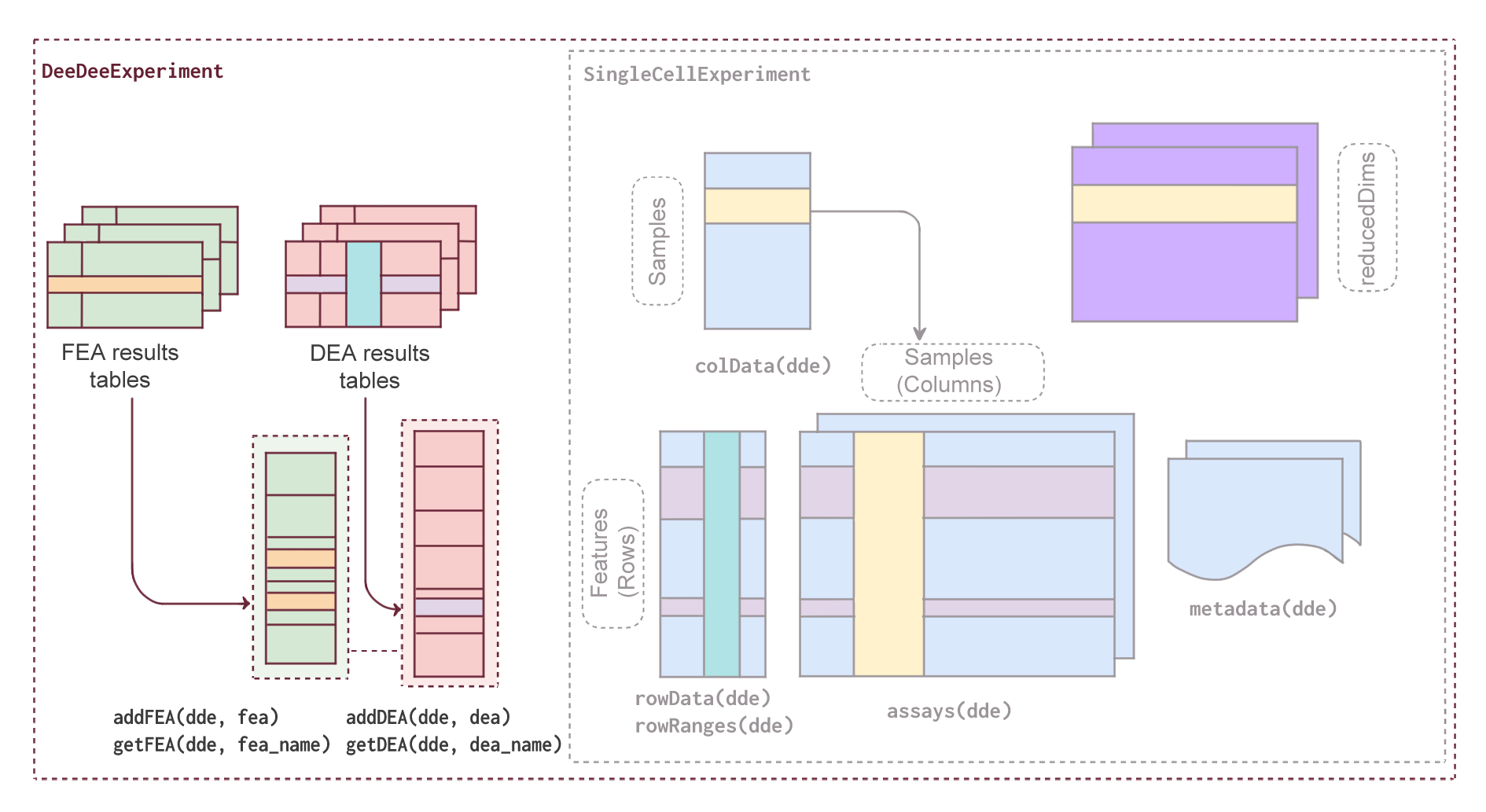
IN SHORT: This paper addresses the critical bottleneck of managing and organizing the growing volume of differential expression and functional enrichment analysis results from complex omics experiments, which currently lack standardized data structures for storage and contextualization.
核心创新
- Methodology Introduces the first standardized S4 class specifically designed to co-store DEA and FEA results with their metadata in a single, structured container within the Bioconductor ecosystem.
- Methodology Extends the widely adopted SingleCellExperiment class by adding dedicated slots for DEA and FEA results while maintaining full backward compatibility with existing Bioconductor tools.
- Methodology Implements a contrast-centric architecture that organizes results from multiple comparisons (including limma multi-contrast objects and muscat pseudobulk analyses) with efficient storage through pointer-based referencing.
主要结论
- DeeDeeExperiment provides a robust, standardized framework that enables efficient organization and retrieval of DEA/FEA results across multiple contrasts within a single data object.
- The implementation maintains full compatibility with the Bioconductor ecosystem, supporting interoperability with downstream tools like scater for visualization and iSEE for interactive exploration.
- By consolidating analysis results and metadata, the framework supports more nuanced quantitative approaches beyond simple overlap strategies, enabling trustworthy summaries of complex experimental measurements.
摘要: Summary: Modern omics experiments now involve multiple conditions and complex designs, producing an increasingly large set of differential expression and functional enrichment analysis results. However, no standardized data structure exists to store and contextualize these results together with their metadata, leaving researchers with an unmanageable and potentially non-reproducible collection of results that are difficult to navigate and/or share. Here we introduce DeeDeeExperiment, a new S4 class for managing and storing omics data analysis results, implemented within the Bioconductor ecosystem, which promotes interoperability, reproducibility and good documentation. This class extends the widely used SingleCellExperiment object by introducing dedicated slots for Differential Expression (DEA) and Functional Enrichment Analysis (FEA) results, allowing users to organize, store, and retrieve information on multiple contrasts and associated metadata within a single data object, ultimately streamlining the management and interpretation of many omics datasets. Availability and implementation: DeeDeeExperiment is available on Bioconductor under the MIT license (https://bioconductor.org/packages/DeeDeeExperiment), with its development version also available on Github (https://github.com/imbeimainz/DeeDeeExperiment).