
Paper List
-
A Unified Variational Principle for Branching Transport Networks: Wave Impedance, Viscous Flow, and Tissue Metabolism
This paper solves the core problem of predicting the empirically observed branching exponent (α≈2.7) in mammalian arterial trees, which neither Murray...
-
Household Bubbling Strategies for Epidemic Control and Social Connectivity
This paper addresses the core challenge of designing household merging (social bubble) strategies that effectively control epidemic risk while maximiz...
-
Empowering Chemical Structures with Biological Insights for Scalable Phenotypic Virtual Screening
This paper addresses the core challenge of bridging the gap between scalable chemical structure screening and biologically informative but resource-in...
-
A mechanical bifurcation constrains the evolution of cell sheet folding in the family Volvocaceae
This paper addresses the core problem of why there is an evolutionary gap in species with intermediate cell numbers (e.g., 256 cells) in Volvocaceae, ...
-
Bayesian Inference in Epidemic Modelling: A Beginner’s Guide Illustrated with the SIR Model
This guide addresses the core challenge of estimating uncertain epidemiological parameters (like transmission and recovery rates) from noisy, real-wor...
-
Geometric framework for biological evolution
This paper addresses the fundamental challenge of developing a coordinate-independent, geometric description of evolutionary dynamics that bridges gen...
-
A multiscale discrete-to-continuum framework for structured population models
This paper addresses the core challenge of systematically deriving uniformly valid continuum approximations from discrete structured population models...
-
Whole slide and microscopy image analysis with QuPath and OMERO
使QuPath能够直接分析存储在OMERO服务器中的图像而无需下载整个数据集,克服了大规模研究的本地存储限制。
EcoCast: A Spatio-Temporal Model for Continual Biodiversity and Climate Risk Forecasting
Concordia University | Algoma University
30秒速读
IN SHORT: This paper addresses the critical bottleneck in conservation: the lack of timely, high-resolution, near-term forecasts of species distribution shifts under rapidly changing environmental conditions, moving beyond static models to operational, data-driven decision support.
核心创新
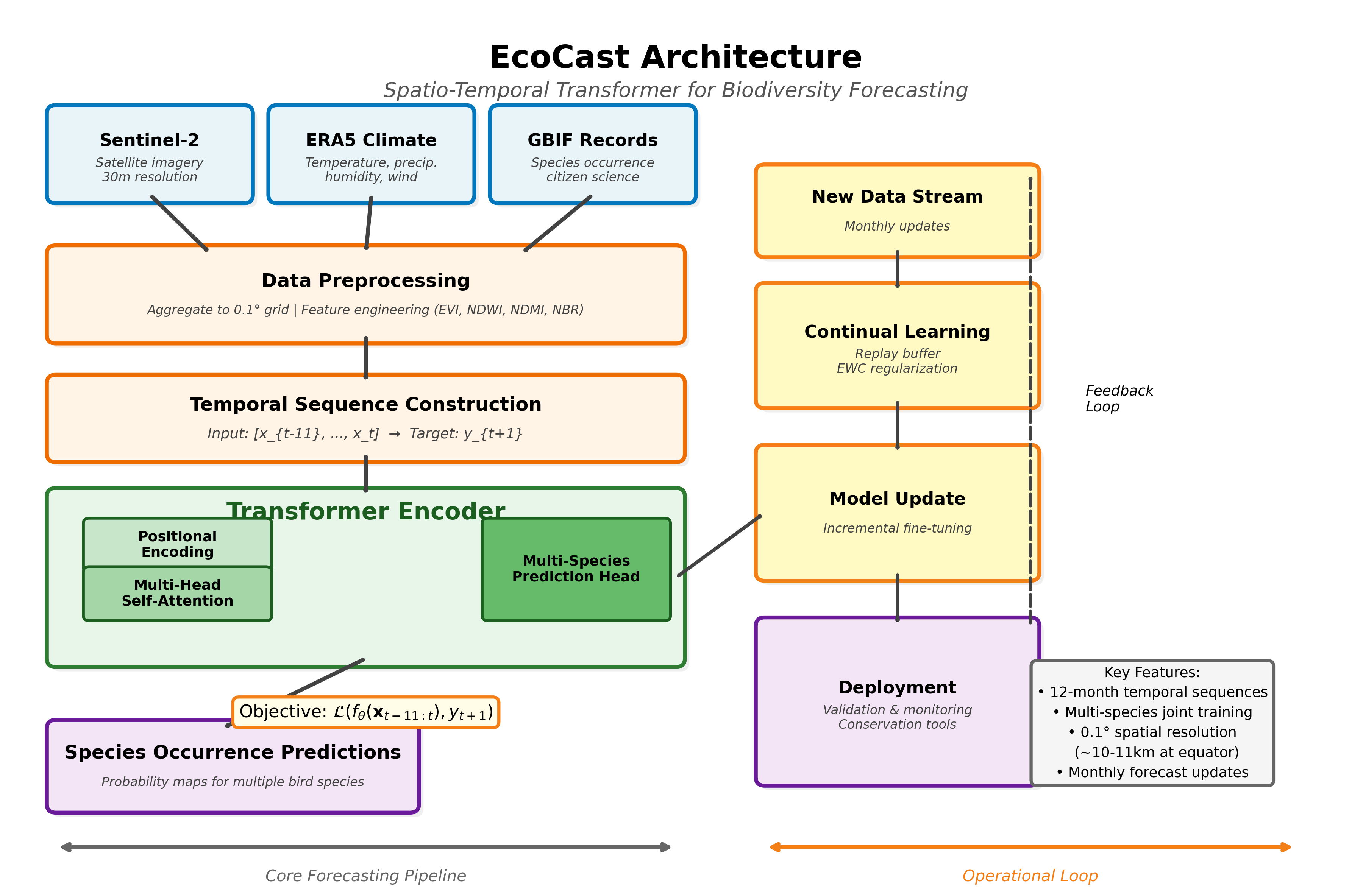
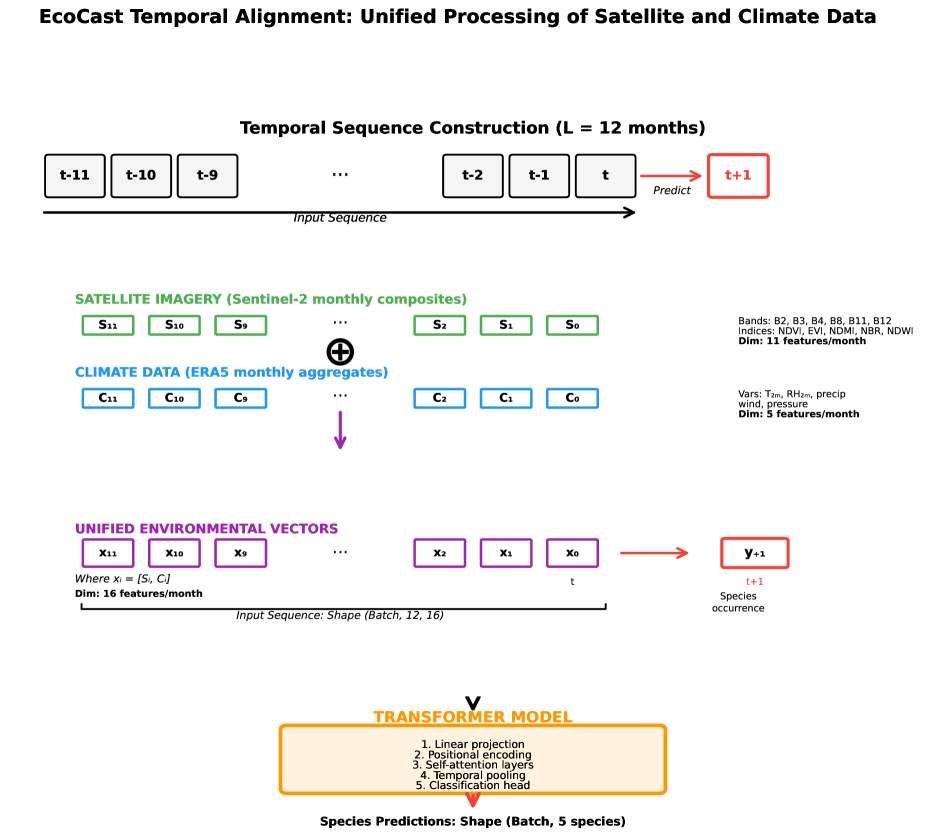
- Methodology First transformer-based model applied to ecological and climate risk forecasting in Africa, using sequence-to-point prediction (12-month environmental sequences → next-month species occurrence) with explicit temporal dependency modeling via self-attention.
- Methodology Integration of continual learning (rehearsal + EWC) into biodiversity forecasting, enabling model updates with new data streams without catastrophic forgetting, crucial for non-stationary climate impacts.
- Biology Operational near-term forecasting paradigm (monthly to seasonal) that requires no future climate projections, using observed environmental sequences to predict immediate conservation-relevant shifts, bridging geophysical forecasting architectures with species distribution modeling.
主要结论
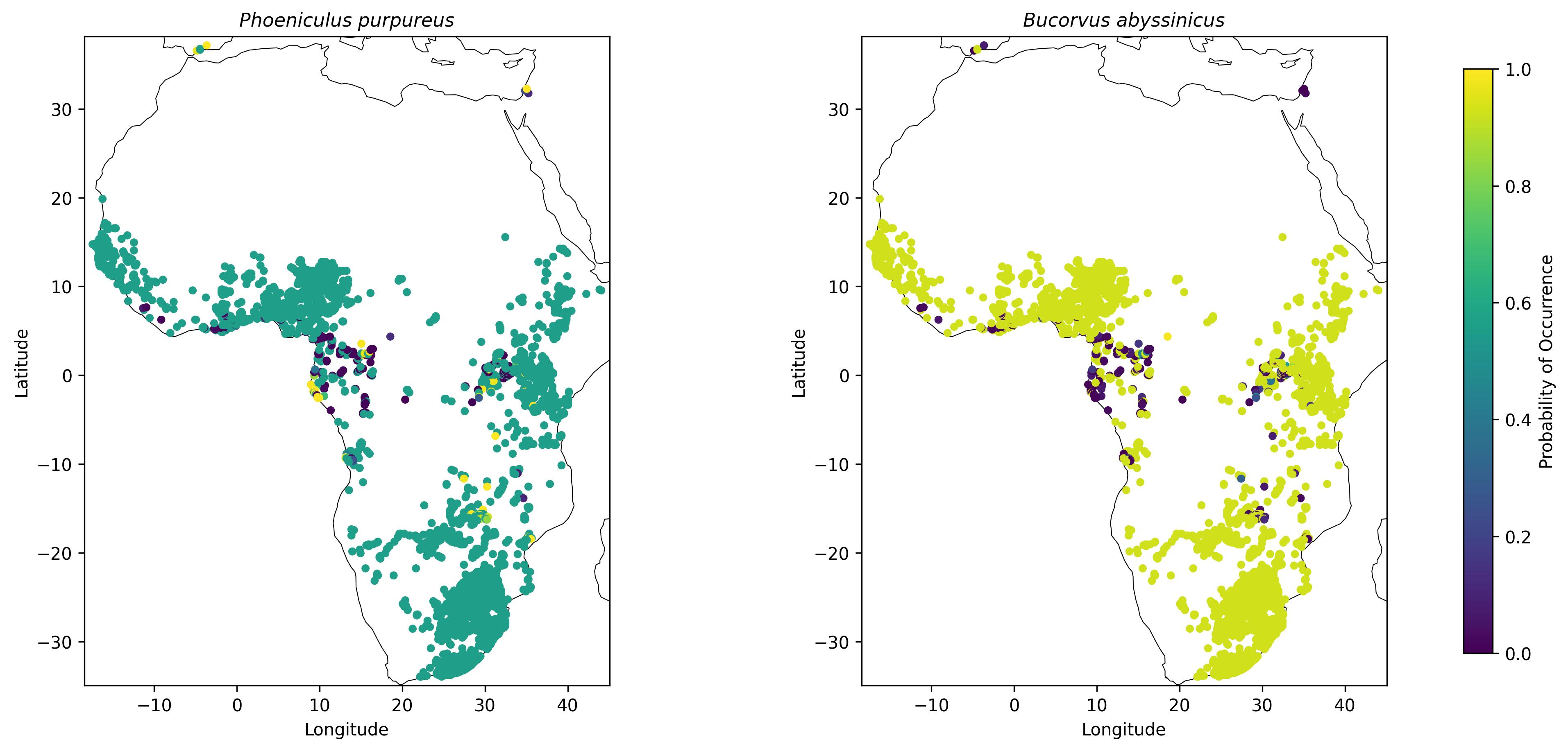
- EcoCast achieves macro-averaged F1 score of 0.65 and PR-AUC of 0.72 on 2023 holdout data for five African bird species, representing +34 and +43 percentage point improvements respectively over Random Forest baseline (F1=0.31, PR-AUC=0.29).
- Transformer architecture successfully captures critical temporal dependencies: annual seasonality via positional encoding, lagged environmental responses (2-4 month delays), and cross-species ecological signals through joint multi-label training.
- The framework demonstrates operational feasibility with monthly forecast updates using near-real-time data (ERA5 available within 5 days, final data 2-3 months later), enabling alignment with conservation planning cycles rather than static decadal projections.
摘要: Increasing climate change and habitat loss are driving unprecedented shifts in species distributions. Conservation professionals urgently need timely, high-resolution predictions of biodiversity risks, especially in ecologically diverse regions like Africa. We propose EcoCast, a spatio-temporal model designed for continual biodiversity and climate risk forecasting. Utilizing multisource satellite imagery, climate data, and citizen science occurrence records, EcoCast predicts near-term (monthly to seasonal) shifts in species distributions through sequence-based transformers that model spatio-temporal environmental dependencies. The architecture is designed with support for continual learning to enable future operational deployment with new data streams. Our pilot study in Africa shows promising improvements in forecasting distributions of selected bird species compared to a Random Forest baseline, highlighting EcoCast's potential to inform targeted conservation policies. By demonstrating an end-to-end pipeline from multi-modal data ingestion to operational forecasting, EcoCast bridges the gap between cutting-edge machine learning and biodiversity management, ultimately guiding data-driven strategies for climate resilience and ecosystem conservation throughout Africa.