
Paper List
-
A Unified Variational Principle for Branching Transport Networks: Wave Impedance, Viscous Flow, and Tissue Metabolism
This paper solves the core problem of predicting the empirically observed branching exponent (α≈2.7) in mammalian arterial trees, which neither Murray...
-
Household Bubbling Strategies for Epidemic Control and Social Connectivity
This paper addresses the core challenge of designing household merging (social bubble) strategies that effectively control epidemic risk while maximiz...
-
Empowering Chemical Structures with Biological Insights for Scalable Phenotypic Virtual Screening
This paper addresses the core challenge of bridging the gap between scalable chemical structure screening and biologically informative but resource-in...
-
A mechanical bifurcation constrains the evolution of cell sheet folding in the family Volvocaceae
This paper addresses the core problem of why there is an evolutionary gap in species with intermediate cell numbers (e.g., 256 cells) in Volvocaceae, ...
-
Bayesian Inference in Epidemic Modelling: A Beginner’s Guide Illustrated with the SIR Model
This guide addresses the core challenge of estimating uncertain epidemiological parameters (like transmission and recovery rates) from noisy, real-wor...
-
Geometric framework for biological evolution
This paper addresses the fundamental challenge of developing a coordinate-independent, geometric description of evolutionary dynamics that bridges gen...
-
A multiscale discrete-to-continuum framework for structured population models
This paper addresses the core challenge of systematically deriving uniformly valid continuum approximations from discrete structured population models...
-
Whole slide and microscopy image analysis with QuPath and OMERO
使QuPath能够直接分析存储在OMERO服务器中的图像而无需下载整个数据集,克服了大规模研究的本地存储限制。
Competition, stability, and functionality in excitatory-inhibitory neural circuits
Università degli Studi di Padova | University of California at San Diego | Rice University | University of California at Santa Barbara
30秒速读
IN SHORT: This paper addresses the core challenge of extending interpretable energy-based frameworks to biologically realistic asymmetric neural networks, where traditional symmetric weight assumptions break down.
核心创新
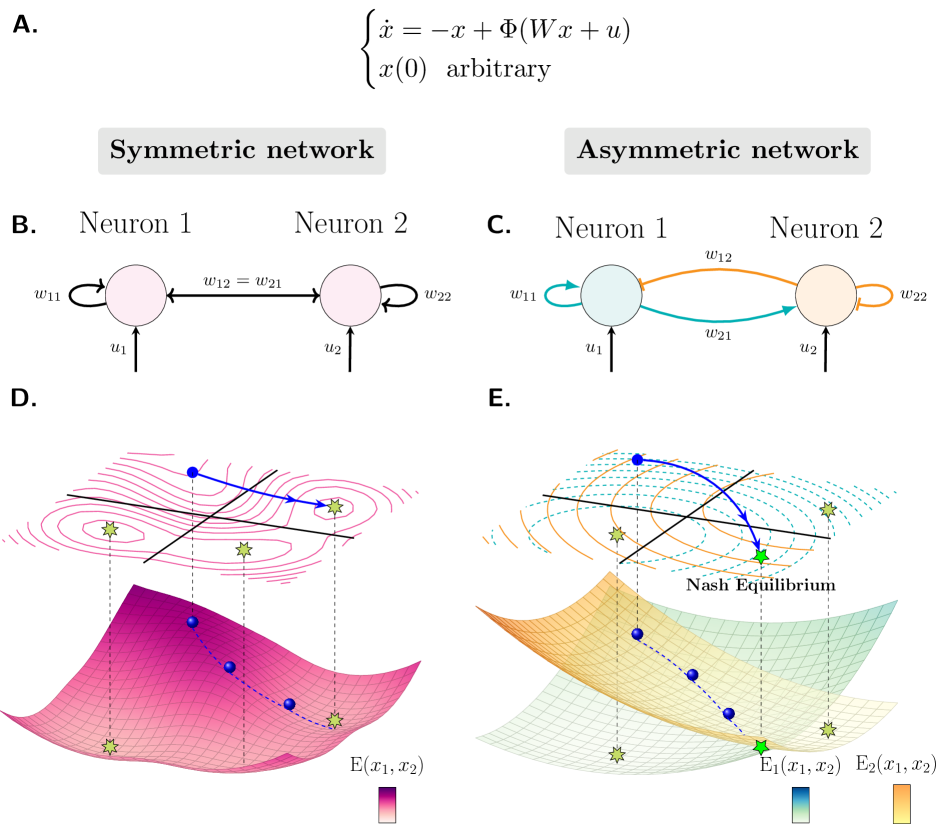
- Methodology Introduces a game-theoretic interpretation where each neuron acts as a selfish agent minimizing its own energy, with collective dynamics reaching Nash equilibria rather than global energy minima.
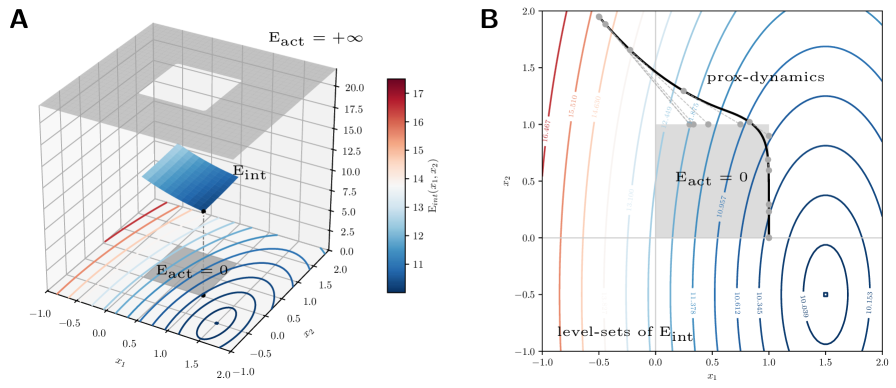
- Methodology Extends the proximal gradient dynamics framework to asymmetric firing rate networks, defining neuron-specific interaction costs {E_int^i(x,u_i)} and activation costs {E_act^i(x_i)}.
- Theory Bridges energy-based models with network stability theory (Lyapunov diagonal stability) to analyze regulation and balancing in excitatory-inhibitory circuits.
主要结论
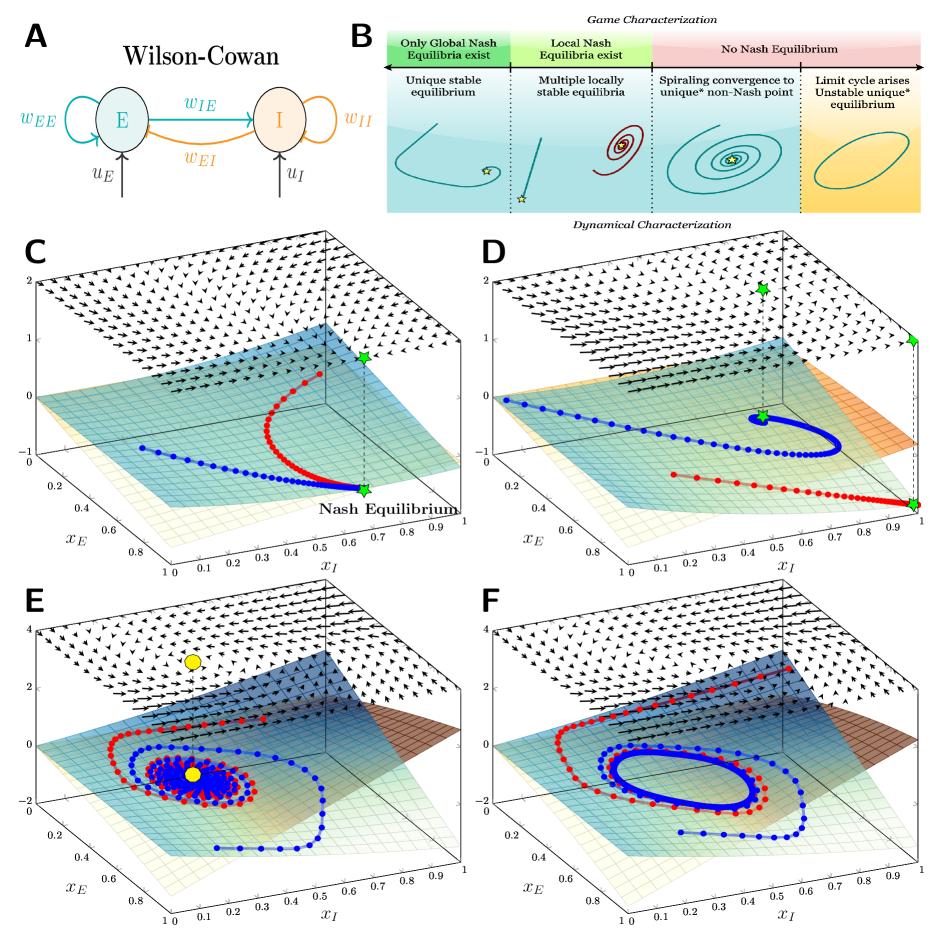
- Asymmetric neural networks can be reformulated as noncooperative games where Nash equilibria correspond to stable network states, providing interpretability without global energy functions.
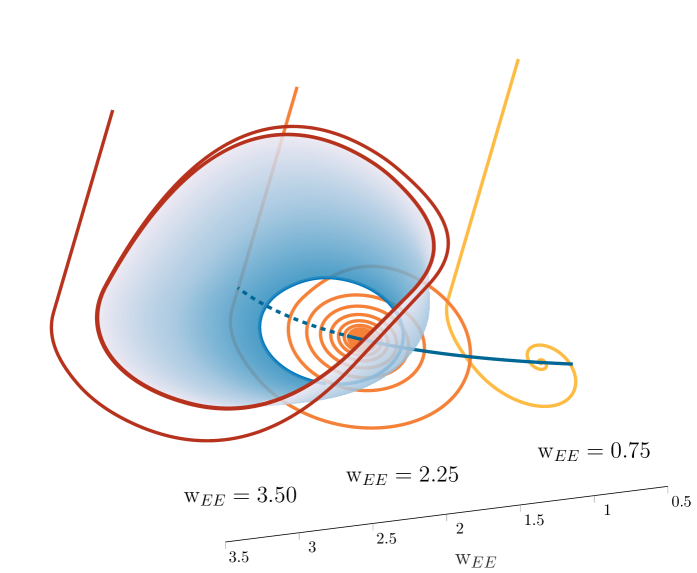
- The Wilson-Cowan model reveals that excitatory self-connection weight w_EE serves as a principal switch governing transitions between cooperative and antagonistic dynamical regimes.
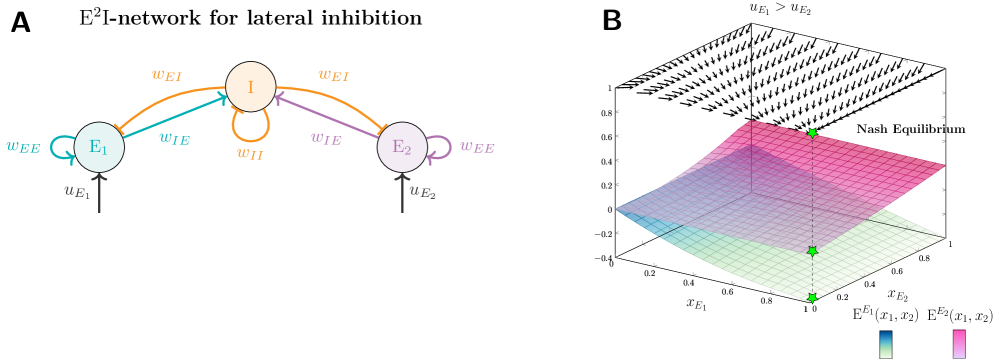
- Lateral inhibition microcircuits function as contrast enhancers through hierarchical excitation-inhibition interplay, sharpening subtle environmental differences with arbitrary precision.
摘要: Energy-based models have become a central paradigm for understanding computation and stability in both theoretical neuroscience and machine learning. However, the energetic framework typically relies on symmetry in synaptic or weight matrices - a constraint that excludes biologically realistic systems such as excitatory–inhibitory (E–I) networks. When symmetry is relaxed, the classical notion of a global energy landscape fails, leaving the dynamics of asymmetric neural systems conceptually unanchored. In this work, we extend the energetic framework to asymmetric firing rate networks, revealing an underlying game-theoretic structure for the neural dynamics in which each neuron is an agent that seeks to minimize its own energy. In addition, we exploit rigorous stability principles from network theory to study regulation and balancing of neural activity in E-I networks. We combine the novel game-energetic interpretation and the stability results to revisit standard frameworks in theoretical neuroscience, such as the Wilson-Cowan and lateral inhibition models. These insights allow us to study cortical columns of lateral inhibition microcircuits as contrast enhancer - with the ability to selectively sharpen subtle differences in the environment through hierarchical excitation–inhibition interplay. Our results bridge energetic and game-theoretic views of neural computation, offering a pathway toward the systematic engineering of biologically grounded, dynamically stable neural architectures.