
Paper List
-
A Unified Variational Principle for Branching Transport Networks: Wave Impedance, Viscous Flow, and Tissue Metabolism
This paper solves the core problem of predicting the empirically observed branching exponent (α≈2.7) in mammalian arterial trees, which neither Murray...
-
Household Bubbling Strategies for Epidemic Control and Social Connectivity
This paper addresses the core challenge of designing household merging (social bubble) strategies that effectively control epidemic risk while maximiz...
-
Empowering Chemical Structures with Biological Insights for Scalable Phenotypic Virtual Screening
This paper addresses the core challenge of bridging the gap between scalable chemical structure screening and biologically informative but resource-in...
-
A mechanical bifurcation constrains the evolution of cell sheet folding in the family Volvocaceae
This paper addresses the core problem of why there is an evolutionary gap in species with intermediate cell numbers (e.g., 256 cells) in Volvocaceae, ...
-
Bayesian Inference in Epidemic Modelling: A Beginner’s Guide Illustrated with the SIR Model
This guide addresses the core challenge of estimating uncertain epidemiological parameters (like transmission and recovery rates) from noisy, real-wor...
-
Geometric framework for biological evolution
This paper addresses the fundamental challenge of developing a coordinate-independent, geometric description of evolutionary dynamics that bridges gen...
-
A multiscale discrete-to-continuum framework for structured population models
This paper addresses the core challenge of systematically deriving uniformly valid continuum approximations from discrete structured population models...
-
Whole slide and microscopy image analysis with QuPath and OMERO
使QuPath能够直接分析存储在OMERO服务器中的图像而无需下载整个数据集,克服了大规模研究的本地存储限制。
Generative design and validation of therapeutic peptides for glioblastoma based on a potential target ATP5A
Shanghai Jiao Tong University | QuietD Biotech
30秒速读
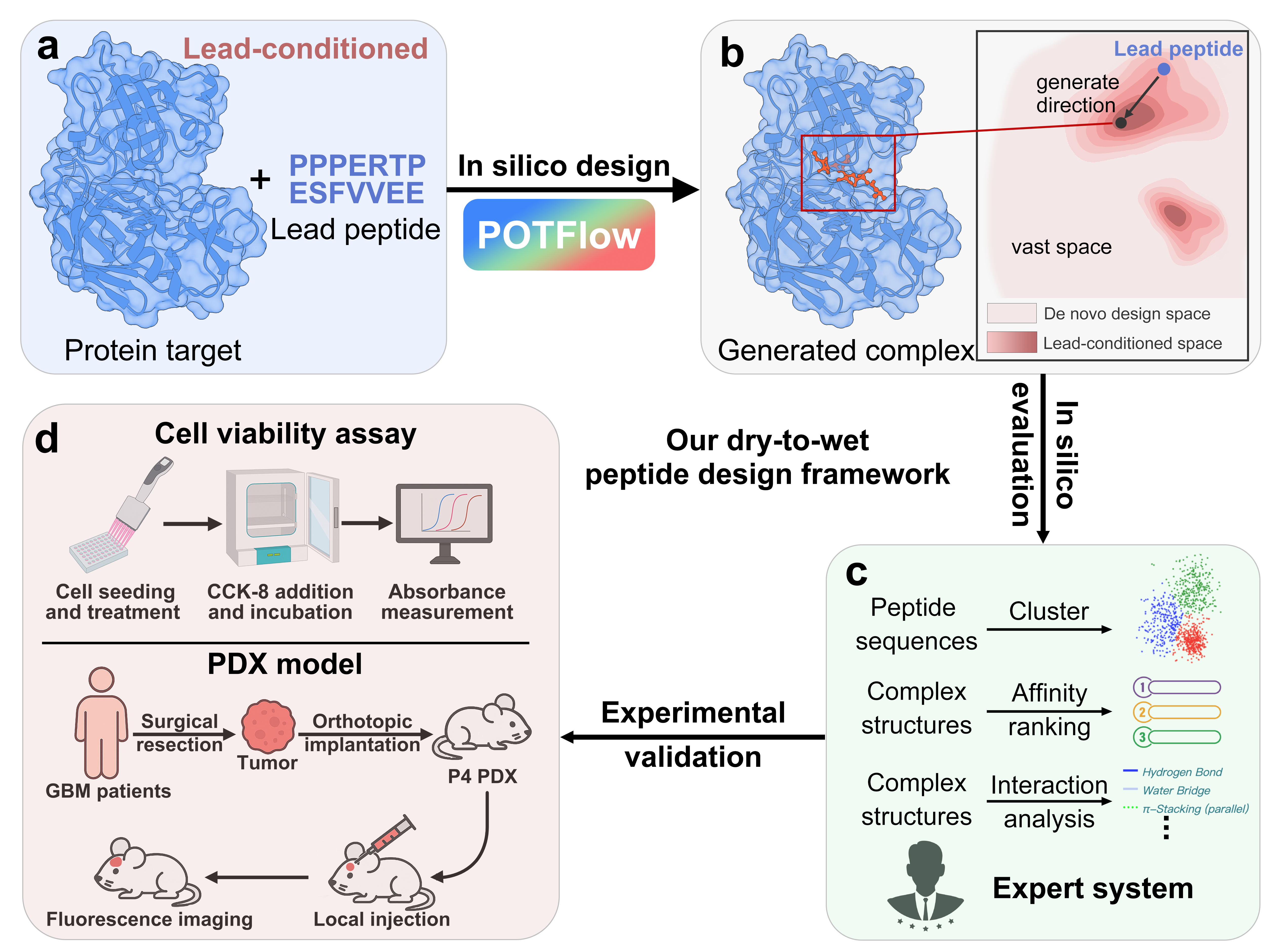
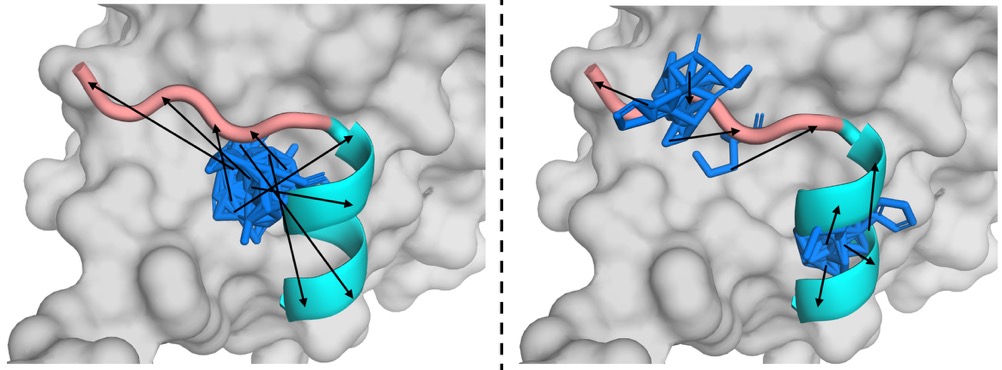
IN SHORT: This paper addresses the critical bottleneck in therapeutic peptide design: how to efficiently optimize lead peptides with geometric constraints while bridging the gap between computational generation and experimental validation.
核心创新
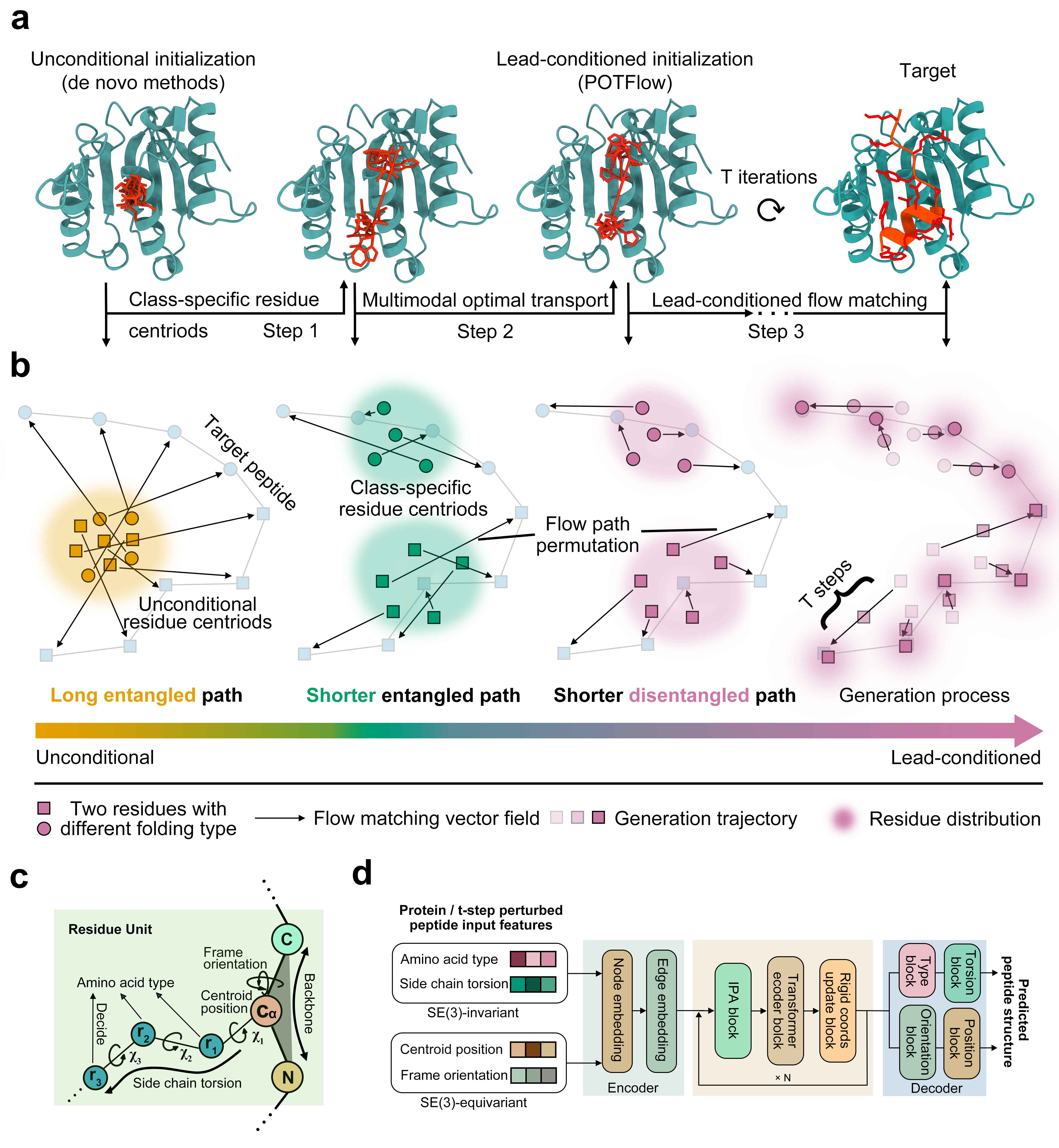
- Methodology Introduces POTFlow, the first lead peptide-conditioned flow matching model that incorporates secondary structure priors and optimal transport for shorter, disentangled generation paths
- Methodology Proposes a dry-to-wet framework that integrates computational design with experimental validation spanning in vitro assays and in vivo PDX models
- Biology Demonstrates successful optimization of ATP5A-binding peptides for glioblastoma, achieving improved tumor selectivity and in vivo efficacy
主要结论
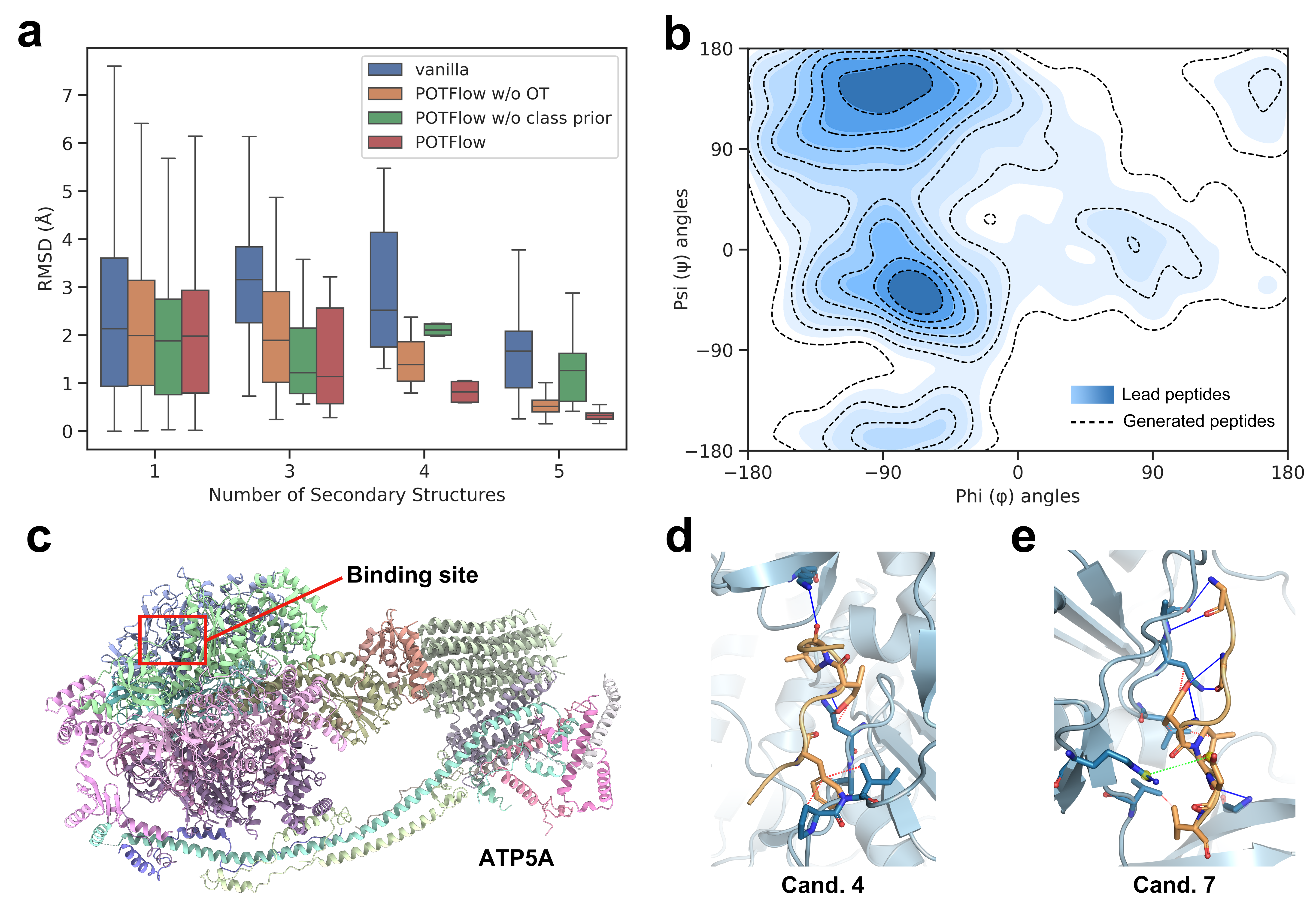
- POTFlow outperforms five state-of-the-art methods across multiple metrics, achieving 53.44% similarity, 95.07% compactness, 30.56% affinity, and 1.66Å RMSD on benchmark datasets

- Generated peptide candidates showed 18-68% higher inhibition of viability rate (IVR) in GBM cells compared to non-cancerous cells (<10%), demonstrating improved tumor selectivity
- High-dose candidate 4 (20mg/kg) significantly prolonged survival in PDX models (p-value = 0.02) with 40% of mice surviving beyond week 18 compared to 0% in control group
摘要: Glioblastoma (GBM) remains the most aggressive tumor, urgently requiring novel therapeutic strategies. Here, we present a dry-to-wet framework combining generative modeling and experimental validation to optimize peptides targeting ATP5A, a potential peptide-binding protein for GBM. Our framework introduces the first lead-conditioned generative model, which focuses exploration on geometrically relevant regions around lead peptides and mitigates the combinatorial complexity of de novo methods. Specifically, we propose POTFlow, a Prior and Optimal Transport-based Flow-matching model for peptide optimization. POTFlow employs secondary structure information (e.g., helix, sheet, loop) as geometric constraints, which are further refined by optimal transport to produce shorter flow paths. With this design, our method achieves state-of-the-art performance compared with five popular approaches. When applied to GBM, our method generates peptides that selectively inhibit cell viability and significantly prolong survival in a patient-derived xenograft (PDX) model. As the first lead peptide-conditioned flow matching model, POTFlow holds strong potential as a generalizable framework for therapeutic peptide design.