
Paper List
-
A Unified Variational Principle for Branching Transport Networks: Wave Impedance, Viscous Flow, and Tissue Metabolism
This paper solves the core problem of predicting the empirically observed branching exponent (α≈2.7) in mammalian arterial trees, which neither Murray...
-
Household Bubbling Strategies for Epidemic Control and Social Connectivity
This paper addresses the core challenge of designing household merging (social bubble) strategies that effectively control epidemic risk while maximiz...
-
Empowering Chemical Structures with Biological Insights for Scalable Phenotypic Virtual Screening
This paper addresses the core challenge of bridging the gap between scalable chemical structure screening and biologically informative but resource-in...
-
A mechanical bifurcation constrains the evolution of cell sheet folding in the family Volvocaceae
This paper addresses the core problem of why there is an evolutionary gap in species with intermediate cell numbers (e.g., 256 cells) in Volvocaceae, ...
-
Bayesian Inference in Epidemic Modelling: A Beginner’s Guide Illustrated with the SIR Model
This guide addresses the core challenge of estimating uncertain epidemiological parameters (like transmission and recovery rates) from noisy, real-wor...
-
Geometric framework for biological evolution
This paper addresses the fundamental challenge of developing a coordinate-independent, geometric description of evolutionary dynamics that bridges gen...
-
A multiscale discrete-to-continuum framework for structured population models
This paper addresses the core challenge of systematically deriving uniformly valid continuum approximations from discrete structured population models...
-
Whole slide and microscopy image analysis with QuPath and OMERO
使QuPath能够直接分析存储在OMERO服务器中的图像而无需下载整个数据集,克服了大规模研究的本地存储限制。
Setting up for failure: automatic discovery of the neural mechanisms of cognitive errors
Department of Engineering, University of Cambridge | Department of Psychology, University of Cambridge | Department of Cognitive Science, Central European University
30秒速读
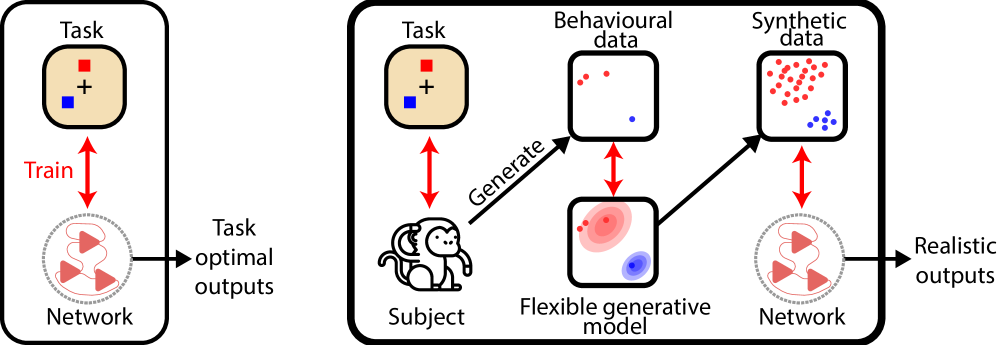
IN SHORT: This paper addresses the core challenge of automating the discovery of biologically plausible recurrent neural network (RNN) dynamics that can replicate the full richness of human and animal behavioral data, including characteristic errors and suboptimalities, rather than just optimal task performance.
核心创新
- Methodology Introduces a novel diffusion model-based training objective for RNNs to capture complex, multimodal behavioral response distributions (e.g., from swap errors), moving beyond traditional moment-matching or simple loss functions like MSE.
- Methodology Proposes using a non-parametric generative model (Bayesian Non-parametric model of Swap errors, BNS) to create surrogate behavioral data for training, overcoming the data scarcity problem inherent in experimental neuroscience.
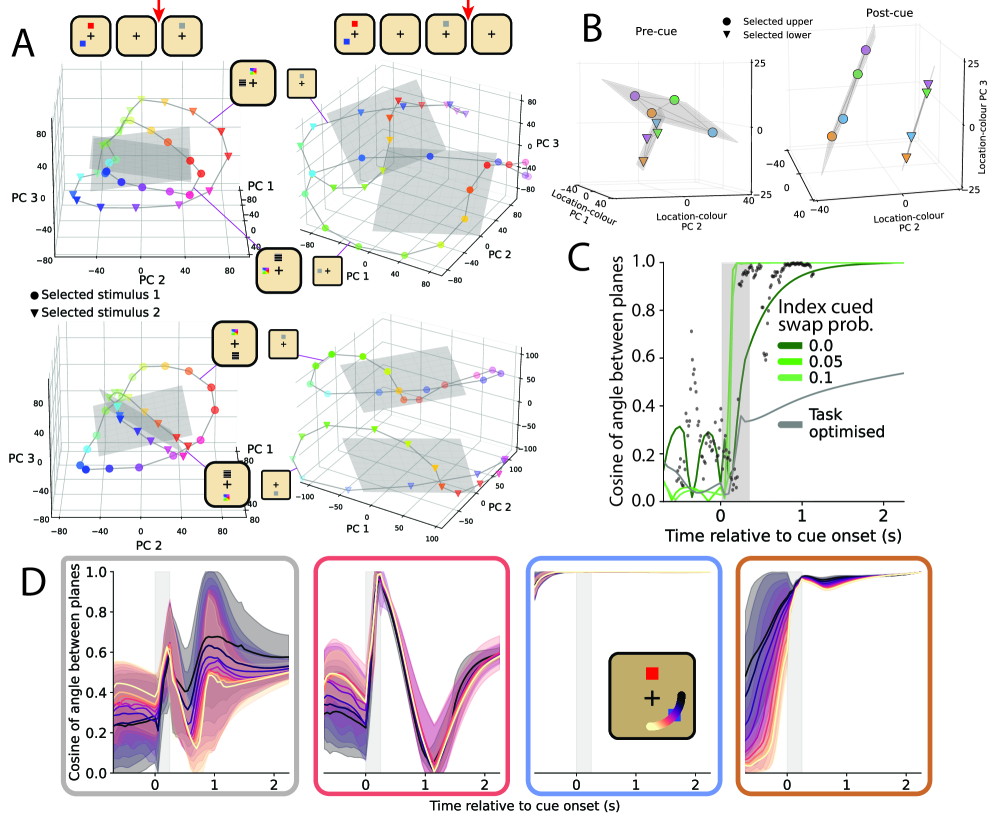
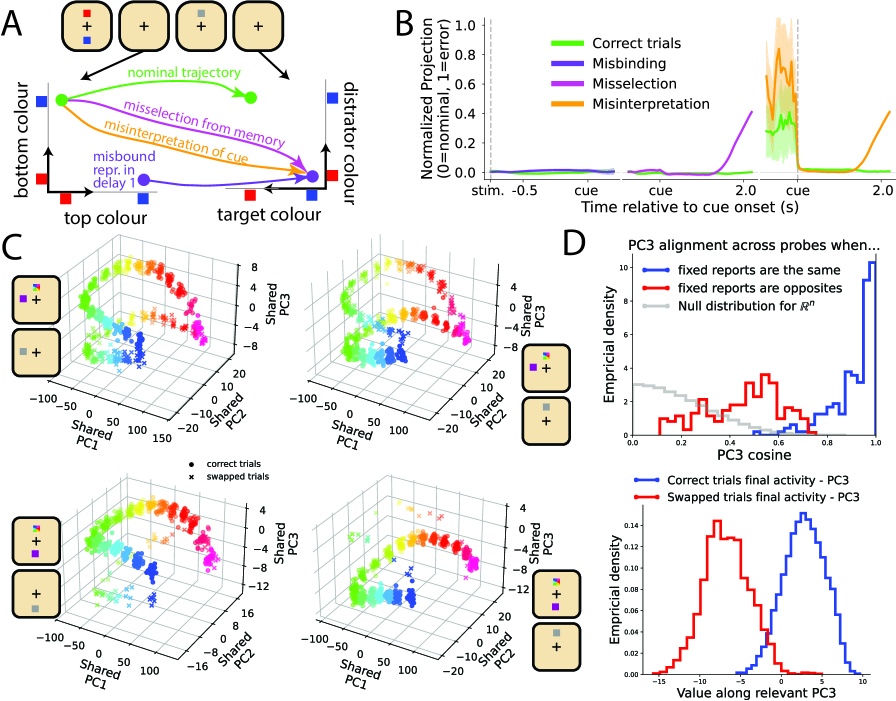
- Biology Demonstrates that RNNs trained to reproduce suboptimal behavior (swap errors) successfully recapitulate qualitative neural signatures (e.g., planar alignment of population activity) observed in macaque prefrontal cortex during visual working memory tasks, which task-optimal networks fail to capture.
主要结论
- RNNs trained with the novel diffusion-based method to reproduce probe-distance-dependent swap errors successfully matched the planar alignment geometry of neural population activity observed in macaque PFC (cosine similarity increase during cue period, as in Panichello et al., 2021), a signature not captured by task-optimal or no-swap-error models.
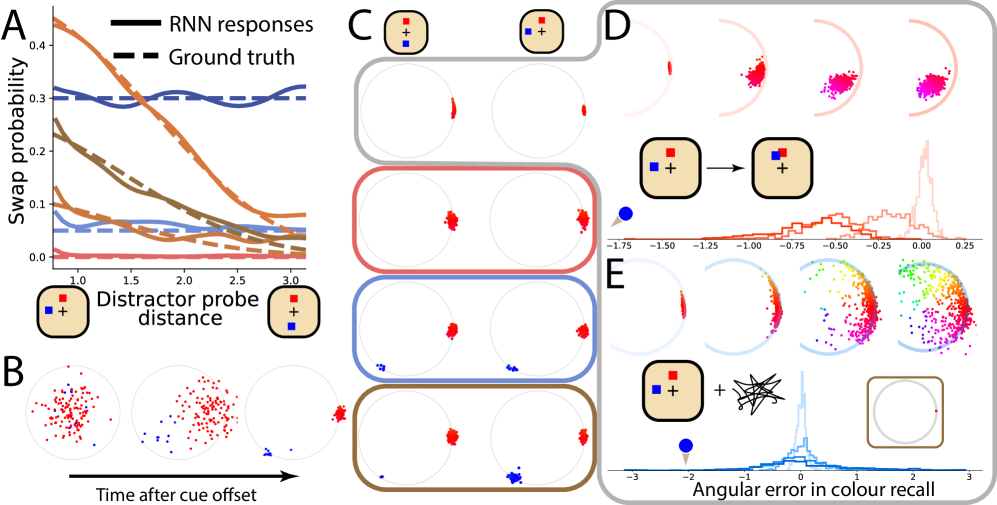
- The method accurately replicated target swap error rates as a function of distractor proximity (as defined by the generative BNS model), demonstrating quantitative fitting to complex behavioral distributions.
- The approach generated novel, testable hypotheses about the neural circuit mechanisms underlying swap errors (e.g., misselection at cue time), moving beyond descriptive population coding models.
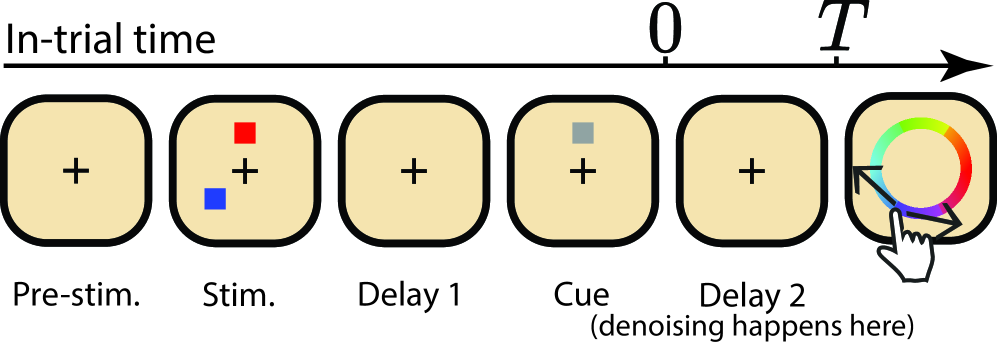
摘要: Discovering the neural mechanisms underpinning cognition is one of the grand challenges of neuroscience. However, previous approaches for building models of recurrent neural network (RNN) dynamics that explain behaviour required iterative refinement of architectures and/or optimization objectives, resulting in a piecemeal, and mostly heuristic, human-in-the-loop process. Here, we offer an alternative approach that automates the discovery of viable RNN mechanisms by explicitly training RNNs to reproduce behaviour, including the same characteristic errors and suboptimalities, that humans and animals produce in a cognitive task. Achieving this required two main innovations. First, as the amount of behavioural data that can be collected in experiments is often too limited to train RNNs, we use a non-parametric generative model of behavioural responses to produce surrogate data for training RNNs. Second, to capture all relevant statistical aspects of the data, rather than a limited number of hand-picked low-order moments as in previous moment-matching-based approaches, we developed a novel diffusion model-based approach for training RNNs. To showcase the potential of our approach, we chose a visual working memory task as our test-bed, as behaviour in this task is well known to produce response distributions that are patently multimodal (due to so-called swap errors). The resulting network dynamics correctly predicted previously reported qualitative features of neural data recorded in macaques. Importantly, these results were not possible to obtain with more traditional approaches, i.e., when only a limited set of behavioural signatures (rather than the full richness of behavioural response distributions) were fitted, or when RNNs were trained for task optimality (instead of reproducing behaviour). Our approach also yields novel predictions about the mechanism of swap errors, which can be readily tested in experiments. These results suggest that fitting RNNs to rich patterns of behaviour provides a powerful way to automatically discover the neural network dynamics supporting important cognitive functions.