
Paper List
-
A Unified Variational Principle for Branching Transport Networks: Wave Impedance, Viscous Flow, and Tissue Metabolism
This paper solves the core problem of predicting the empirically observed branching exponent (α≈2.7) in mammalian arterial trees, which neither Murray...
-
Household Bubbling Strategies for Epidemic Control and Social Connectivity
This paper addresses the core challenge of designing household merging (social bubble) strategies that effectively control epidemic risk while maximiz...
-
Empowering Chemical Structures with Biological Insights for Scalable Phenotypic Virtual Screening
This paper addresses the core challenge of bridging the gap between scalable chemical structure screening and biologically informative but resource-in...
-
A mechanical bifurcation constrains the evolution of cell sheet folding in the family Volvocaceae
This paper addresses the core problem of why there is an evolutionary gap in species with intermediate cell numbers (e.g., 256 cells) in Volvocaceae, ...
-
Bayesian Inference in Epidemic Modelling: A Beginner’s Guide Illustrated with the SIR Model
This guide addresses the core challenge of estimating uncertain epidemiological parameters (like transmission and recovery rates) from noisy, real-wor...
-
Geometric framework for biological evolution
This paper addresses the fundamental challenge of developing a coordinate-independent, geometric description of evolutionary dynamics that bridges gen...
-
A multiscale discrete-to-continuum framework for structured population models
This paper addresses the core challenge of systematically deriving uniformly valid continuum approximations from discrete structured population models...
-
Whole slide and microscopy image analysis with QuPath and OMERO
使QuPath能够直接分析存储在OMERO服务器中的图像而无需下载整个数据集,克服了大规模研究的本地存储限制。
ANNE Apnea Paper
University of Toronto Department of Medicine, Computer Science | Sunnybrook Research Institute Department of Medicine Neurology Div.
30秒速读
IN SHORT: This paper addresses the core challenge of achieving accurate, event-level sleep apnea detection and characterization using a non-intrusive, multimodal wearable device, moving beyond simple recording-level AHI prediction.
核心创新
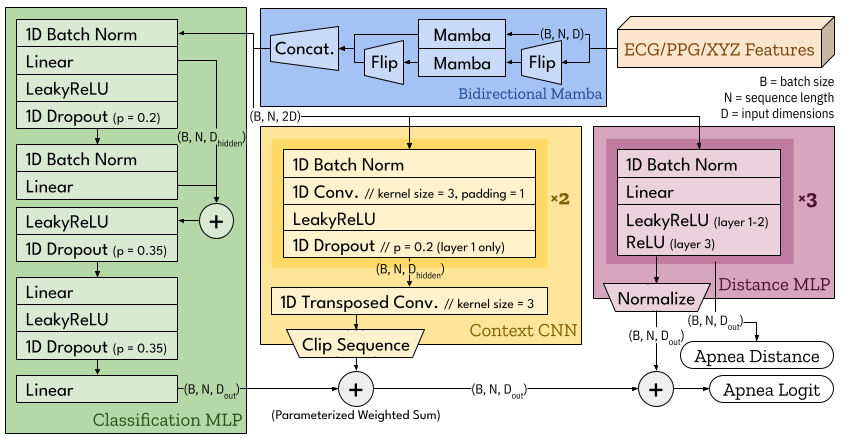
- Methodology Proposes a novel Mamba-based deep sequential neural network architecture, integrating a classification MLP, a context CNN for local patterns, and a distance MLP for event localization, inspired by YOLO for multi-task learning.
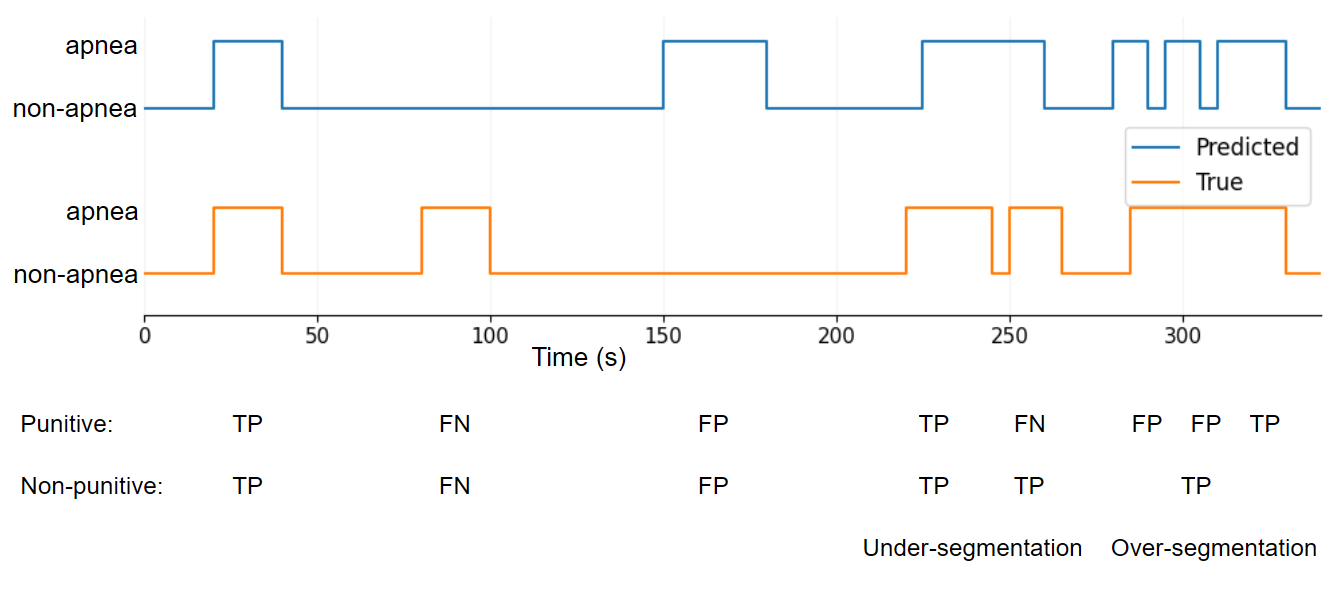
- Methodology Introduces a comprehensive event-wise evaluation framework for apnea detection models, moving beyond traditional segment-wise metrics to quantify true positives, false positives, and false negatives based on event overlap (IoU).
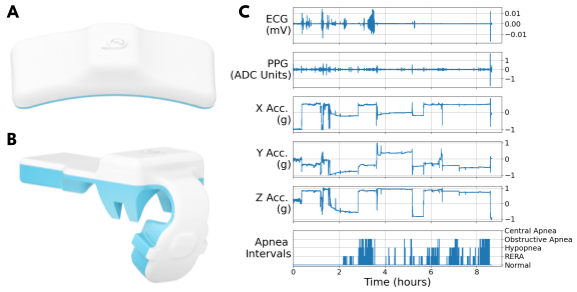
- Biology/Application Demonstrates the application of the Mamba architecture on a rich, multimodal dataset from the ANNE One wearable (ECG, accelerometry, temperature, PPG) from an older, clinically diverse cohort (mean age 56), testing robustness in realistic, noisy conditions.
主要结论
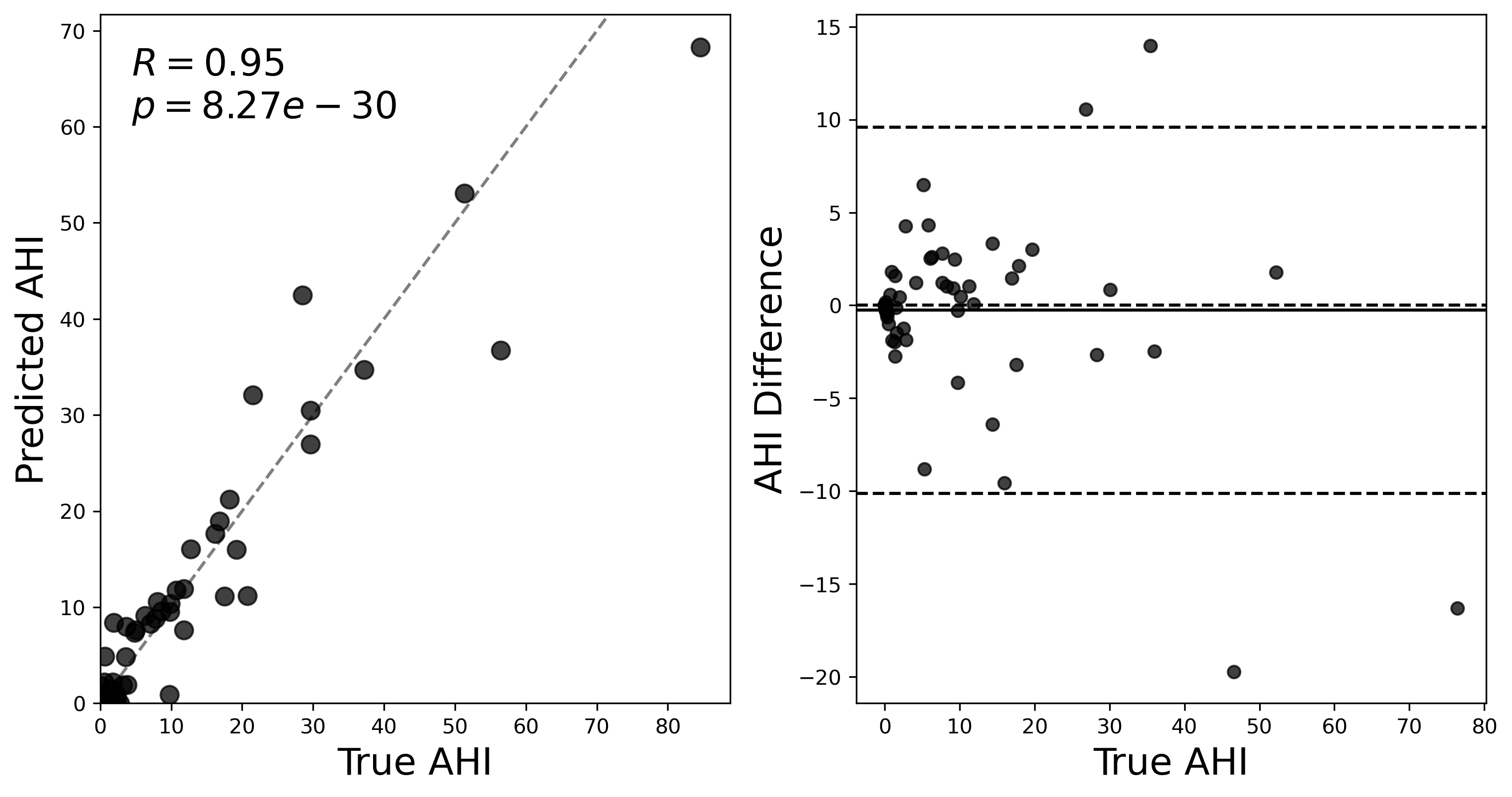
- The model-predicted AHI showed a very high correlation with PSG-derived AHI (R=0.95, p=8.3e-30) with a mean absolute error of 2.83 events/hour.
- At the 30-second epoch level, the model achieved high sensitivity (0.93) and specificity (0.95) for detecting epochs containing any respiratory event.
- The model demonstrated capability in event-type characterization, correctly classifying 77% of central apneas and 95% of other respiratory events (RERA/Hypopnea/Obstructive).
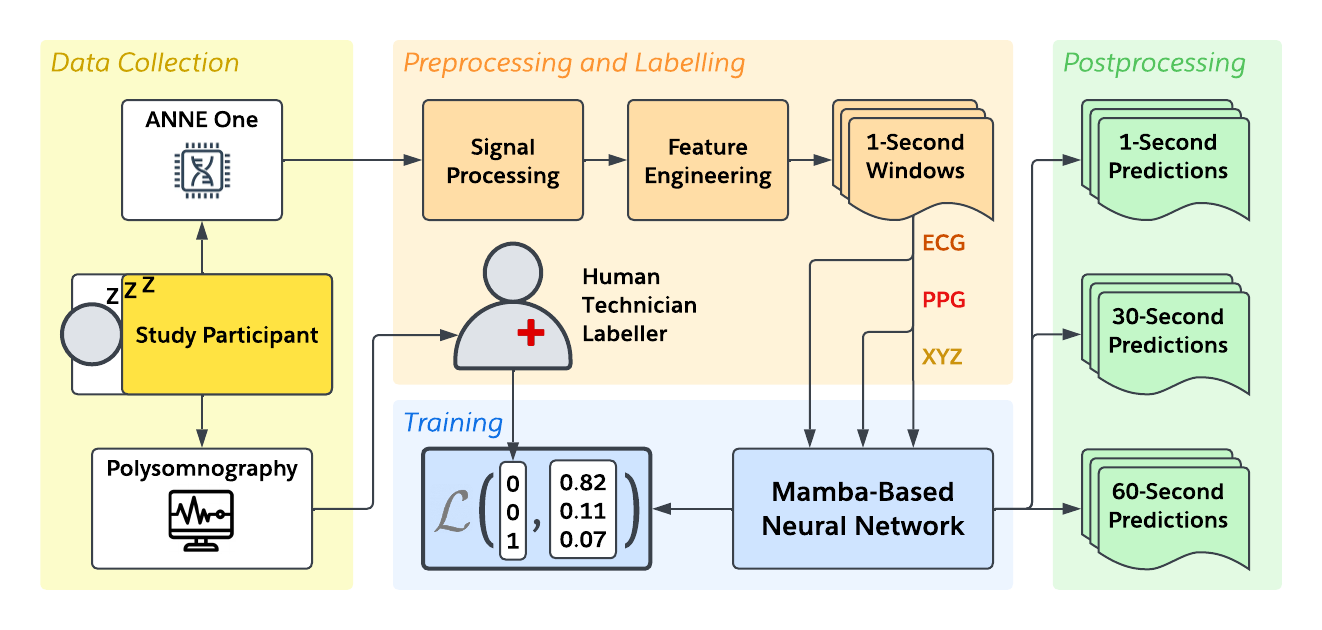
摘要: Objectives: In-laboratory polysomnography (PSG) is the reference standard for the diagnosis of sleep disordered breathing, and characterization of disease physiology along multiple dimensions. However, it is labour intensive, poorly scalable, and can perturb sleep. Numerous devices for home sleep apnea testing (HSAT), along with tools for automated analysis, have been developed to address these limitations. Although several such tools have shown good performance at establishing a diagnosis of SDB at the recording level, most have uncertain performance at the individual event level, including differentiation of event type (e.g. central vs. obstructive apneas), and determination of precise event timing. Moreover, while disruption of sleep architecture is a key feature of sleep disordered breathing, not all HSAT devices are able to return epoch-by-epoch sleep staging. Here we present and evaluate a deep-learning model for diagnosis and event-level characterization of sleep disordered breathing based on signals from the ANNE One, a non-intrusive dual-module wireless wearable system measuring chest electrocardiography, triaxial accelerometry, chest and finger temperature, and finger phototplethysmography. Methods: We obtained concurrent PSG and wearable sensor recordings from 384 adults attending a tertiary care sleep laboratory. Respiratory events in the PSG were manually annotated in accordance with AASM guidelines. Wearable sensor and PSG recordings were automatically aligned based on the ECG signal, alignment confirmed by visual inspection, and PSG-derived respiratory event labels were used to train and evaluate a deep sequential neural network based on the Mamba architecture. Results: In 57 recordings in our test set (mean age 56, mean AHI 10.8, 43.86% female) the model-predicted AHI was highly correlated with that derived form the PSG labels (R=0.95, p=8.3e-30, men absolute error 2.83). This performance did not vary with age or sex. At a threshold of AHI >5, the model had a sensitivity of 0.96, specificity of 0.87, and kappa of 0.82, and at a threshold of AHI >15, the model had a sensitivity of 0.86, specificity of 0.98, and kappa of 0.85. At the level of 30-sec epochs, the model had a sensitivity of 0.93 and specificity of 0.95, with a kappa of 0.68 regarding whether any given epoch contained a respiratory event. Among 3,555 detected respiratory events, and contrasting central apneas from other events, the model correctly classified 77% of central apneas and 95% of RERA/Hyp/Obs. Moreover, model predicted mean respiratory event duration was moderately correlated with PSG-derived event duration (R=0.53, p=4.9e-3). Conclusions: Applied to data from the ANNE One, a wireless wearable sensor system without sensors on the face or the head, a Mamba-based deep learning model can accurately predict AHI and identify SDB at clinically relevant thresholds, achieves good epoch- and event-level identification of individual respiratory events, and shows promise at physiological characterization of these events including event type (central vs. other) and event duration.