
Paper List
-
Autonomous Agents Coordinating Distributed Discovery Through Emergent Artifact Exchange
This paper addresses the fundamental limitation of current AI-assisted scientific research by enabling truly autonomous, decentralized investigation w...
-
D-MEM: Dopamine-Gated Agentic Memory via Reward Prediction Error Routing
This paper addresses the fundamental scalability bottleneck in LLM agentic memory systems: the O(N²) computational complexity and unbounded API token ...
-
Countershading coloration in blue shark skin emerges from hierarchically organized and spatially tuned photonic architectures inside skin denticles
This paper solves the core problem of how blue sharks achieve their striking dorsoventral countershading camouflage, revealing that coloration origina...
-
Human-like Object Grouping in Self-supervised Vision Transformers
This paper addresses the core challenge of quantifying how well self-supervised vision models capture human-like object grouping in natural scenes, br...
-
Hierarchical pp-Adic Framework for Gene Regulatory Networks: Theory and Stability Analysis
This paper addresses the core challenge of mathematically capturing the inherent hierarchical organization and multi-scale stability of gene regulator...
-
Towards unified brain-to-text decoding across speech production and perception
This paper addresses the core challenge of developing a unified brain-to-text decoding framework that works across both speech production and percepti...
-
Dual-Laws Model for a theory of artificial consciousness
This paper addresses the core challenge of developing a comprehensive, testable theory of consciousness that bridges biological and artificial systems...
-
Pulse desynchronization of neural populations by targeting the centroid of the limit cycle in phase space
This work addresses the core challenge of determining optimal pulse timing and intensity for desynchronizing pathological neural oscillations when the...
Fluctuating Environments Favor Extreme Dormancy Strategies and Penalize Intermediate Ones
Universidad de Córdoba, Spain | Istituto Nazionale di Oceanografia e Geofisica Sperimentale (OGS), Italy | Universidad de Granada, Spain


30秒速读
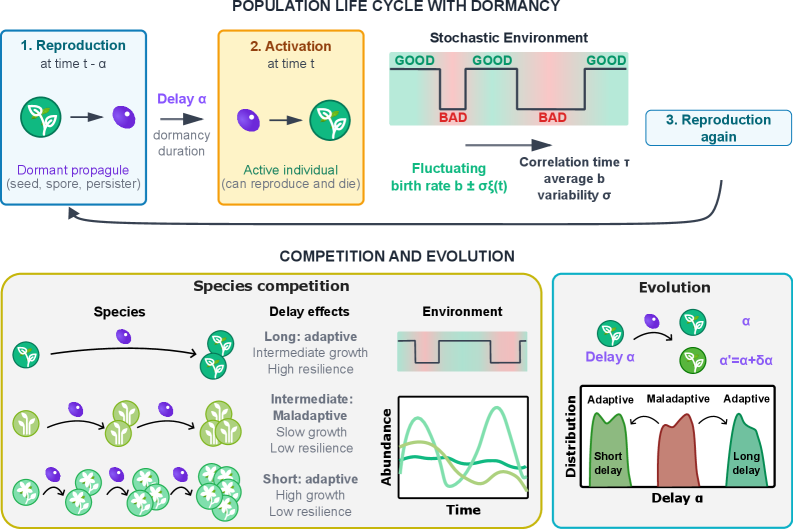
IN SHORT: This paper addresses the core challenge of determining how organisms should tune dormancy duration to match the temporal autocorrelation of their environment, revealing that intermediate dormancy times are systematically maladaptive.
核心创新
- Theory Identifies a generic mechanism where the interplay between demographic delay (dormancy) and environmental autocorrelation generates a strongly non-monotonic fitness landscape.
- Methodology Develops a parsimonious delayed-logistic model with colored multiplicative noise (dichotomous Markov noise) to analytically and numerically dissect the three-regime population performance.
- Biology Demonstrates evolutionary bistability, where selection favors either very short or very long dormancy strategies, systematically avoiding the maladaptive intermediate regime, as confirmed by an agent-based model.
主要结论
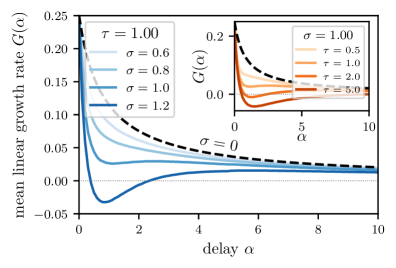
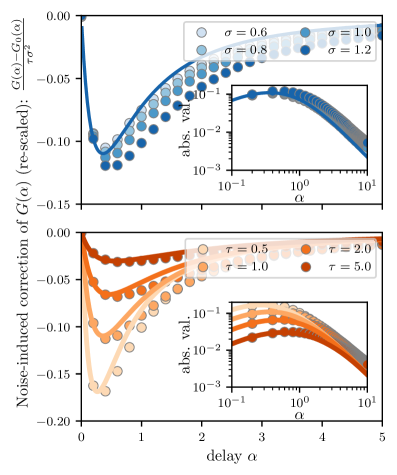
- For a population near the critical threshold (b ≳ d), the mean linear growth rate G(α) exhibits a local minimum at intermediate dormancy durations when noise amplitude σ or correlation time τ exceed a threshold, making this strategy globally least favorable (Figure 4).
- The stationary mean population density x* shows a pronounced depression (a 'valley') for intermediate α combined with strong environmental noise (σ > 0), which deepens and broadens as σ increases, potentially driving extinction (Figure 3).
- Evolutionary simulations confirm bistable selection: populations evolve towards either very short (α → 0) or very long (α ≳ 5) dormancy extremes, with the intermediate regime (e.g., α = 1) consistently leading to population collapse.
摘要: Dormancy is a widespread adaptive strategy that enables biological populations to persist in fluctuating environments. Yet how its evolutionary benefits depend on the temporal structure of environmental variability, and whether dormancy can become systematically maladaptive, remains poorly understood. Here we examine how dormancy interacts with environmental correlation times using a parsimonious delayed-logistic model in which dormant individuals reactivate after a fixed lag while birth rates fluctuate under temporally correlated stochasticity. Numerical simulations and analytical calculations reveal that the joint effect of demographic memory and colored multiplicative noise generates a strongly non-monotonic dependence of fitness on dormancy duration, with three distinct regimes of population performance. Very short dormancy maximizes linear growth but amplifies fluctuations and extinction risk. Very long dormancy buffers environmental variability, substantially increasing mean extinction times despite slower growth. Strikingly, and central to our results, there is a broad band of intermediate dormancy durations that is maladaptive, simultaneously reducing both growth and persistence—an effect that arises generically from the mismatch between delay times and environmental autocorrelation. The predicted bistability between short- and long-dormancy strategies is confirmed in an evolutionary agent-based model, which avoids intermediate lag times and selects for evolutionarily stable extremes. Our results show that dormancy duration is not merely a life-history parameter but an adaptive mechanism tuned to environmental timescales, and that “dangerous middle” dormancy times can be inherently disfavored, with implications for understanding persistence in seed banks, microbial persisters, and cancer cell dormancy. More broadly, this work identifies a general mechanism by which demographic delays interacting with correlated environmental variability generate a non-monotonic fitness landscape that selects for extreme timing strategies, and raises fundamental questions on analyzing delayed, non-Markovian dynamics driven by correlated multiplicative noise near absorbing boundaries.