
Paper List
-
Developing the PsyCogMetrics™ AI Lab to Evaluate Large Language Models and Advance Cognitive Science
This paper addresses the critical gap between sophisticated LLM evaluation needs and the lack of accessible, scientifically rigorous platforms that in...
-
Equivalence of approximation by networks of single- and multi-spike neurons
This paper resolves the fundamental question of whether single-spike spiking neural networks (SNNs) are inherently less expressive than multi-spike SN...
-
The neuroscience of transformers
提出了Transformer架构与皮层柱微环路之间的新颖计算映射,连接了现代AI与神经科学。
-
Framing local structural identifiability and observability in terms of parameter-state symmetries
This paper addresses the core challenge of systematically determining which parameters and states in a mechanistic ODE model can be uniquely inferred ...
-
Leveraging Phytolith Research using Artificial Intelligence
This paper addresses the critical bottleneck in phytolith research by automating the labor-intensive manual microscopy process through a multimodal AI...
-
Neural network-based encoding in free-viewing fMRI with gaze-aware models
This paper addresses the core challenge of building computationally efficient and ecologically valid brain encoding models for naturalistic vision by ...
-
Scalable DNA Ternary Full Adder Enabled by a Competitive Blocking Circuit
This paper addresses the core bottleneck of carry information attenuation and limited computational scale in DNA binary adders by introducing a scalab...
-
ELISA: An Interpretable Hybrid Generative AI Agent for Expression-Grounded Discovery in Single-Cell Genomics
This paper addresses the critical bottleneck of translating high-dimensional single-cell transcriptomic data into interpretable biological hypotheses ...
DeeDeeExperiment: Building an infrastructure for integrating and managing omics data analysis results in R/Bioconductor
Institute of Medical Biostatistics, Epidemiology and Informatics (IMBEI), University Medical Center Mainz | Research Center for Immunotherapy (FZI) Mainz | Department of Nephrology, Rheumatology and Kidney Transplantation, University Medical Center Mainz
30秒速读
IN SHORT: This paper addresses the critical bottleneck of managing and organizing the growing volume of differential expression and functional enrichment analysis results from complex omics experiments, which currently lack standardized data structures for storage and contextualization.
核心创新
- Methodology Introduces the first standardized S4 class specifically designed to co-store DEA and FEA results with their metadata in a single, structured container within the Bioconductor ecosystem.
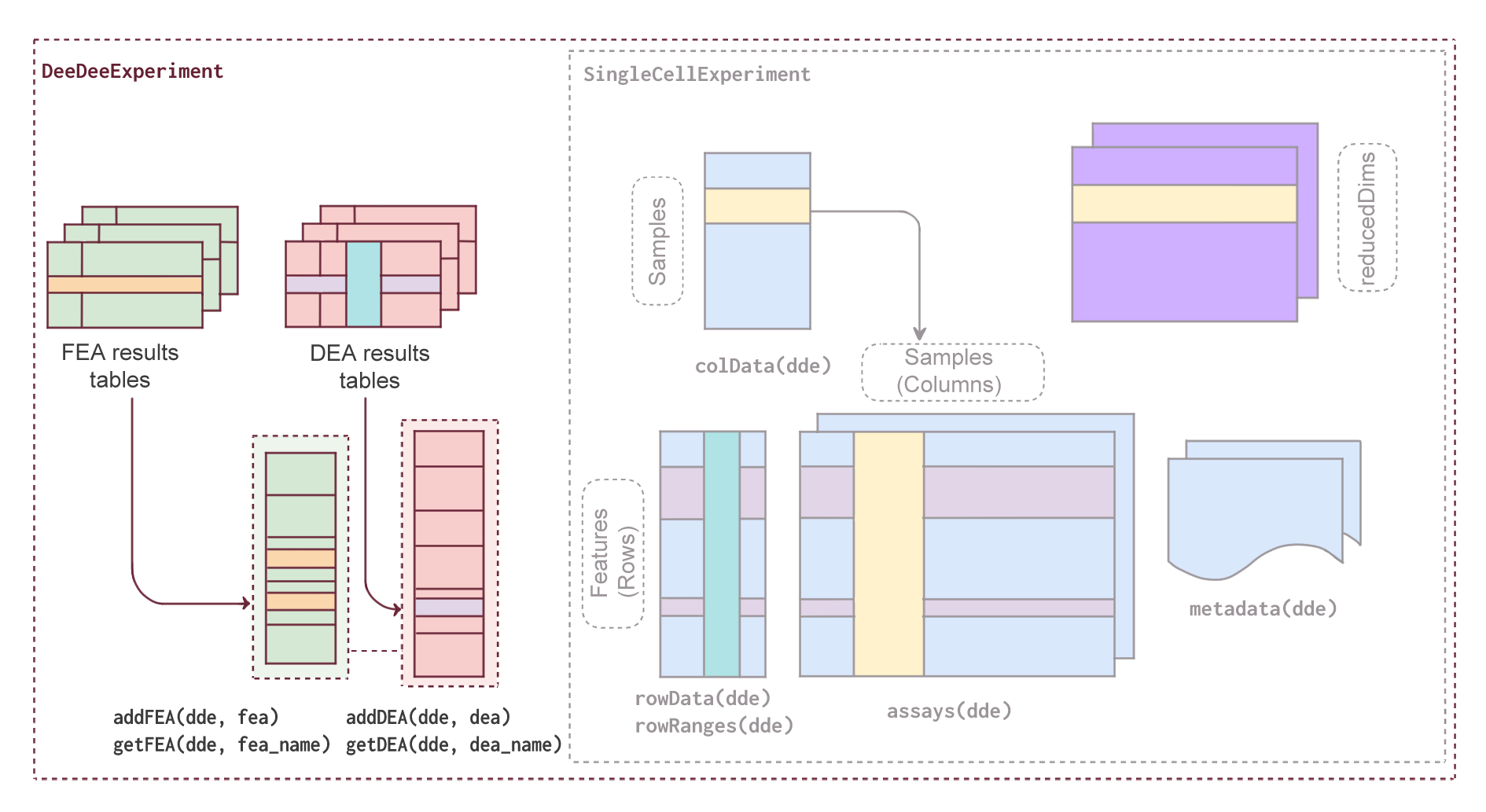
- Methodology Extends the widely adopted SingleCellExperiment class by adding dedicated slots for DEA and FEA results while maintaining full backward compatibility with existing Bioconductor tools.
- Methodology Implements a contrast-centric architecture that organizes results from multiple comparisons (including limma multi-contrast objects and muscat pseudobulk analyses) with efficient storage through pointer-based referencing.
主要结论
- DeeDeeExperiment provides a robust, standardized framework that enables efficient organization and retrieval of DEA/FEA results across multiple contrasts within a single data object.
- The implementation maintains full compatibility with the Bioconductor ecosystem, supporting interoperability with downstream tools like scater for visualization and iSEE for interactive exploration.
- By consolidating analysis results and metadata, the framework supports more nuanced quantitative approaches beyond simple overlap strategies, enabling trustworthy summaries of complex experimental measurements.
摘要: Summary: Modern omics experiments now involve multiple conditions and complex designs, producing an increasingly large set of differential expression and functional enrichment analysis results. However, no standardized data structure exists to store and contextualize these results together with their metadata, leaving researchers with an unmanageable and potentially non-reproducible collection of results that are difficult to navigate and/or share. Here we introduce DeeDeeExperiment, a new S4 class for managing and storing omics data analysis results, implemented within the Bioconductor ecosystem, which promotes interoperability, reproducibility and good documentation. This class extends the widely used SingleCellExperiment object by introducing dedicated slots for Differential Expression (DEA) and Functional Enrichment Analysis (FEA) results, allowing users to organize, store, and retrieve information on multiple contrasts and associated metadata within a single data object, ultimately streamlining the management and interpretation of many omics datasets. Availability and implementation: DeeDeeExperiment is available on Bioconductor under the MIT license (https://bioconductor.org/packages/DeeDeeExperiment), with its development version also available on Github (https://github.com/imbeimainz/DeeDeeExperiment).