
Paper List
-
Developing the PsyCogMetrics™ AI Lab to Evaluate Large Language Models and Advance Cognitive Science
This paper addresses the critical gap between sophisticated LLM evaluation needs and the lack of accessible, scientifically rigorous platforms that in...
-
Equivalence of approximation by networks of single- and multi-spike neurons
This paper resolves the fundamental question of whether single-spike spiking neural networks (SNNs) are inherently less expressive than multi-spike SN...
-
The neuroscience of transformers
提出了Transformer架构与皮层柱微环路之间的新颖计算映射,连接了现代AI与神经科学。
-
Framing local structural identifiability and observability in terms of parameter-state symmetries
This paper addresses the core challenge of systematically determining which parameters and states in a mechanistic ODE model can be uniquely inferred ...
-
Leveraging Phytolith Research using Artificial Intelligence
This paper addresses the critical bottleneck in phytolith research by automating the labor-intensive manual microscopy process through a multimodal AI...
-
Neural network-based encoding in free-viewing fMRI with gaze-aware models
This paper addresses the core challenge of building computationally efficient and ecologically valid brain encoding models for naturalistic vision by ...
-
Scalable DNA Ternary Full Adder Enabled by a Competitive Blocking Circuit
This paper addresses the core bottleneck of carry information attenuation and limited computational scale in DNA binary adders by introducing a scalab...
-
ELISA: An Interpretable Hybrid Generative AI Agent for Expression-Grounded Discovery in Single-Cell Genomics
This paper addresses the critical bottleneck of translating high-dimensional single-cell transcriptomic data into interpretable biological hypotheses ...
PanFoMa: A Lightweight Foundation Model and Benchmark for Pan-Cancer
Extracted from affiliations in the content snippet (specific institutions not fully listed in provided text)
30秒速读
IN SHORT: This paper addresses the dual challenge of achieving computational efficiency without sacrificing accuracy in whole-transcriptome single-cell representation learning for pan-cancer analysis, moving beyond the limitations of pure Transformer or Mamba architectures.
核心创新
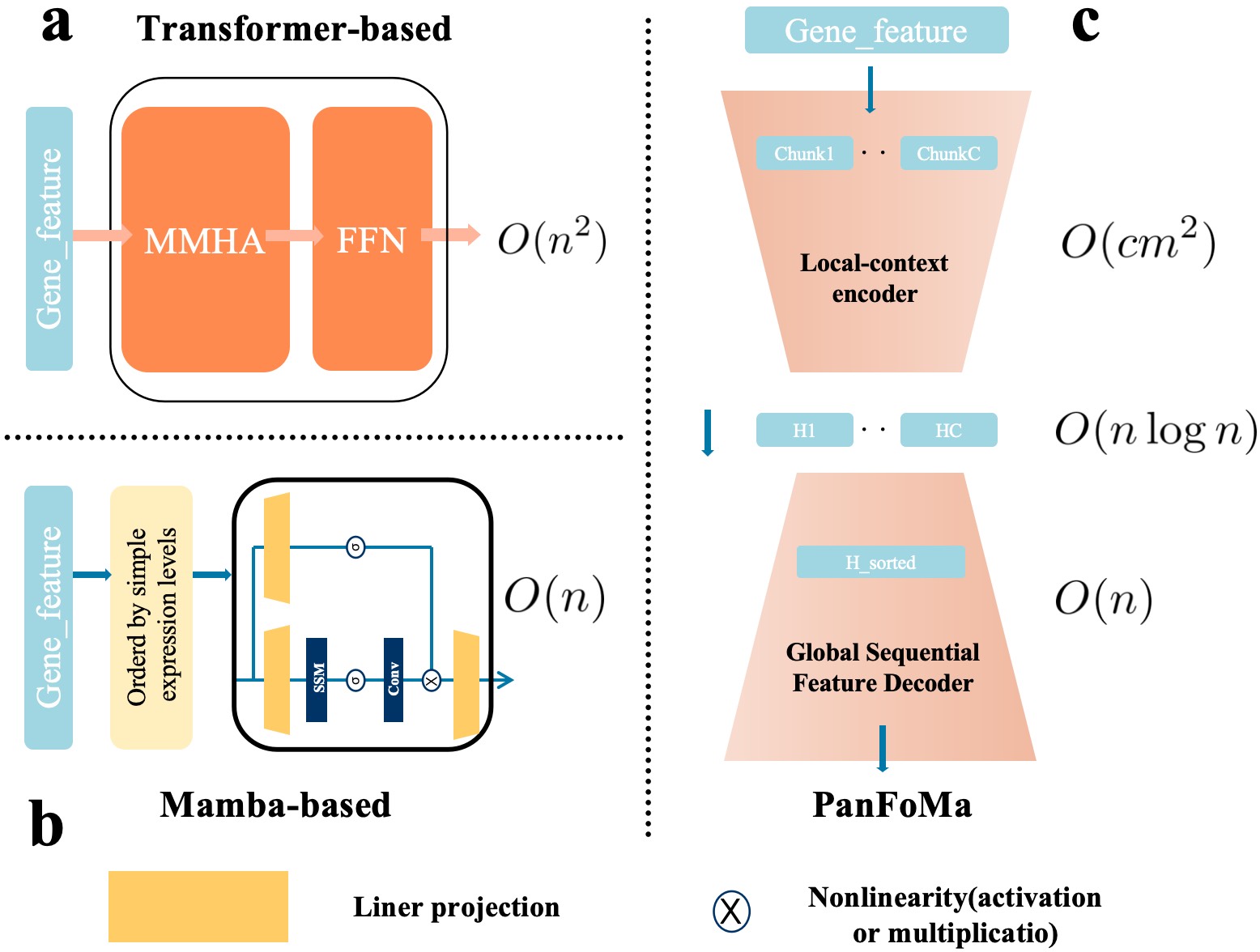
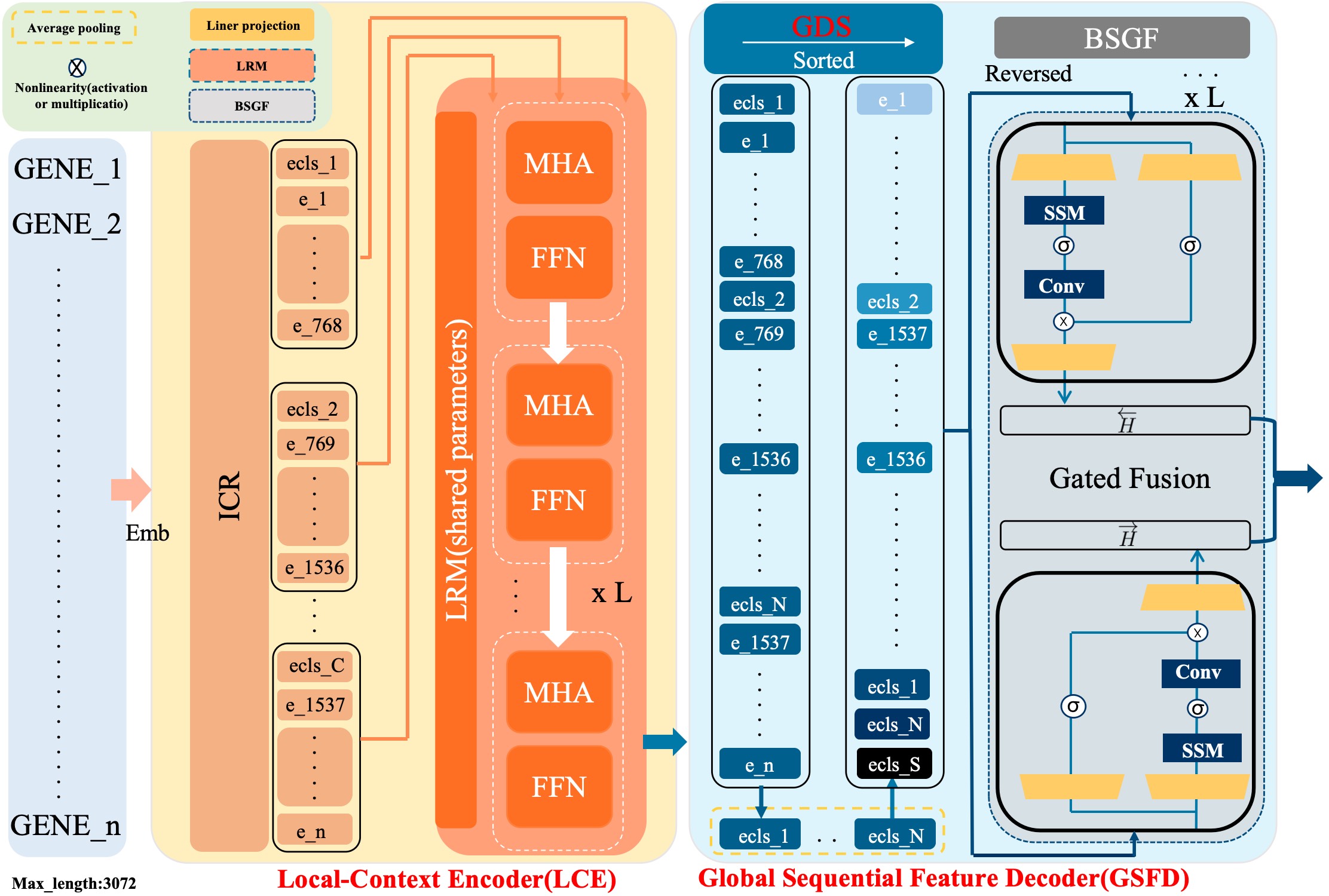
- Methodology Proposes a novel hybrid architecture (PanFoMa) that decouples local gene interaction modeling (via a lightweight, chunked Transformer encoder) from global context integration (via a bidirectional Mamba decoder), achieving O(C·M² + N log N) complexity.
- Methodology Introduces a Global-informed Dynamic Sorting (GDS) mechanism that adaptively orders genes for the Mamba decoder based on a learned global cell state vector, moving beyond static, heuristic gene ordering (e.g., by mean expression).
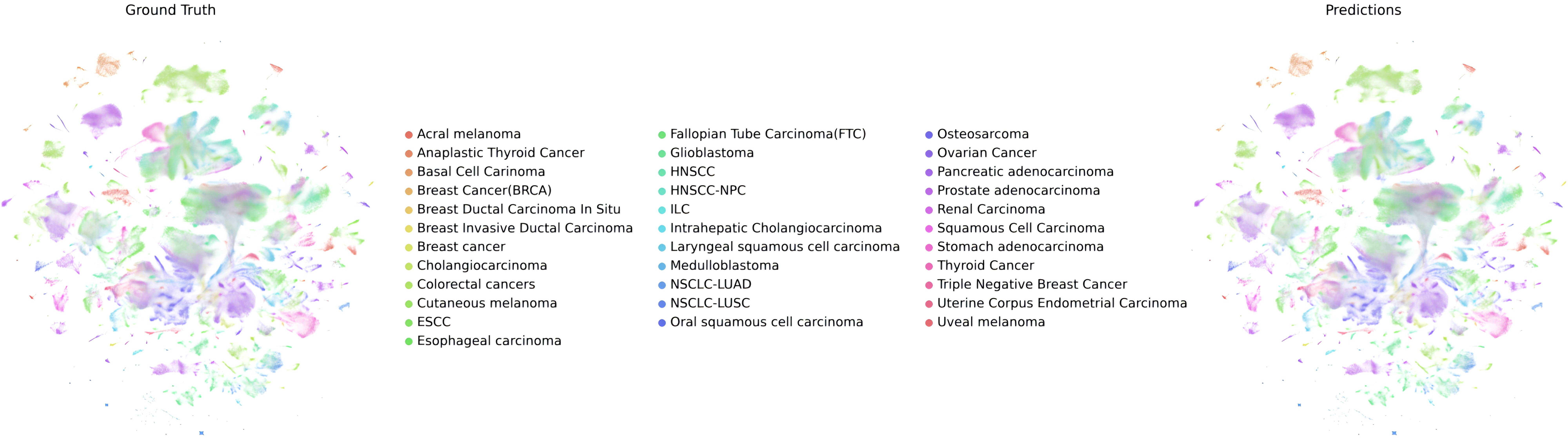
- Biology Constructs and releases PanFoMaBench, a large-scale, rigorously curated pan-cancer single-cell benchmark comprising over 3.5 million high-quality cells across 33 cancer subtypes from 23 tissues, addressing the lack of comprehensive evaluation resources.
主要结论
- PanFoMa achieves state-of-the-art pan-cancer classification accuracy of 94.74% (ACC) and 92.5% (Macro-F1) on PanFoMaBench, outperforming GeneFormer by +3.5% ACC and +4.0% F1.
- The model demonstrates superior generalizability across foundational tasks, showing improvements of +7.4% in cell type annotation, +4.0% in batch integration, and +3.1% in multi-omics integration over baselines.
- The hybrid local-global design and dynamic sorting are validated as effective, enabling efficient processing of full transcriptome-scale data (~3000 genes) while capturing both fine-grained local interactions and broad global regulatory patterns.
摘要: Single-cell RNA sequencing (scRNA-seq) is essential for decoding tumor heterogeneity. However, pan-cancer research still faces two key challenges: learning discriminative and efficient single-cell representations, and establishing a comprehensive evaluation benchmark. In this paper, we introduce PanFoMa, a lightweight hybrid neural network that combines the strengths of Transformers and state-space models to achieve a balance between performance and efficiency. PanFoMa consists of a front-end local-context encoder with shared self-attention layers to capture complex, order-independent gene interactions; and a back-end global sequential feature decoder that efficiently integrates global context using a linear-time state-space model. This modular design preserves the expressive power of Transformers while leveraging the scalability of Mamba to enable transcriptome modeling, effectively capturing both local and global regulatory signals. To enable robust evaluation, we also construct a large-scale pan-cancer single-cell benchmark, PanFoMaBench, containing over 3.5 million high-quality cells across 33 cancer subtypes, curated through a rigorous preprocessing pipeline. Experimental results show that PanFoMa outperforms state-of-the-art models on our pan-cancer benchmark (+4.0%) and across multiple public tasks, including cell type annotation (+7.4%), batch integration (+4.0%) and multi-omics integration (+3.1%). The code is available at https://github.com/Xiaoshui-Huang/PanFoMa.