
Paper List
-
SpikGPT: A High-Accuracy and Interpretable Spiking Attention Framework for Single-Cell Annotation
This paper addresses the core challenge of robust single-cell annotation across heterogeneous datasets with batch effects and the critical need to ide...
-
Unlocking hidden biomolecular conformational landscapes in diffusion models at inference time
This paper addresses the core challenge of efficiently and accurately sampling the conformational landscape of biomolecules from diffusion-based struc...
-
Personalized optimization of pediatric HD-tDCS for dose consistency and target engagement
This paper addresses the critical limitation of one-size-fits-all HD-tDCS protocols in pediatric populations by developing a personalized optimization...
-
Realistic Transition Paths for Large Biomolecular Systems: A Langevin Bridge Approach
This paper addresses the core challenge of generating physically realistic and computationally efficient transition paths between distinct protein con...
-
Consistent Synthetic Sequences Unlock Structural Diversity in Fully Atomistic De Novo Protein Design
This paper addresses the core pain point of low sequence-structure alignment in existing synthetic datasets (e.g., AFDB), which severely limits the pe...
-
MoRSAIK: Sequence Motif Reactor Simulation, Analysis and Inference Kit in Python
This work addresses the computational bottleneck in simulating prebiotic RNA reactor dynamics by developing a Python package that tracks sequence moti...
-
On the Approximation of Phylogenetic Distance Functions by Artificial Neural Networks
This paper addresses the core challenge of developing computationally efficient and scalable neural network architectures that can learn accurate phyl...
-
EcoCast: A Spatio-Temporal Model for Continual Biodiversity and Climate Risk Forecasting
This paper addresses the critical bottleneck in conservation: the lack of timely, high-resolution, near-term forecasts of species distribution shifts ...
Revealing stimulus-dependent dynamics through statistical complexity
Universidade Federal de Pernambuco | University of Minho | University of Arkansas | Universidade Federal de Alagoas
30秒速读
IN SHORT: This paper addresses the core challenge of detecting stimulus-specific patterns in neural population dynamics that remain hidden to traditional variability metrics like the coefficient of variation.
核心创新
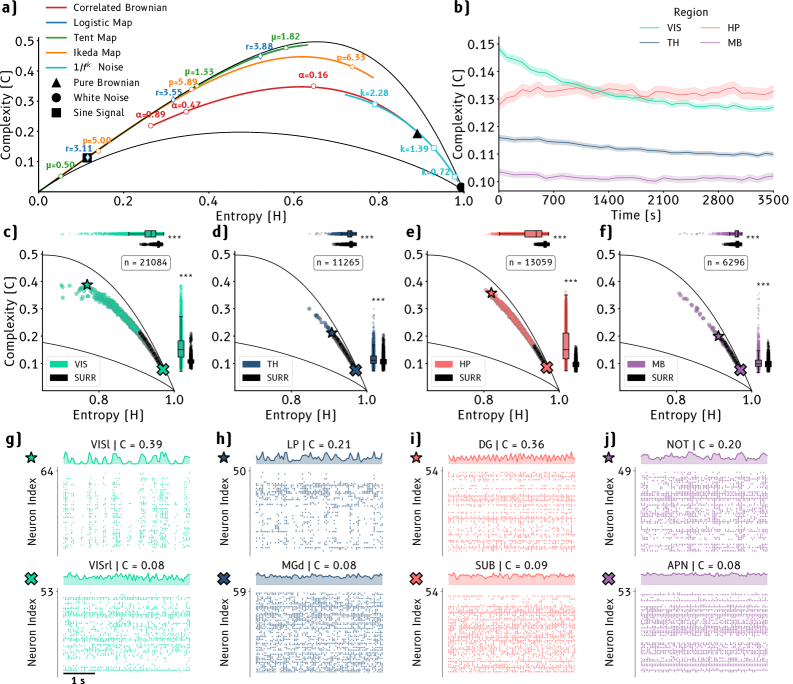
- Methodology Introduces the application of statistical complexity, an information-theoretic measure based on ordinal pattern analysis (Bandt-Pompe symbolization), to characterize the organizational structure of neural population dynamics across multiple brain regions.
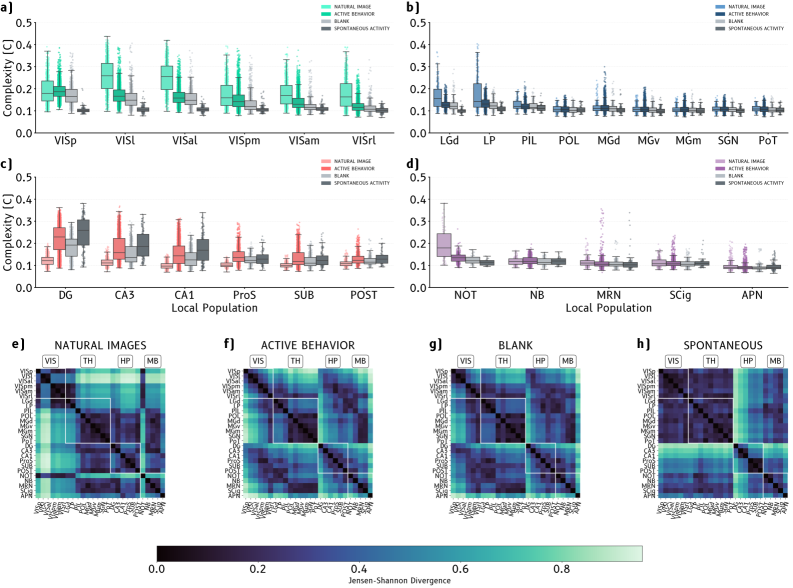
- Biology Reveals a hierarchical gradient of stimulus-dependence: visual cortex dynamics are strongly modulated by stimulus conditions, thalamus shows attenuated modulation, while hippocampus and midbrain maintain relatively invariant dynamics, suggesting distinct computational roles.
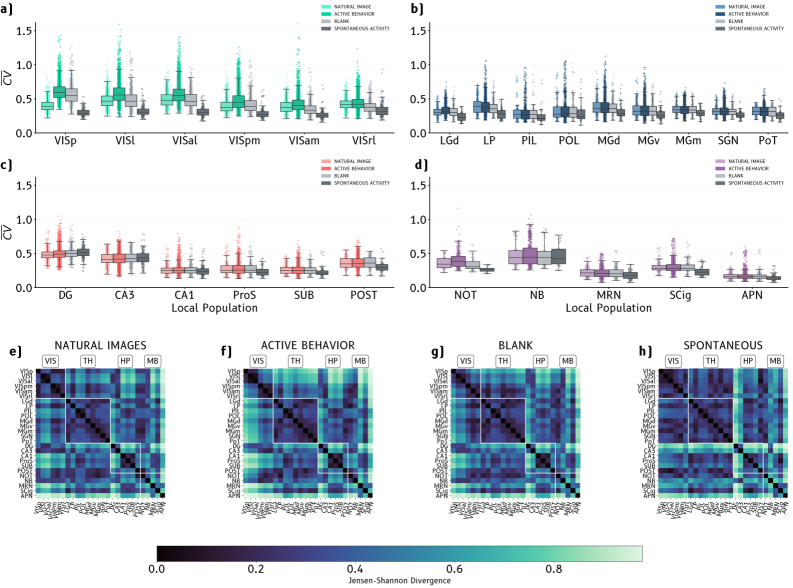
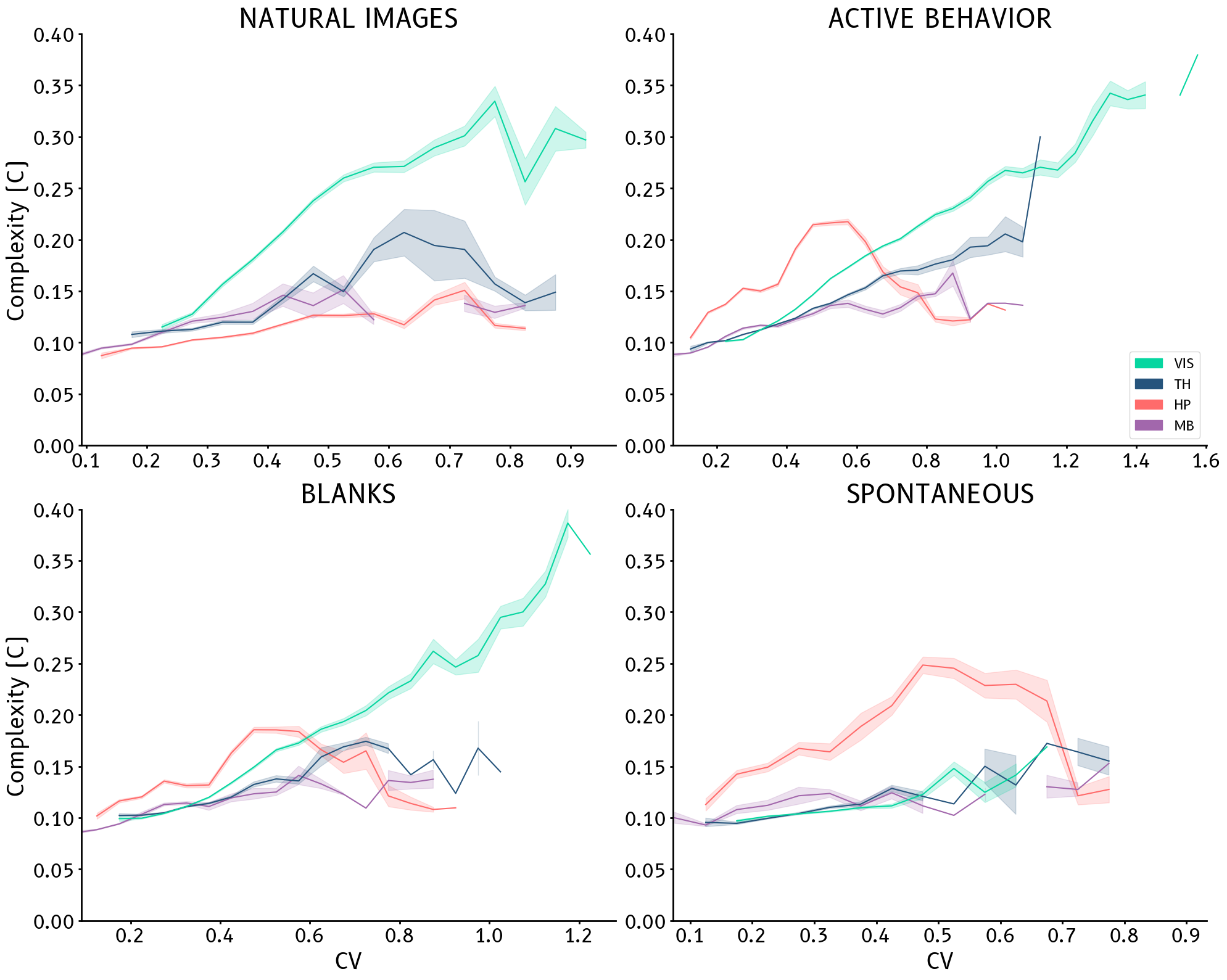
- Methodology Demonstrates that statistical complexity, but not the classical coefficient of variation (CV), can discriminate between different stimulus conditions (natural images, blank screens, spontaneous activity), uncovering structured motifs in population activity.
主要结论
- Statistical complexity revealed clear, stimulus-specific motifs in population activity across visual cortex, hippocampus, thalamus, and midbrain, while the coefficient of variation (CV) failed to discriminate between natural image presentations, blank screens, and spontaneous activity conditions.
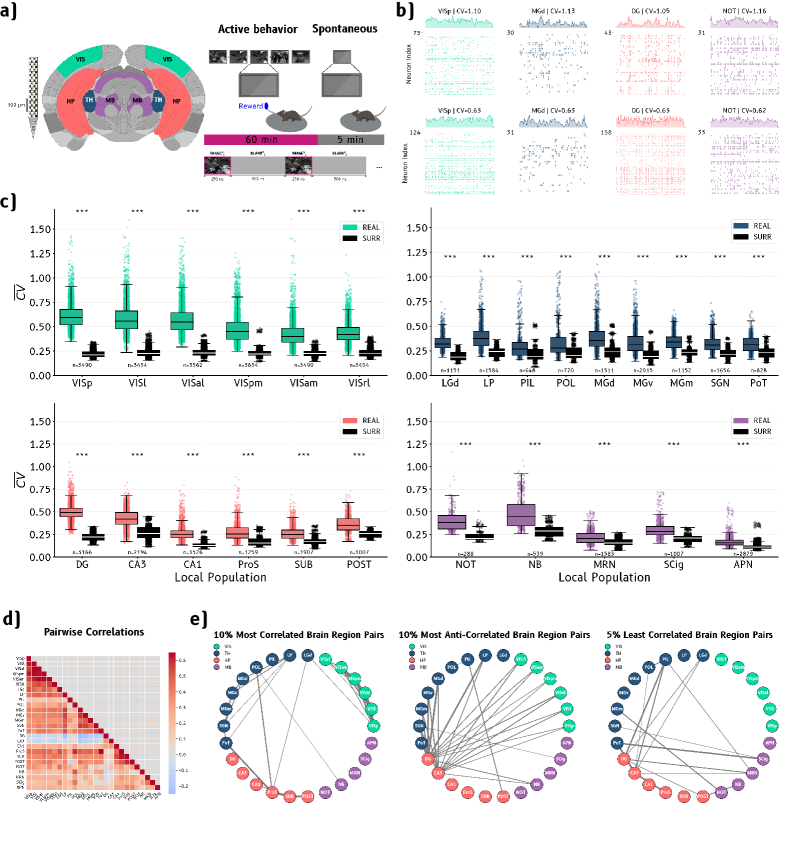
- Visual cortex subregions exhibited the highest CV values (median range: 0.40–0.59, approximately 2–3× higher than shuffled surrogates, p<0.001), showing strong stimulus-dependent modulation, while midbrain areas displayed the most invariant dynamics across all experimental conditions.
- The complexity-entropy (C-H) plane framework enabled classification of dynamical regimes, with different brain regions occupying distinct positions: visual cortex showed intermediate entropy with high complexity during stimulus presentation, while surrogate data clustered near the random limit (high entropy, low complexity).
摘要: Advances in large-scale neural recordings have expanded our ability to describe the activity of distributed brain circuits. However, understanding how neural population dynamics differ across regions and behavioral contexts remains challenging. Here, we surveyed neuronal population dynamics across multiple mouse brain areas (visual cortex, hippocampus, thalamus, and midbrain) using spike data from local ensembles. Two complementary measures were used to characterize these dynamics: the coefficient of variation (CV), a classical indicator of spike-time variability, and statistical complexity, an information-theoretic quantifier of organizational structure. To probe stimulus-dependent activity, we segmented and concatenated recordings from behavioral experiments into distinct time series corresponding to natural image presentations, blank screens during visual task, and spontaneous activity. While the CV failed to discriminate between these conditions, statistical complexity revealed clear, stimulus-specific motifs in population activity. These results indicate that information-theoretic measures can uncover structured, stimulus-dependent patterns in neural population dynamics that remain unobserved in traditional variability metrics.