
Paper List
-
Developing the PsyCogMetrics™ AI Lab to Evaluate Large Language Models and Advance Cognitive Science
This paper addresses the critical gap between sophisticated LLM evaluation needs and the lack of accessible, scientifically rigorous platforms that in...
-
Equivalence of approximation by networks of single- and multi-spike neurons
This paper resolves the fundamental question of whether single-spike spiking neural networks (SNNs) are inherently less expressive than multi-spike SN...
-
The neuroscience of transformers
提出了Transformer架构与皮层柱微环路之间的新颖计算映射,连接了现代AI与神经科学。
-
Framing local structural identifiability and observability in terms of parameter-state symmetries
This paper addresses the core challenge of systematically determining which parameters and states in a mechanistic ODE model can be uniquely inferred ...
-
Leveraging Phytolith Research using Artificial Intelligence
This paper addresses the critical bottleneck in phytolith research by automating the labor-intensive manual microscopy process through a multimodal AI...
-
Neural network-based encoding in free-viewing fMRI with gaze-aware models
This paper addresses the core challenge of building computationally efficient and ecologically valid brain encoding models for naturalistic vision by ...
-
Scalable DNA Ternary Full Adder Enabled by a Competitive Blocking Circuit
This paper addresses the core bottleneck of carry information attenuation and limited computational scale in DNA binary adders by introducing a scalab...
-
ELISA: An Interpretable Hybrid Generative AI Agent for Expression-Grounded Discovery in Single-Cell Genomics
This paper addresses the critical bottleneck of translating high-dimensional single-cell transcriptomic data into interpretable biological hypotheses ...
Influence of Object Affordance on Action Language Understanding: Evidence from Dynamic Causal Modeling Analysis
Centre for Linguistic Science and Technology (CLST), Indian Institute of Technology Guwahati | Neural Engineering Lab, Department of Bio Sciences and Bio Engineering, IIT Guwahati | Biomimetic Robotics and Artificial Intelligence Lab (BRAIL), Department of Mechanical Engineering, IIT Guwahati
30秒速读
IN SHORT: This study addresses the core challenge of moving beyond correlational evidence to establish the *causal direction* and *temporal dynamics* of how object affordance processing in sensorimotor brain regions drives the comprehension of action-related language.
核心创新
- Methodology Applies Dynamic Causal Modeling (DCM) to EEG data to infer *directed, causal connectivity* between key brain regions during affordance-language processing, moving beyond traditional correlational analyses.
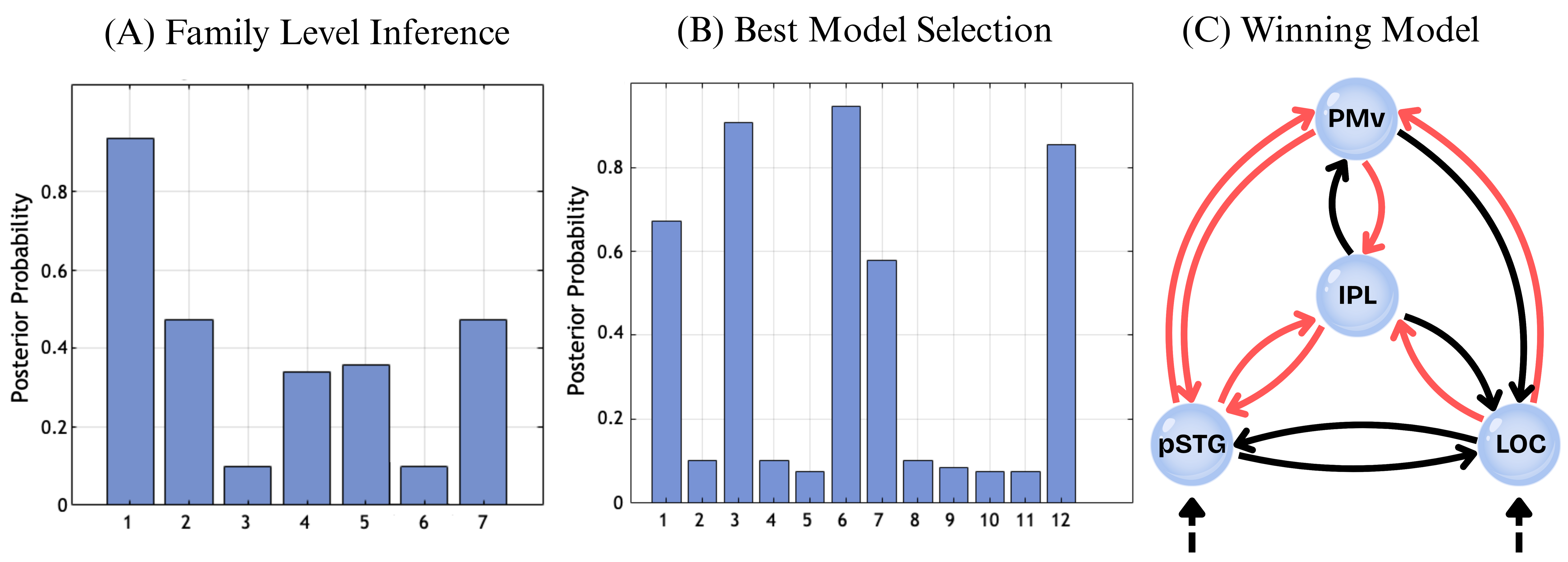
- Biology Identifies a specific feedforward causal architecture where the Ventral Premotor Cortex (PMv) acts as a driver, causally influencing the Inferior Parietal Lobule (IPL) and Posterior Superior Temporal Gyrus (pSTG) during action language comprehension.
- Theory Provides direct, mechanistic evidence supporting grounded/embodied cognition theories by showing that affordance-related motor regions (PMv) actively *drive* semantic hubs (pSTG, IPL), rather than merely co-activating with them.
主要结论
- Bayesian Model Selection identified a dominant model (M6, exceedance probability = 0.91) featuring strong modulatory influences from PMv to IPL (mean coupling strength = 0.28 Hz ± 0.05) and PMv to pSTG, establishing a causal feedforward pathway from motor to semantic regions.
- The video+text condition significantly strengthened the causal influence from PMv to IPL and pSTG compared to the text-only condition, demonstrating that multimodal (visual+linguistic) affordance cues amplify the driving role of premotor cortex.
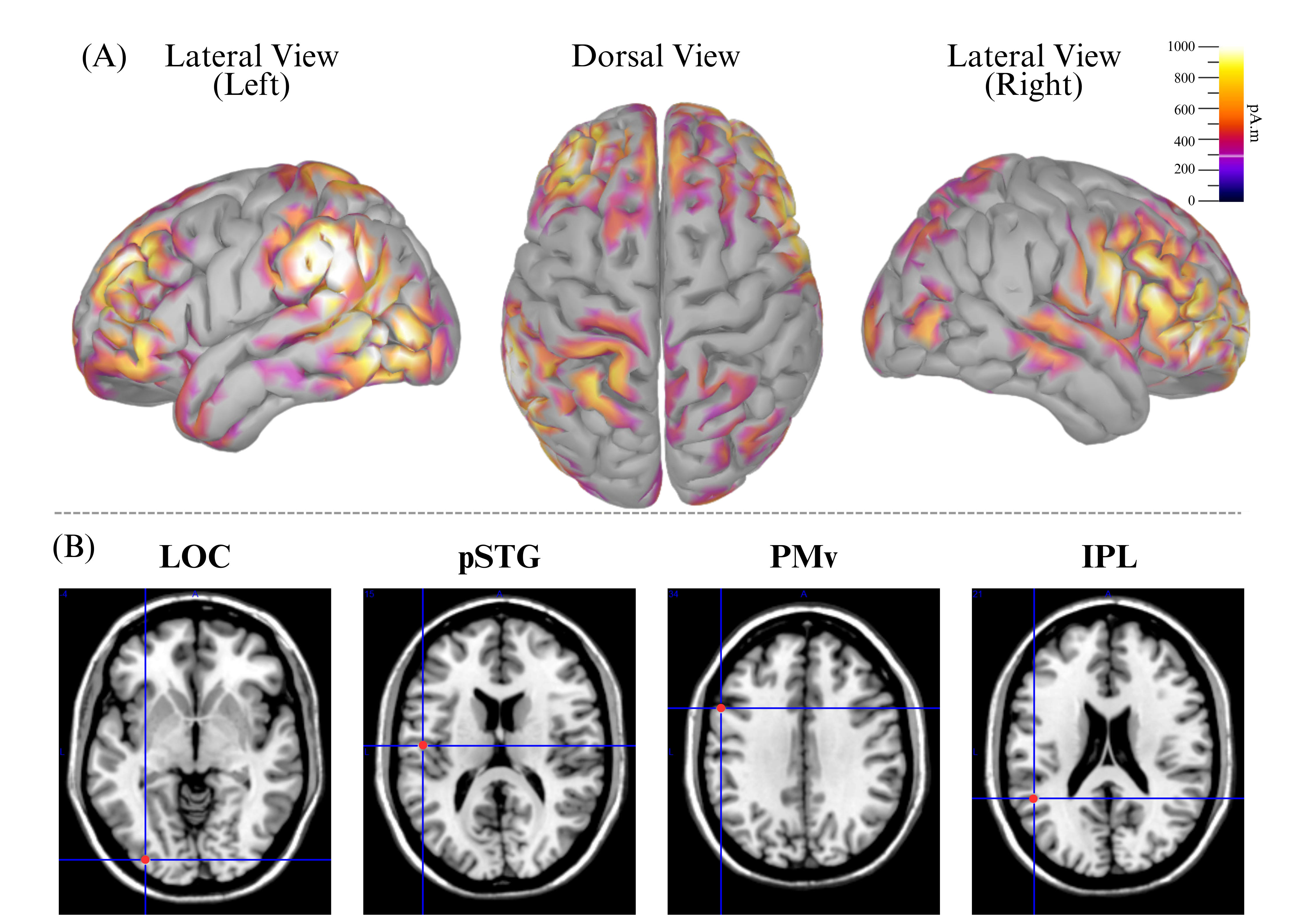
- Source localization (LORETA) and DCM together delineate a core left-hemisphere network (LOC, pSTg, PMv, IPL) where visual input (LOC) feeds into premotor affordance processing (PMv), which in turn causally drives semantic integration in parietal (IPL) and temporal (pSTG) hubs.
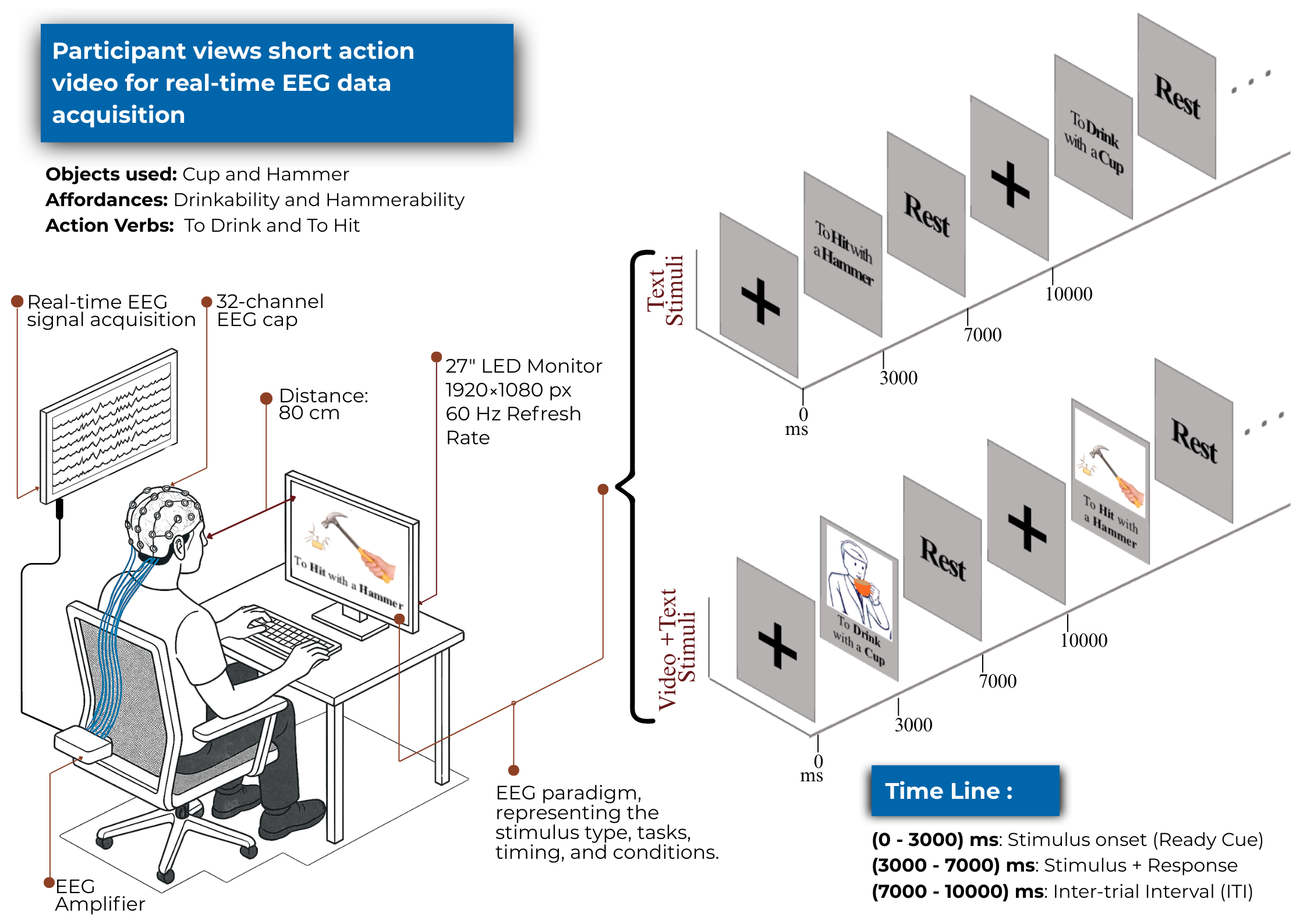
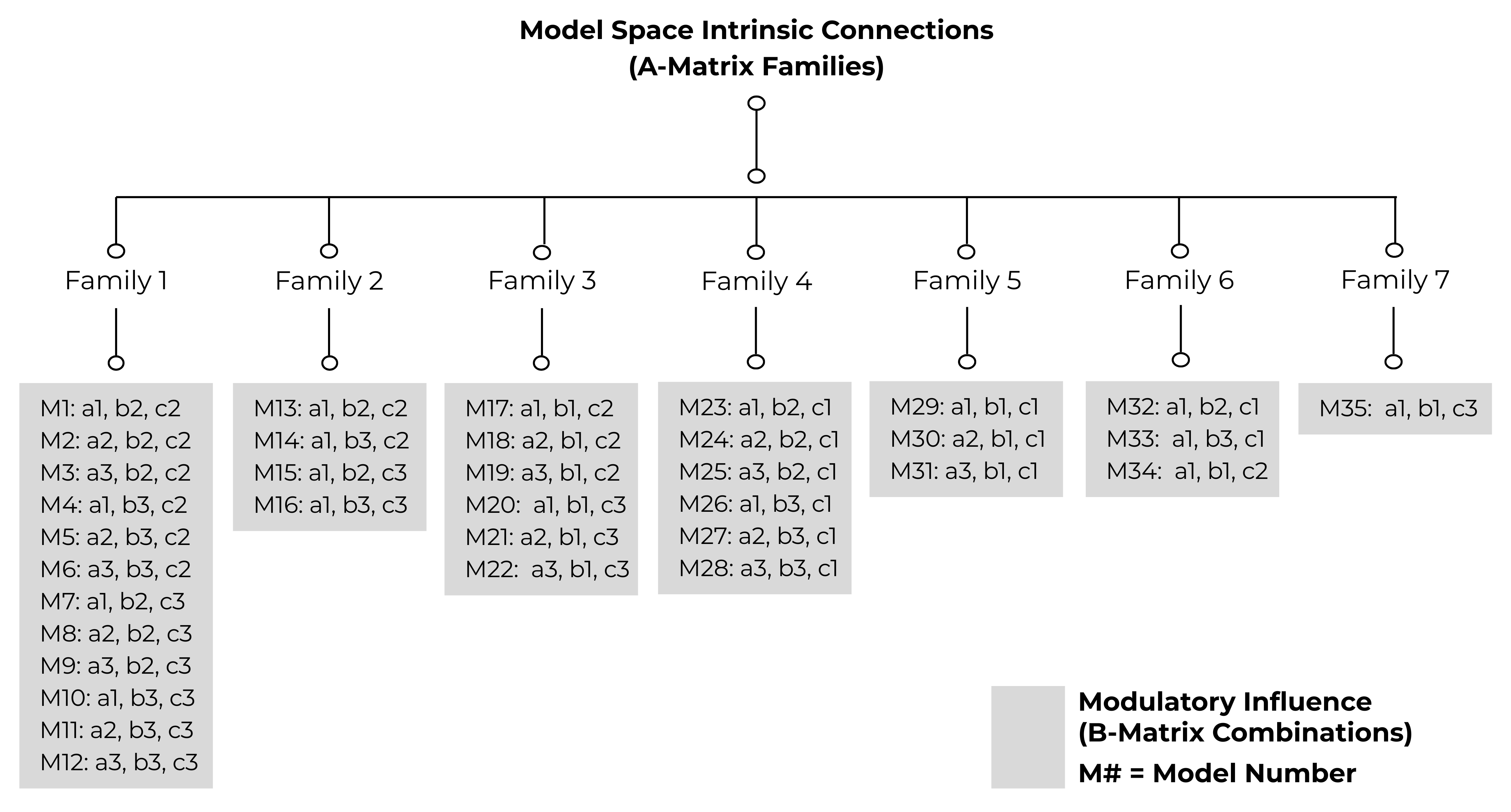
摘要: This study investigates the causal neural dynamics by which affordance representations influence action language comprehension. In this study, 18 participants observed stimuli displayed in two conditions during the experiment: text-only (e.g., ‘Hit with a hammer’) and video+text (visual clips with matching phrases). EEG data were recorded from 32 channels and analyzed for event-related potentials and source localization using LORETA, which identified four left-hemisphere regions of interest: the Lateral Occipital Cortex (LOC), Posterior Superior Temporal Gyrus (pSTG), Ventral Premotor Cortex (PMv), and Inferior Parietal Lobule (IPL). A space of dynamic causal modeling (DCM) was constructed with driving inputs to LOC and pSTG, and multiple connectivity configurations were tested. Bayesian Model Selection revealed a dominant model in which PMv causally influenced IPL and pSTG, reflecting a feedforward architecture from affordance-related motor regions to semantic hubs. Bayesian Model Averaging further confirmed strong endogenous connections from LOC to PMv and IPL, and significant modulation from PMv to IPL. These findings provide direct evidence that affordance processing in premotor regions drives action language understanding by engaging downstream parietal and temporal areas. The results support grounded cognition theories and offer a mechanistic account of how sensorimotor information contributes to linguistic comprehension.