
Paper List
-
Autonomous Agents Coordinating Distributed Discovery Through Emergent Artifact Exchange
This paper addresses the fundamental limitation of current AI-assisted scientific research by enabling truly autonomous, decentralized investigation w...
-
D-MEM: Dopamine-Gated Agentic Memory via Reward Prediction Error Routing
This paper addresses the fundamental scalability bottleneck in LLM agentic memory systems: the O(N²) computational complexity and unbounded API token ...
-
Countershading coloration in blue shark skin emerges from hierarchically organized and spatially tuned photonic architectures inside skin denticles
This paper solves the core problem of how blue sharks achieve their striking dorsoventral countershading camouflage, revealing that coloration origina...
-
Human-like Object Grouping in Self-supervised Vision Transformers
This paper addresses the core challenge of quantifying how well self-supervised vision models capture human-like object grouping in natural scenes, br...
-
Hierarchical pp-Adic Framework for Gene Regulatory Networks: Theory and Stability Analysis
This paper addresses the core challenge of mathematically capturing the inherent hierarchical organization and multi-scale stability of gene regulator...
-
Towards unified brain-to-text decoding across speech production and perception
This paper addresses the core challenge of developing a unified brain-to-text decoding framework that works across both speech production and percepti...
-
Dual-Laws Model for a theory of artificial consciousness
This paper addresses the core challenge of developing a comprehensive, testable theory of consciousness that bridges biological and artificial systems...
-
Pulse desynchronization of neural populations by targeting the centroid of the limit cycle in phase space
This work addresses the core challenge of determining optimal pulse timing and intensity for desynchronizing pathological neural oscillations when the...
Influence of Object Affordance on Action Language Understanding: Evidence from Dynamic Causal Modeling Analysis
Centre for Linguistic Science and Technology (CLST), Indian Institute of Technology Guwahati | Neural Engineering Lab, Department of Bio Sciences and Bio Engineering, IIT Guwahati | Biomimetic Robotics and Artificial Intelligence Lab (BRAIL), Department of Mechanical Engineering, IIT Guwahati
30秒速读
IN SHORT: This study addresses the core challenge of moving beyond correlational evidence to establish the *causal direction* and *temporal dynamics* of how object affordance processing in sensorimotor brain regions drives the comprehension of action-related language.
核心创新
- Methodology Applies Dynamic Causal Modeling (DCM) to EEG data to infer *directed, causal connectivity* between key brain regions during affordance-language processing, moving beyond traditional correlational analyses.
- Biology Identifies a specific feedforward causal architecture where the Ventral Premotor Cortex (PMv) acts as a driver, causally influencing the Inferior Parietal Lobule (IPL) and Posterior Superior Temporal Gyrus (pSTG) during action language comprehension.
- Theory Provides direct, mechanistic evidence supporting grounded/embodied cognition theories by showing that affordance-related motor regions (PMv) actively *drive* semantic hubs (pSTG, IPL), rather than merely co-activating with them.
主要结论
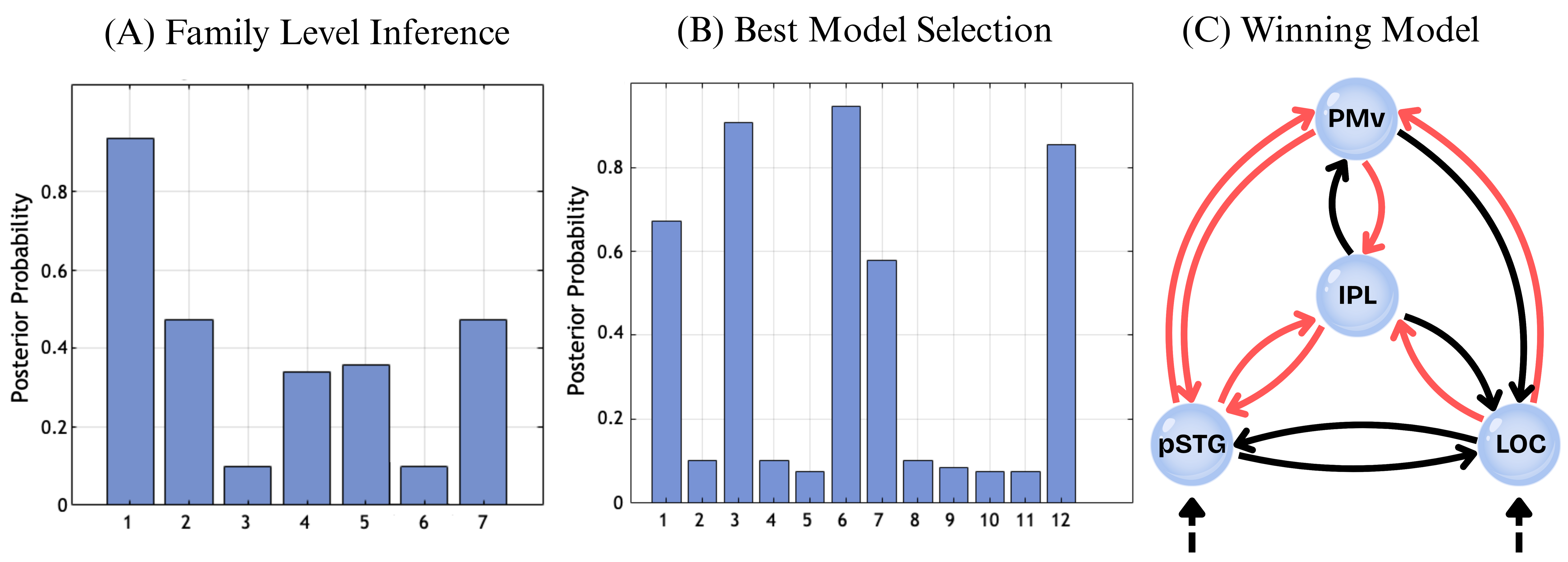
- Bayesian Model Selection identified a dominant model (M6, exceedance probability = 0.91) featuring strong modulatory influences from PMv to IPL (mean coupling strength = 0.28 Hz ± 0.05) and PMv to pSTG, establishing a causal feedforward pathway from motor to semantic regions.
- The video+text condition significantly strengthened the causal influence from PMv to IPL and pSTG compared to the text-only condition, demonstrating that multimodal (visual+linguistic) affordance cues amplify the driving role of premotor cortex.
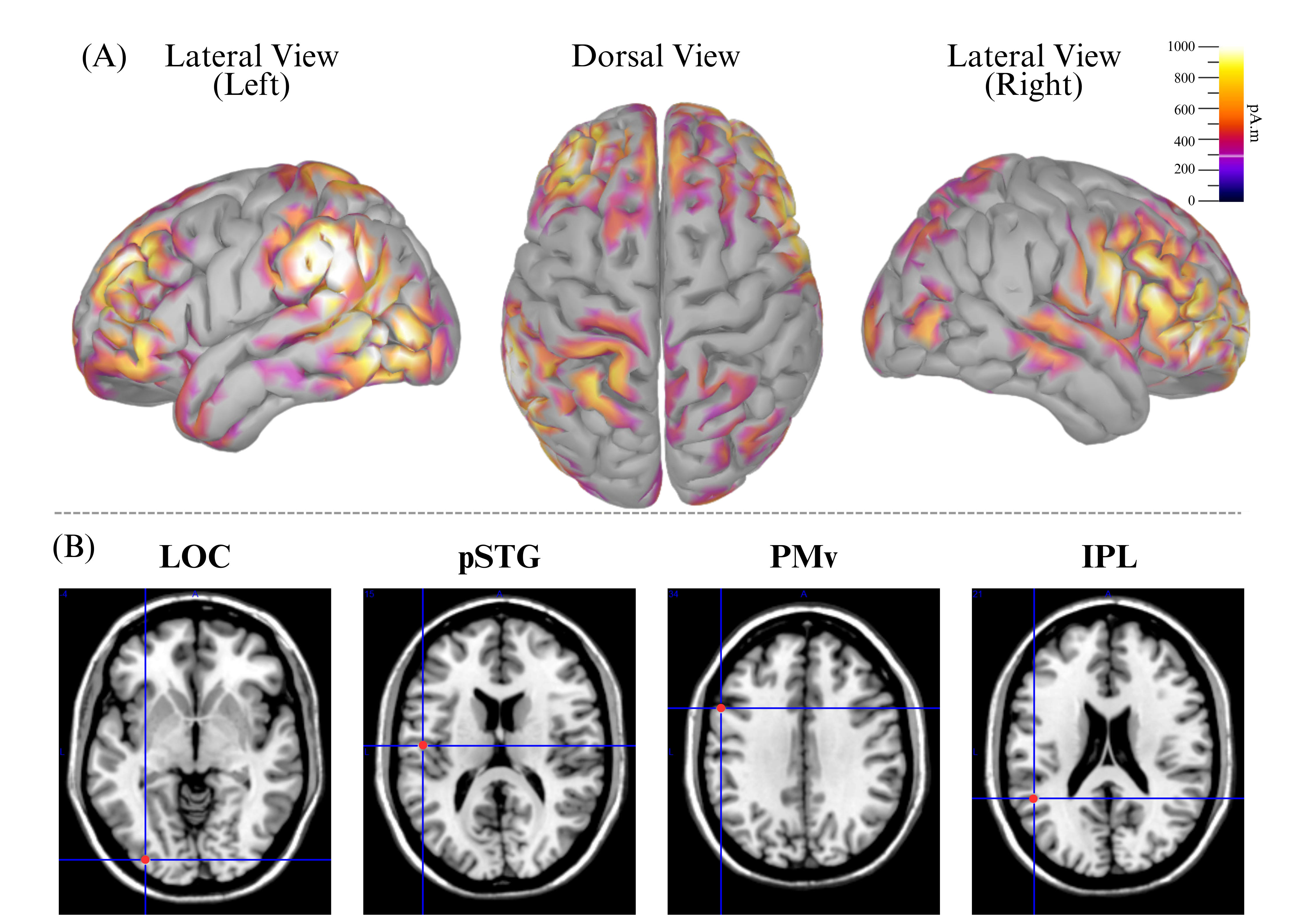
- Source localization (LORETA) and DCM together delineate a core left-hemisphere network (LOC, pSTg, PMv, IPL) where visual input (LOC) feeds into premotor affordance processing (PMv), which in turn causally drives semantic integration in parietal (IPL) and temporal (pSTG) hubs.
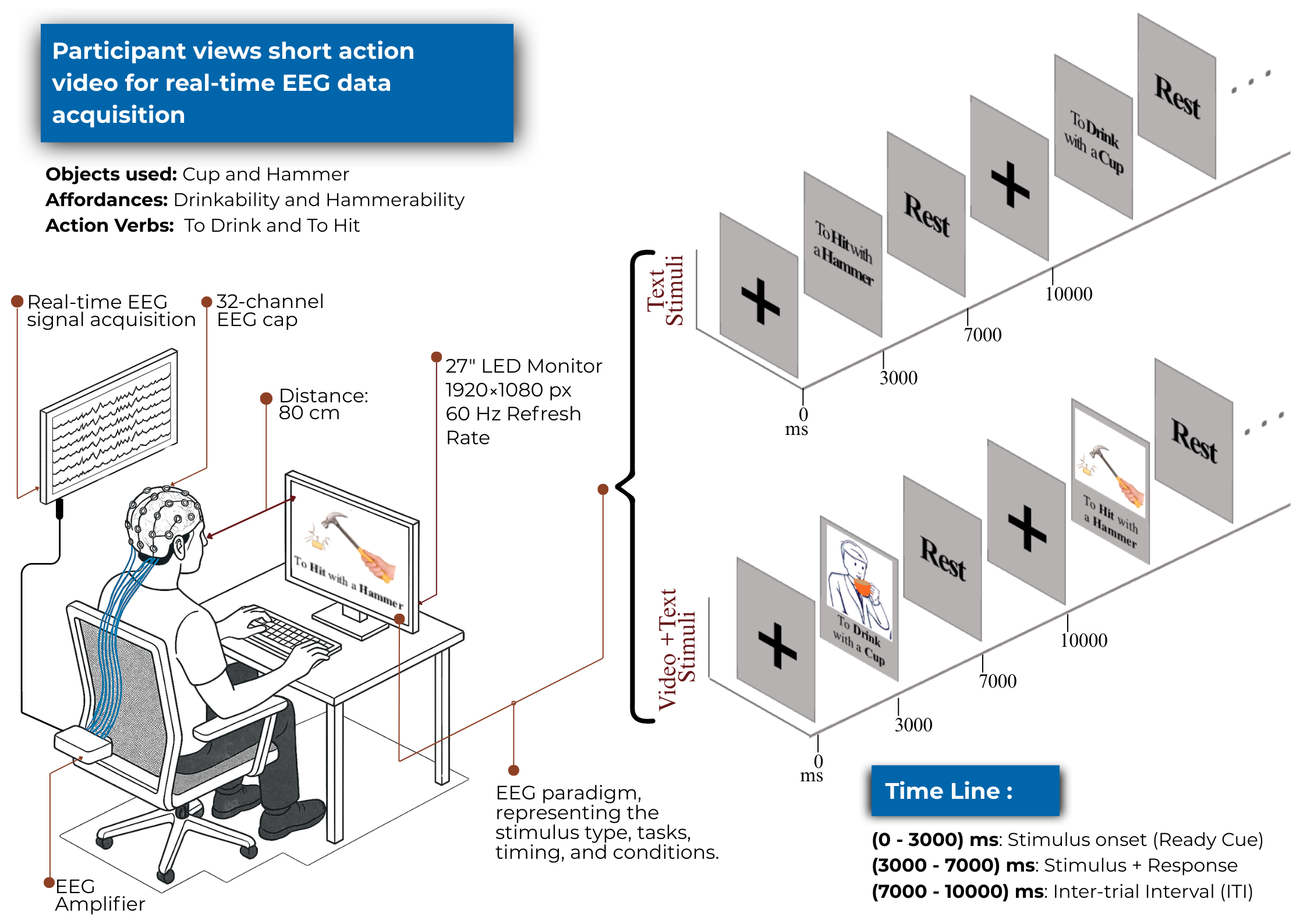
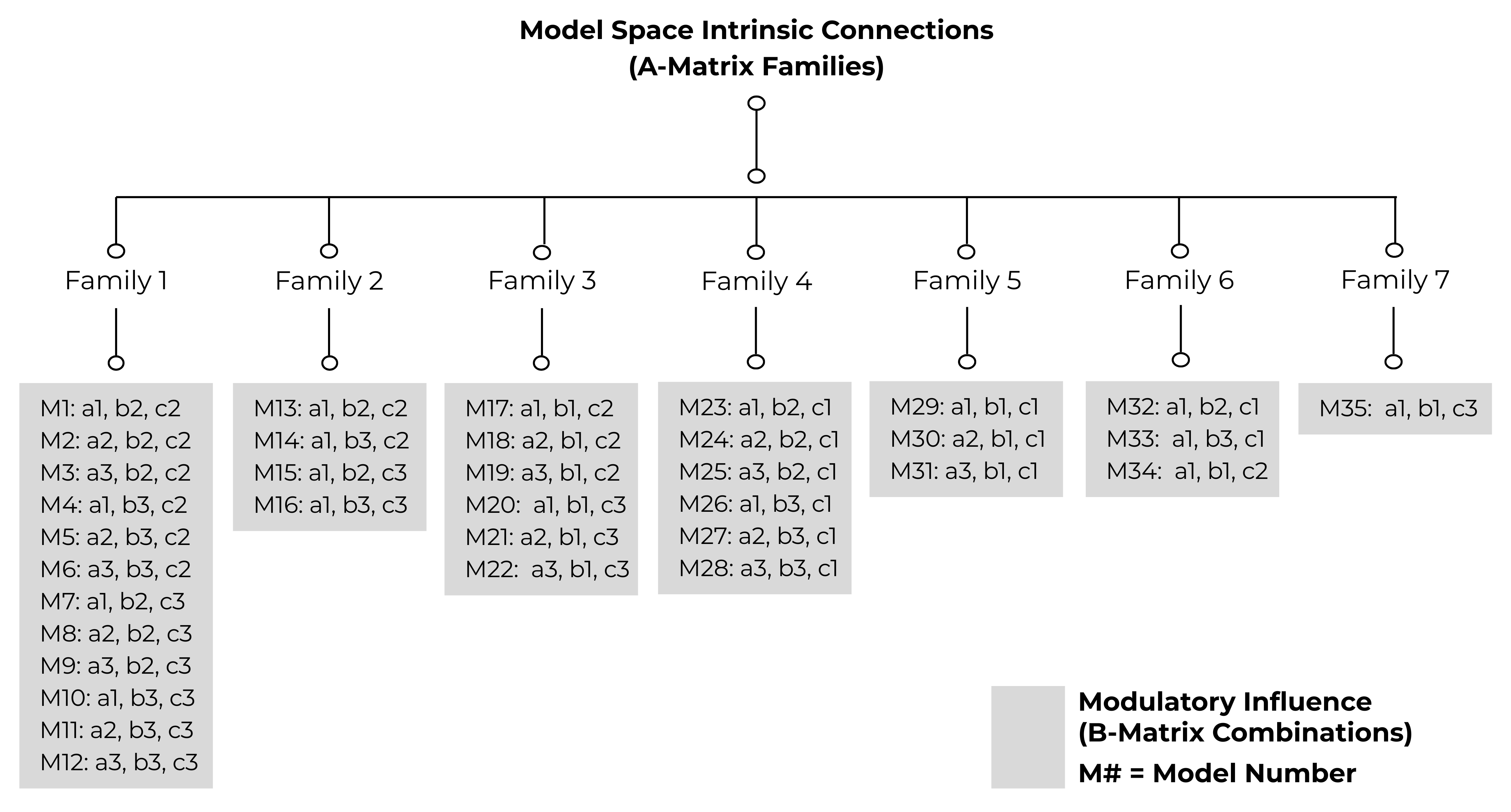
摘要: This study investigates the causal neural dynamics by which affordance representations influence action language comprehension. In this study, 18 participants observed stimuli displayed in two conditions during the experiment: text-only (e.g., ‘Hit with a hammer’) and video+text (visual clips with matching phrases). EEG data were recorded from 32 channels and analyzed for event-related potentials and source localization using LORETA, which identified four left-hemisphere regions of interest: the Lateral Occipital Cortex (LOC), Posterior Superior Temporal Gyrus (pSTG), Ventral Premotor Cortex (PMv), and Inferior Parietal Lobule (IPL). A space of dynamic causal modeling (DCM) was constructed with driving inputs to LOC and pSTG, and multiple connectivity configurations were tested. Bayesian Model Selection revealed a dominant model in which PMv causally influenced IPL and pSTG, reflecting a feedforward architecture from affordance-related motor regions to semantic hubs. Bayesian Model Averaging further confirmed strong endogenous connections from LOC to PMv and IPL, and significant modulation from PMv to IPL. These findings provide direct evidence that affordance processing in premotor regions drives action language understanding by engaging downstream parietal and temporal areas. The results support grounded cognition theories and offer a mechanistic account of how sensorimotor information contributes to linguistic comprehension.