
Paper List
-
Autonomous Agents Coordinating Distributed Discovery Through Emergent Artifact Exchange
This paper addresses the fundamental limitation of current AI-assisted scientific research by enabling truly autonomous, decentralized investigation w...
-
D-MEM: Dopamine-Gated Agentic Memory via Reward Prediction Error Routing
This paper addresses the fundamental scalability bottleneck in LLM agentic memory systems: the O(N²) computational complexity and unbounded API token ...
-
Countershading coloration in blue shark skin emerges from hierarchically organized and spatially tuned photonic architectures inside skin denticles
This paper solves the core problem of how blue sharks achieve their striking dorsoventral countershading camouflage, revealing that coloration origina...
-
Human-like Object Grouping in Self-supervised Vision Transformers
This paper addresses the core challenge of quantifying how well self-supervised vision models capture human-like object grouping in natural scenes, br...
-
Hierarchical pp-Adic Framework for Gene Regulatory Networks: Theory and Stability Analysis
This paper addresses the core challenge of mathematically capturing the inherent hierarchical organization and multi-scale stability of gene regulator...
-
Towards unified brain-to-text decoding across speech production and perception
This paper addresses the core challenge of developing a unified brain-to-text decoding framework that works across both speech production and percepti...
-
Dual-Laws Model for a theory of artificial consciousness
This paper addresses the core challenge of developing a comprehensive, testable theory of consciousness that bridges biological and artificial systems...
-
Pulse desynchronization of neural populations by targeting the centroid of the limit cycle in phase space
This work addresses the core challenge of determining optimal pulse timing and intensity for desynchronizing pathological neural oscillations when the...
Learning From Limited Data and Feedback for Cell Culture Process Monitoring: A Comparative Study
Complex Adaptive Systems Laboratory, The Data Science Institute, University of Technology Sydney, NSW 2007, Australia | CSL Innovation, Melbourne, VIC 3000, Australia

30秒速读
IN SHORT: This paper addresses the core challenge of developing accurate real-time bioprocess monitoring soft sensors under severe data constraints: limited historical batches, infrequent offline measurements (once/twice daily), heterogeneous process conditions, and high-dimensional Raman spectral inputs (3,325 wavenumbers).
核心创新
- Methodology Systematic benchmarking of three ML strategies (Dimensionality Reduction, Just-In-Time Learning, Online Learning) specifically tailored for cold-start bioprocess monitoring across simulated and real industrial datasets.
- Methodology Identification of key meta-features (feed media composition, process control strategies) that significantly impact model transferability between heterogeneous bioreactor runs.
- Methodology Demonstration that integrating Raman-based real-time predictions with lagged offline measurements enhances monitoring accuracy, providing a hybrid approach to overcome infrequent feedback.
主要结论
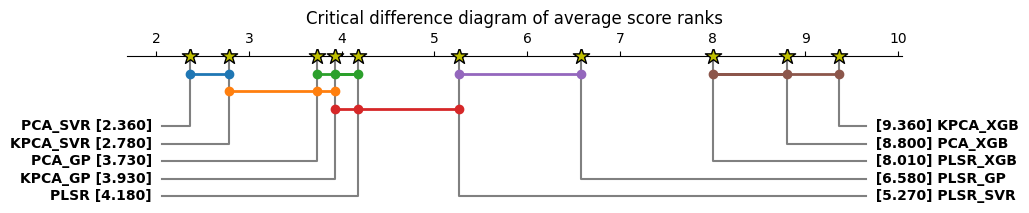
- Batch learning methods (e.g., PLSR, SVR) perform well in homogeneous settings but struggle in cold-start scenarios, where Just-In-Time Learning (JITL) and Online Learning (OL) show superior adaptability with statistically significant improvements (p<0.05 in Friedman tests).
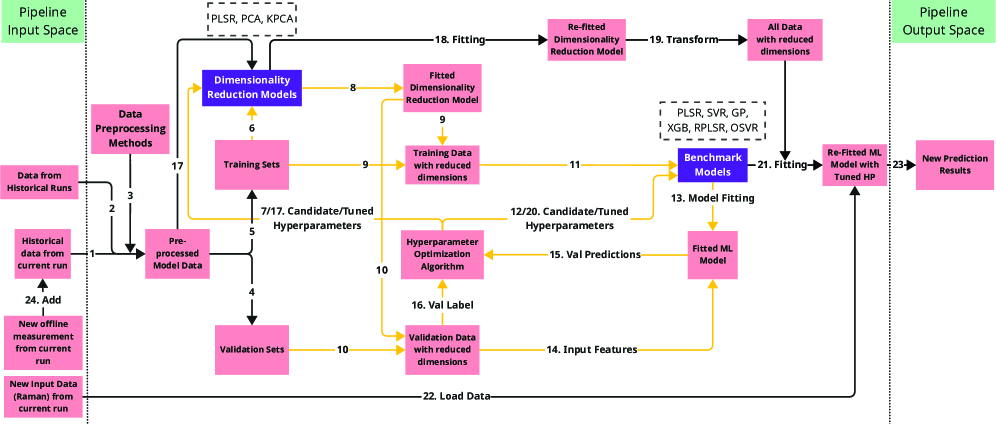
- Dimensionality Reduction is critical for handling high-dimensional Raman data (3,325 features vs. <30 samples), with supervised methods like PLSR outperforming unsupervised PCA when offline measurements are available.
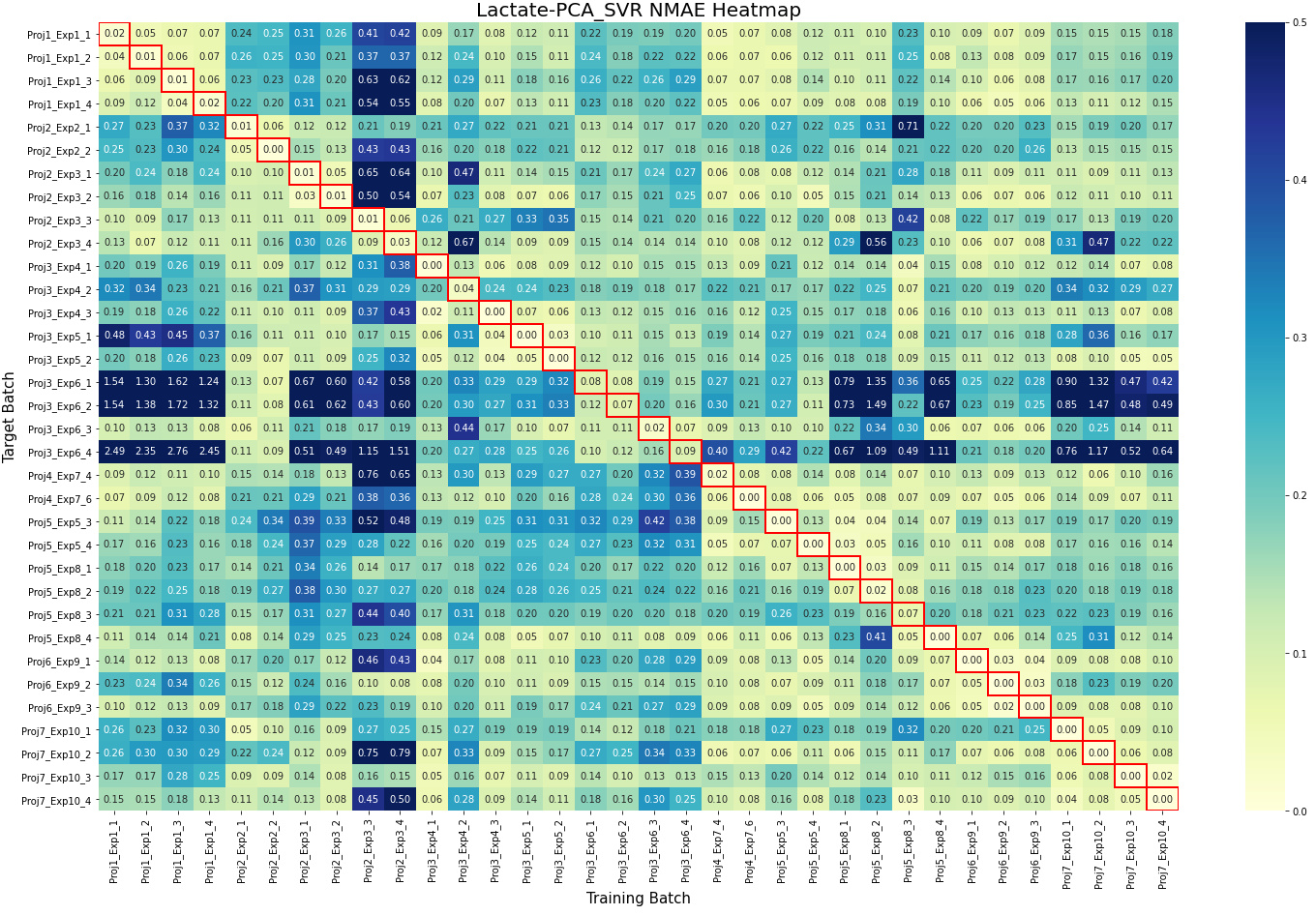
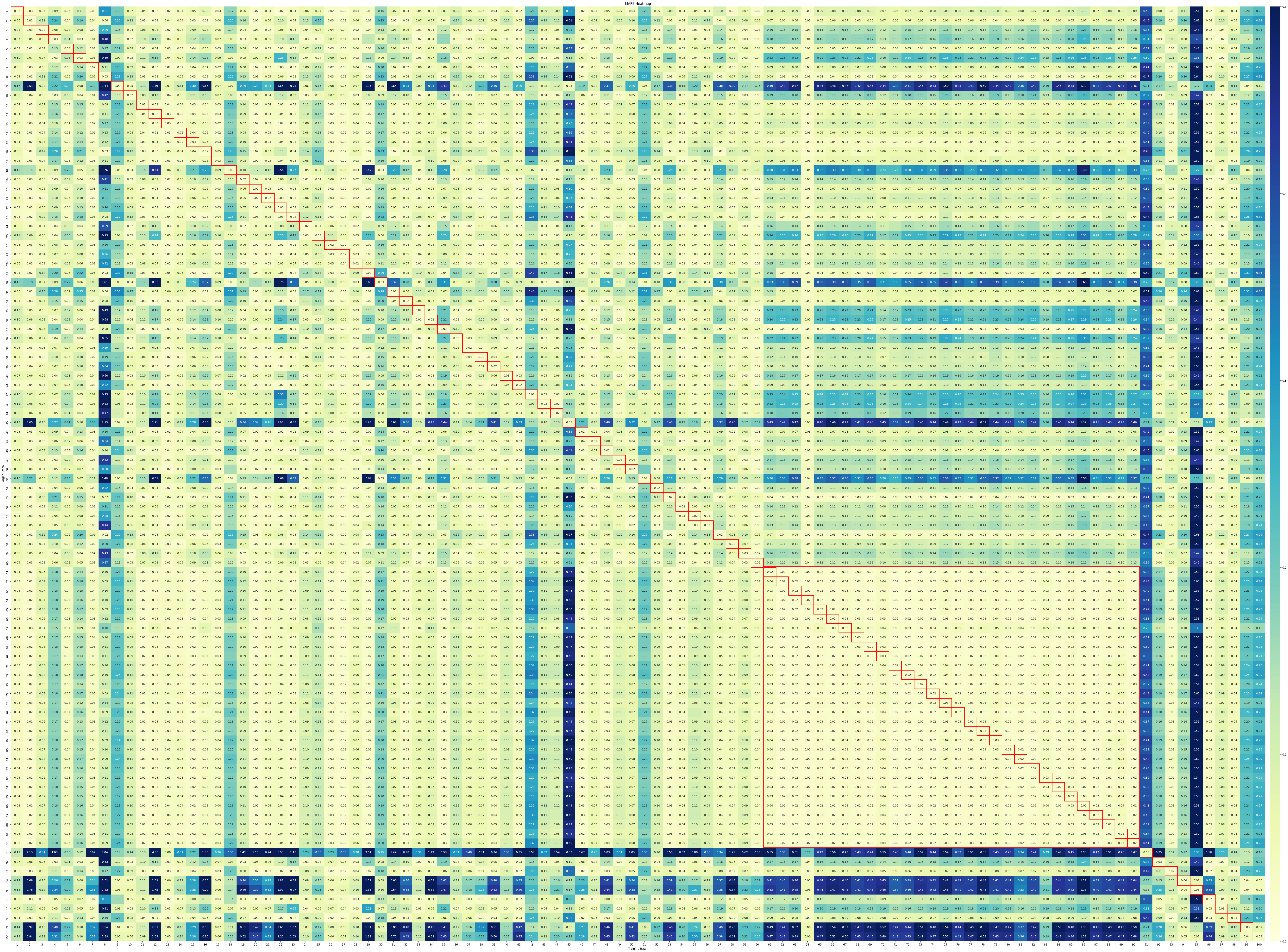
- Model transferability depends heavily on process meta-features; feed media composition explains up to 40% of performance variance across runs, highlighting the need for context-aware training strategies.
摘要: In cell culture bioprocessing, real-time batch process monitoring (BPM) refers to the continuous tracking and analysis of key process variables—such as viable cell density, nutrient levels, metabolite concentrations, and product titer—throughout the duration of a batch run. This enables early detection of deviations and supports timely control actions to ensure optimal cell growth and product quality. BPM plays a critical role in ensuring the quality and regulatory compliance of biopharmaceutical manufacturing processes. However, the development of accurate soft sensors for BPM is hindered by key challenges, including limited historical data, infrequent feedback, heterogeneous process conditions, and high-dimensional sensory inputs. This study presents a comprehensive benchmarking analysis of machine learning (ML) methods designed to address these challenges, with a focus on learning from historical data with limited volume and relevance in the context of bioprocess monitoring. We evaluate multiple ML approaches—including feature dimensionality reduction, online learning, and just-in-time learning—across three datasets, one in silico dataset and two real-world experimental datasets. Our findings highlight the importance of training strategies in handling limited data and feedback, with batch learning proving effective in homogeneous settings, while just-in-time learning and online learning demonstrate superior adaptability in cold-start scenarios. Additionally, we identify key meta-features, such as feed media composition and process control strategies, that significantly impact model transferability. The results also suggest that integrating Raman-based predictions with lagged offline measurements enhances monitoring accuracy, offering a promising direction for future bioprocess soft sensor development.