
Paper List
-
Ill-Conditioning in Dictionary-Based Dynamic-Equation Learning: A Systems Biology Case Study
This paper addresses the critical challenge of numerical ill-conditioning and multicollinearity in library-based sparse regression methods (e.g., SIND...
-
Hybrid eTFCE–GRF: Exact Cluster-Size Retrieval with Analytical pp-Values for Voxel-Based Morphometry
This paper addresses the computational bottleneck in voxel-based neuroimaging analysis by providing a method that delivers exact cluster-size retrieva...
-
abx_amr_simulator: A simulation environment for antibiotic prescribing policy optimization under antimicrobial resistance
This paper addresses the critical challenge of quantitatively evaluating antibiotic prescribing policies under realistic uncertainty and partial obser...
-
PesTwin: a biology-informed Digital Twin for enabling precision farming
This paper addresses the critical bottleneck in precision agriculture: the inability to accurately forecast pest outbreaks in real-time, leading to su...
-
Equivariant Asynchronous Diffusion: An Adaptive Denoising Schedule for Accelerated Molecular Conformation Generation
This paper addresses the core challenge of generating physically plausible 3D molecular structures by bridging the gap between autoregressive methods ...
-
Omics Data Discovery Agents
This paper addresses the core challenge of making published omics data computationally reusable by automating the extraction, quantification, and inte...
-
Single-cell directional sensing at ultra-low chemoattractant concentrations from extreme first-passage events
This work addresses the core challenge of how a cell can rapidly and accurately determine the direction of a chemoattractant source when the signal is...
-
SDSR: A Spectral Divide-and-Conquer Approach for Species Tree Reconstruction
This paper addresses the computational bottleneck in reconstructing species trees from thousands of species and multiple genes by introducing a scalab...
Assessment of Simulation-based Inference Methods for Stochastic Compartmental Models
Bonn Center for Mathematical Life Sciences, University of Bonn | Life and Medical Science Institute, University of Bonn | Institute of Software Technology, German Aerospace Center (DLR)
30秒速读
IN SHORT: This paper addresses the core challenge of performing accurate Bayesian parameter inference for stochastic epidemic models when the likelihood function is intractable, a common bottleneck for real-time forecasting.
核心创新
- Methodology Provides the first comprehensive, praxis-driven comparison between Particle Filters (PF) and Conditional Normalizing Flows (CNF) for inference on stochastic compartmental models, benchmarking their performance head-to-head.
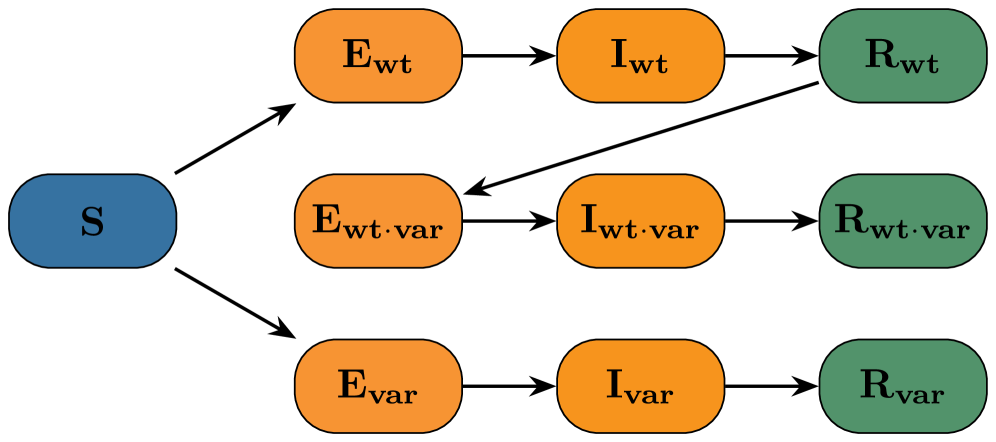
- Methodology Demonstrates the application and robustness of these likelihood-free methods on a complex, non-identifiable two-variant SEIR model with real-world data from an Ethiopian COVID-19 cohort, including scenarios with irregular sampling and missing data.
- Theory Shows that parameter space reparameterization (e.g., using R0, e0, s0) can mitigate ill-conditioning in complex models, improving posterior alignment between PF and CNF methods.
主要结论
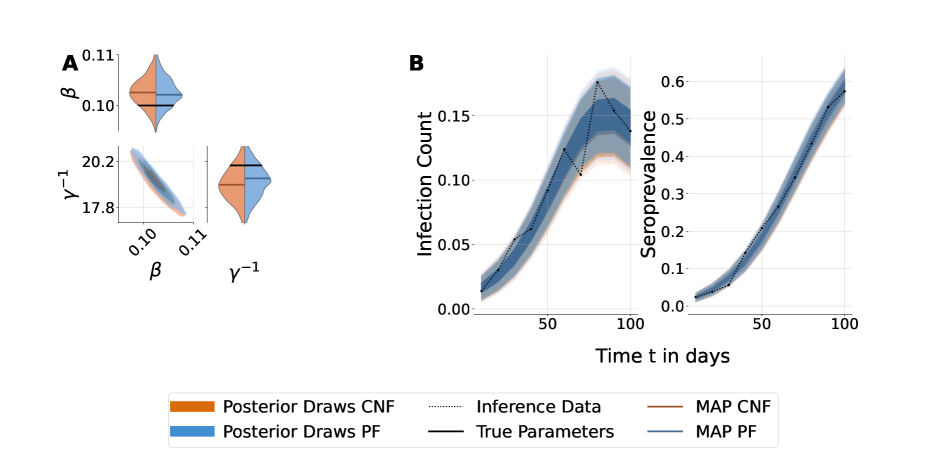
- Both PF and CNF provided robust and reliable inference on the stochastic SIR model with synthetic data, validating the implementation framework.
- For the complex two-variant SEIR model, both methods yielded good fits to synthetic data, but ill-conditioning led to differences in marginal posterior shapes; reparameterization with dimension reduction improved posterior alignment.
- Application to real Ethiopian cohort data demonstrated the operational robustness of both PF and CNF under conditions of real-world noise and irregular data sampling, proving their practical utility.
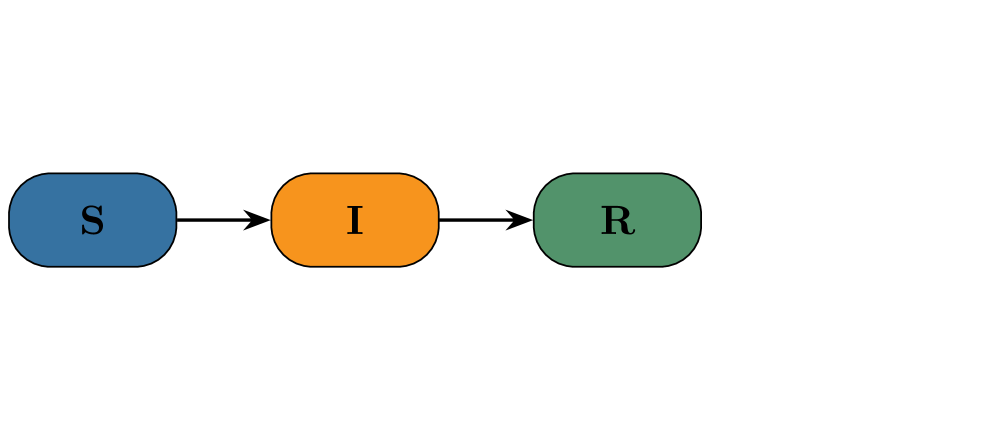
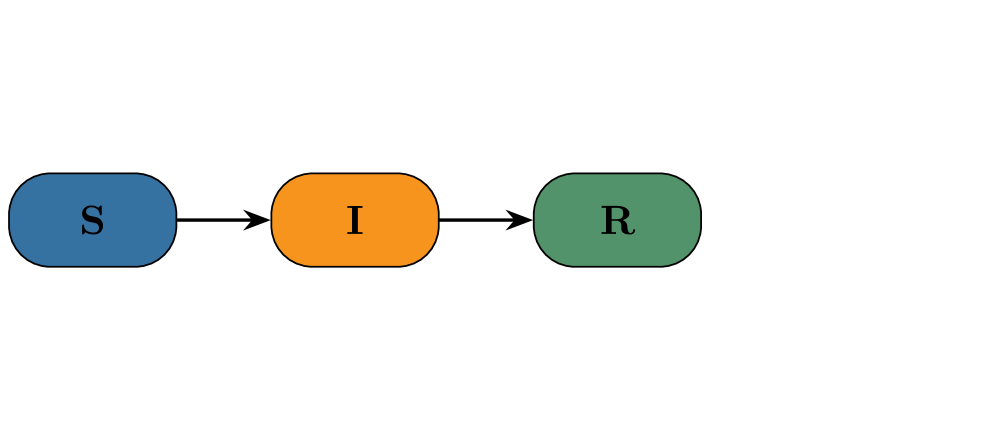
摘要: Global pandemics, such as the recent COVID-19 crisis, highlight the need for stochastic epidemic models that can capture the randomness inherent in the spread of disease. Such models must be accompanied by methods for estimating parameters in order to generate fast nowcasts and short-term forecasts that can inform public health decisions. This paper presents a comparison of two advanced Bayesian inference methods: 1) pseudo-marginal particle Markov chain Monte Carlo, short Particle Filters (PF), and 2) Conditional Normalizing Flows (CNF). We investigate their performance on two commonly used compartmental models: a classical Susceptible-Infected-Recovered (SIR) model and a two-variant Susceptible-Exposed-Infected-Recovered (SEIR) model, complemented by an observation model that maps latent trajectories to empirical data. Addressing the challenges of intractable likelihoods for parameter inference in stochastic settings, our analysis highlights how these likelihood-free methods provide accurate and robust inference capabilities. The results of our simulation study further underscore the effectiveness of these approaches in capturing the stochastic dynamics of epidemics, providing prediction capabilities for the control of epidemic outbreaks. Results on an Ethiopian cohort study demonstrate operational robustness under real‑world noise and irregular data sampling. To facilitate reuse and to enable building pipelines that ultimately contribute to better informed decision making in public health, we make code and synthetic datasets publicly available.