
Paper List
-
Autonomous Agents Coordinating Distributed Discovery Through Emergent Artifact Exchange
This paper addresses the fundamental limitation of current AI-assisted scientific research by enabling truly autonomous, decentralized investigation w...
-
D-MEM: Dopamine-Gated Agentic Memory via Reward Prediction Error Routing
This paper addresses the fundamental scalability bottleneck in LLM agentic memory systems: the O(N²) computational complexity and unbounded API token ...
-
Countershading coloration in blue shark skin emerges from hierarchically organized and spatially tuned photonic architectures inside skin denticles
This paper solves the core problem of how blue sharks achieve their striking dorsoventral countershading camouflage, revealing that coloration origina...
-
Human-like Object Grouping in Self-supervised Vision Transformers
This paper addresses the core challenge of quantifying how well self-supervised vision models capture human-like object grouping in natural scenes, br...
-
Hierarchical pp-Adic Framework for Gene Regulatory Networks: Theory and Stability Analysis
This paper addresses the core challenge of mathematically capturing the inherent hierarchical organization and multi-scale stability of gene regulator...
-
Towards unified brain-to-text decoding across speech production and perception
This paper addresses the core challenge of developing a unified brain-to-text decoding framework that works across both speech production and percepti...
-
Dual-Laws Model for a theory of artificial consciousness
This paper addresses the core challenge of developing a comprehensive, testable theory of consciousness that bridges biological and artificial systems...
-
Pulse desynchronization of neural populations by targeting the centroid of the limit cycle in phase space
This work addresses the core challenge of determining optimal pulse timing and intensity for desynchronizing pathological neural oscillations when the...
Pharmacophore-based design by learning on voxel grids
AIDD, Genentech
30秒速读
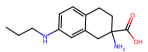
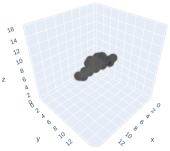
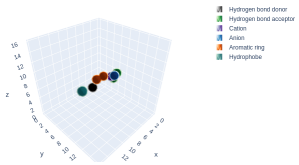
IN SHORT: This paper addresses the computational bottleneck and limited novelty in conventional pharmacophore-based virtual screening by introducing a voxel captioning method that generates novel molecules directly from 3D pharmacophore-shape profiles.
核心创新
- Methodology Proposes VoxCap, the first voxel captioning method for generating SMILES strings from voxelized 3D pharmacophore-shape profiles, bridging 3D structural information with 1D string generation.
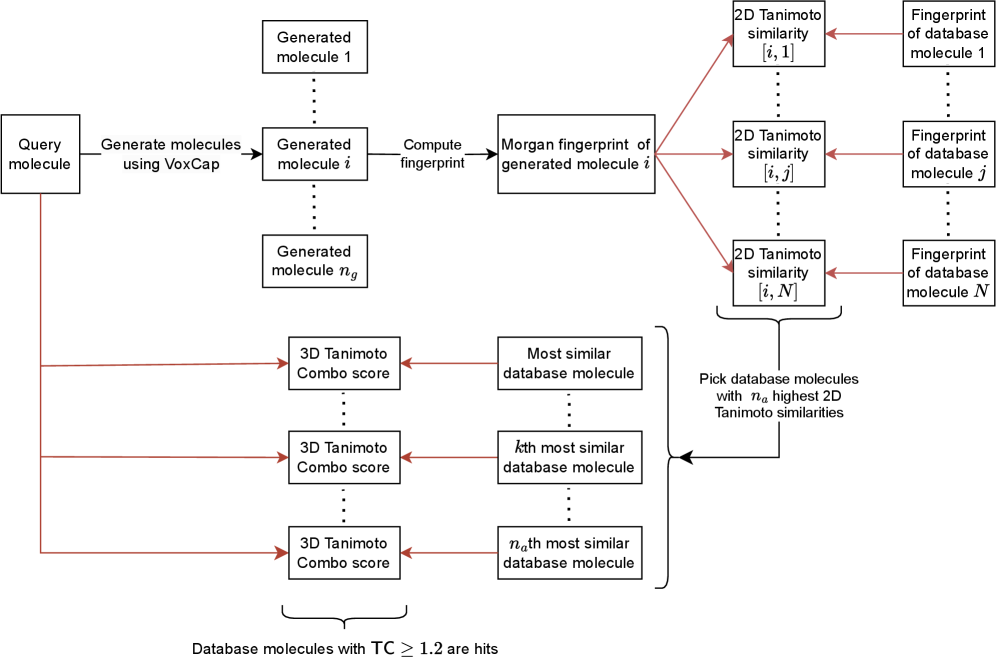
- Methodology Introduces a 'fast search' workflow that reduces computational complexity from O(database size) to O(n_g × n_a), enabling screening of billion-compound libraries previously considered intractable.
- Biology Demonstrates superior performance in generating diverse, novel scaffolds with high pharmacophore-shape similarity (Tanimoto Combo score ≥1.2), addressing both in-distribution and out-of-distribution query molecules.
主要结论
- VoxCap generates significantly more hits than baseline methods, with median hits per query increasing from 0 (baseline) to 116.5 on GEOM-drugs and from 0 to 115 on ChEMBL (p<0.001).
- The model produces diverse scaffolds, with median unique scaffold hits of 55.5 (GEOM-drugs) and 72 (ChEMBL), compared to 0 for baselines and 7-8.5 for PGMG.
- The fast search workflow reduces computational requirements by orders of magnitude while maintaining hit rates, enabling practical screening of billion-compound libraries like Enamine Real (60B compounds).
摘要: Ligand-based drug discovery (LBDD) relies on making use of known binders to a protein target to find structurally diverse molecules similarly likely to bind. This process typically involves a brute force search of the known binder (query) against a molecular library using some metric of molecular similarity. One popular approach overlays the pharmacophore-shape profile of the known binder to 3D conformations enumerated for each of the library molecules, computes overlaps, and picks a set of diverse library molecules with high overlaps. While this virtual screening workflow has had considerable success in hit diversification, scaffold hopping, and patent busting, it scales poorly with library sizes and restricts candidate generation to existing library compounds. Leveraging recent advances in voxel-based generative modelling, we propose a pharmacophore-based generative model and workflows that address the scaling and fecundity issues of conventional pharmacophore-based virtual screening. We introduce VoxCap, a voxel captioning method for generating SMILES strings from voxelised molecular representations.We propose two workflows as practical use cases as well as benchmarks for pharmacophore-based generation: de-novo design, in which we aim to generate new molecules with high pharmacophore-shape similarities to query molecules, and fast search, which aims to combine generative design with a cheap 2D substructure similarity search for efficient hit identification. Our results show that VoxCap significantly outperforms previous methods in generating diverse de-novo hits. When combined with our fast search workflow, VoxCap reduces computational time by orders of magnitude while returning hits for all query molecules, enabling the search of large libraries that are intractable to search by brute force.