
Paper List
-
SpikGPT: A High-Accuracy and Interpretable Spiking Attention Framework for Single-Cell Annotation
This paper addresses the core challenge of robust single-cell annotation across heterogeneous datasets with batch effects and the critical need to ide...
-
Unlocking hidden biomolecular conformational landscapes in diffusion models at inference time
This paper addresses the core challenge of efficiently and accurately sampling the conformational landscape of biomolecules from diffusion-based struc...
-
Personalized optimization of pediatric HD-tDCS for dose consistency and target engagement
This paper addresses the critical limitation of one-size-fits-all HD-tDCS protocols in pediatric populations by developing a personalized optimization...
-
Realistic Transition Paths for Large Biomolecular Systems: A Langevin Bridge Approach
This paper addresses the core challenge of generating physically realistic and computationally efficient transition paths between distinct protein con...
-
Consistent Synthetic Sequences Unlock Structural Diversity in Fully Atomistic De Novo Protein Design
This paper addresses the core pain point of low sequence-structure alignment in existing synthetic datasets (e.g., AFDB), which severely limits the pe...
-
MoRSAIK: Sequence Motif Reactor Simulation, Analysis and Inference Kit in Python
This work addresses the computational bottleneck in simulating prebiotic RNA reactor dynamics by developing a Python package that tracks sequence moti...
-
On the Approximation of Phylogenetic Distance Functions by Artificial Neural Networks
This paper addresses the core challenge of developing computationally efficient and scalable neural network architectures that can learn accurate phyl...
-
EcoCast: A Spatio-Temporal Model for Continual Biodiversity and Climate Risk Forecasting
This paper addresses the critical bottleneck in conservation: the lack of timely, high-resolution, near-term forecasts of species distribution shifts ...
ANNE Apnea Paper
University of Toronto Department of Medicine, Computer Science | Sunnybrook Research Institute Department of Medicine Neurology Div.
30秒速读
IN SHORT: This paper addresses the core challenge of achieving accurate, event-level sleep apnea detection and characterization using a non-intrusive, multimodal wearable device, moving beyond simple recording-level AHI prediction.
核心创新
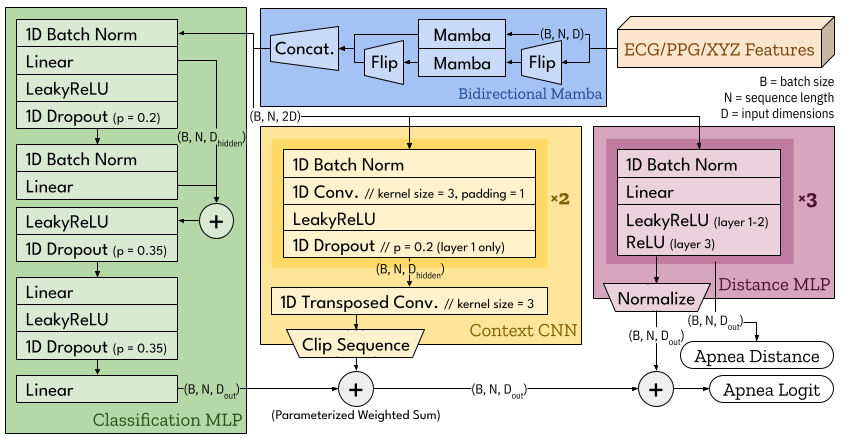
- Methodology Proposes a novel Mamba-based deep sequential neural network architecture, integrating a classification MLP, a context CNN for local patterns, and a distance MLP for event localization, inspired by YOLO for multi-task learning.
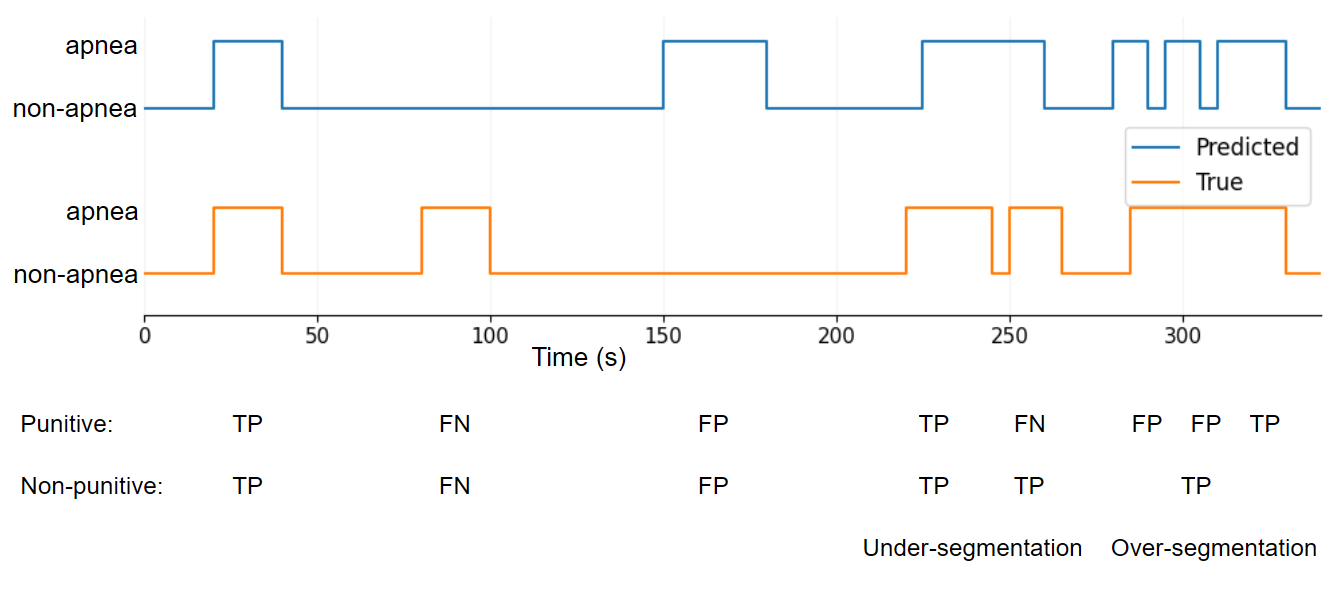
- Methodology Introduces a comprehensive event-wise evaluation framework for apnea detection models, moving beyond traditional segment-wise metrics to quantify true positives, false positives, and false negatives based on event overlap (IoU).
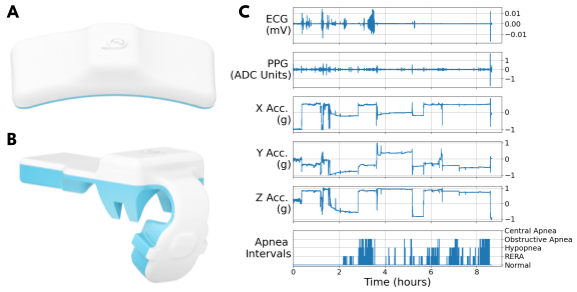
- Biology/Application Demonstrates the application of the Mamba architecture on a rich, multimodal dataset from the ANNE One wearable (ECG, accelerometry, temperature, PPG) from an older, clinically diverse cohort (mean age 56), testing robustness in realistic, noisy conditions.
主要结论
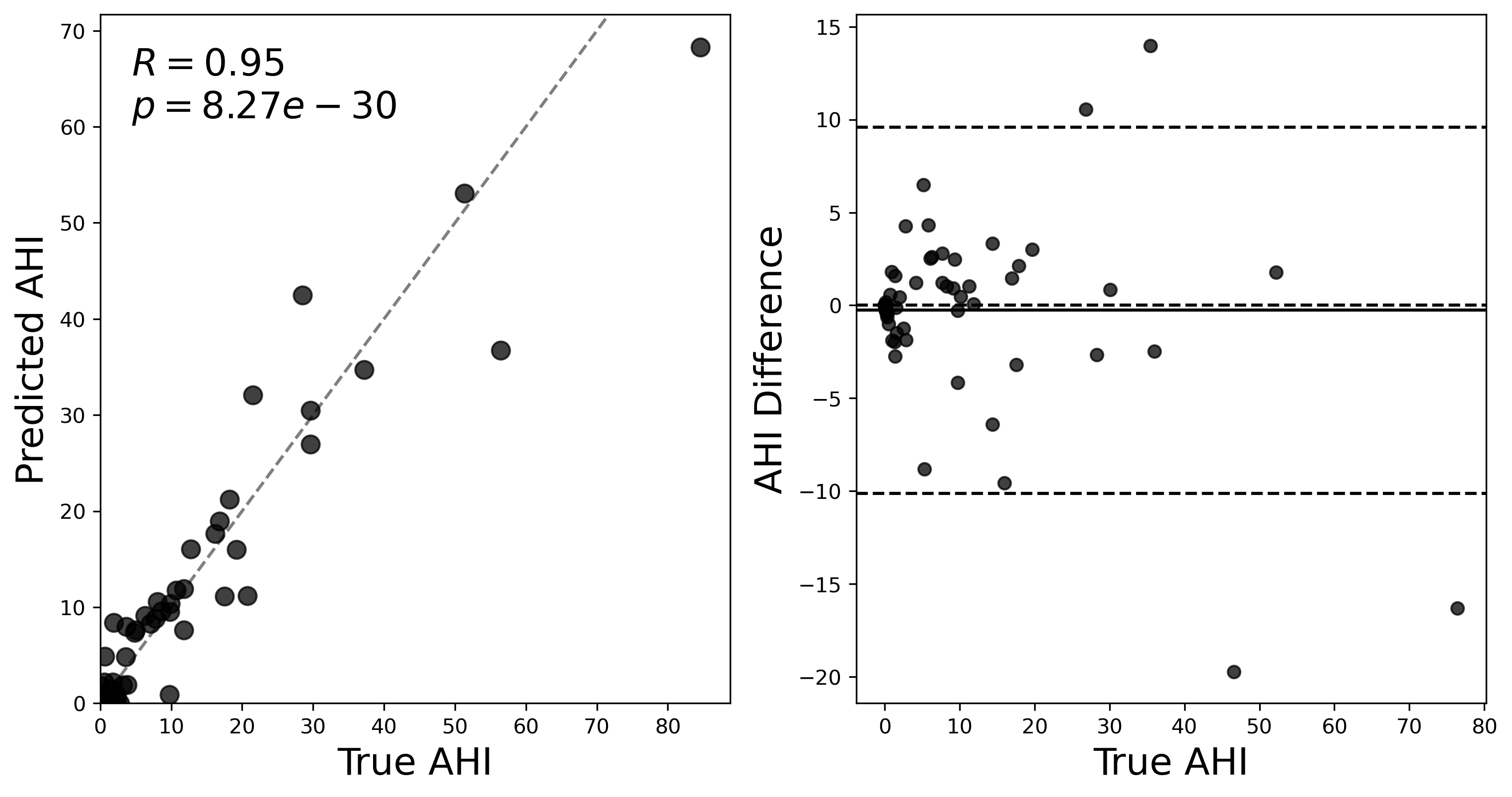
- The model-predicted AHI showed a very high correlation with PSG-derived AHI (R=0.95, p=8.3e-30) with a mean absolute error of 2.83 events/hour.
- At the 30-second epoch level, the model achieved high sensitivity (0.93) and specificity (0.95) for detecting epochs containing any respiratory event.
- The model demonstrated capability in event-type characterization, correctly classifying 77% of central apneas and 95% of other respiratory events (RERA/Hypopnea/Obstructive).
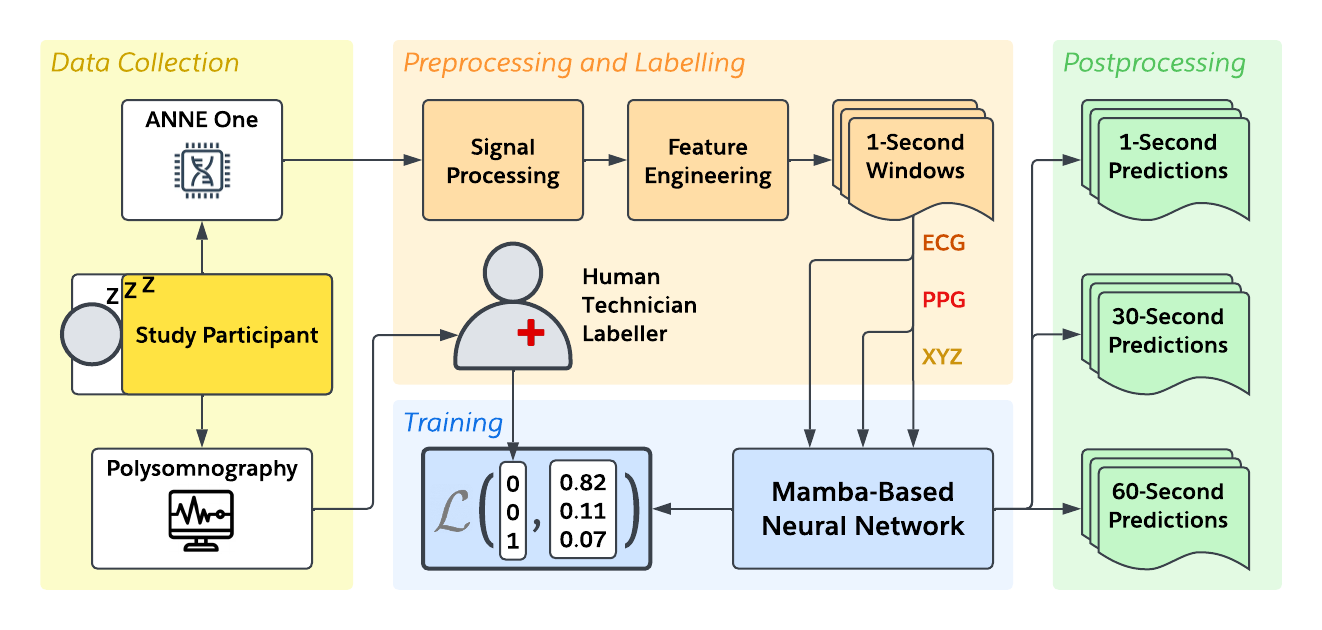
摘要: Objectives: In-laboratory polysomnography (PSG) is the reference standard for the diagnosis of sleep disordered breathing, and characterization of disease physiology along multiple dimensions. However, it is labour intensive, poorly scalable, and can perturb sleep. Numerous devices for home sleep apnea testing (HSAT), along with tools for automated analysis, have been developed to address these limitations. Although several such tools have shown good performance at establishing a diagnosis of SDB at the recording level, most have uncertain performance at the individual event level, including differentiation of event type (e.g. central vs. obstructive apneas), and determination of precise event timing. Moreover, while disruption of sleep architecture is a key feature of sleep disordered breathing, not all HSAT devices are able to return epoch-by-epoch sleep staging. Here we present and evaluate a deep-learning model for diagnosis and event-level characterization of sleep disordered breathing based on signals from the ANNE One, a non-intrusive dual-module wireless wearable system measuring chest electrocardiography, triaxial accelerometry, chest and finger temperature, and finger phototplethysmography. Methods: We obtained concurrent PSG and wearable sensor recordings from 384 adults attending a tertiary care sleep laboratory. Respiratory events in the PSG were manually annotated in accordance with AASM guidelines. Wearable sensor and PSG recordings were automatically aligned based on the ECG signal, alignment confirmed by visual inspection, and PSG-derived respiratory event labels were used to train and evaluate a deep sequential neural network based on the Mamba architecture. Results: In 57 recordings in our test set (mean age 56, mean AHI 10.8, 43.86% female) the model-predicted AHI was highly correlated with that derived form the PSG labels (R=0.95, p=8.3e-30, men absolute error 2.83). This performance did not vary with age or sex. At a threshold of AHI >5, the model had a sensitivity of 0.96, specificity of 0.87, and kappa of 0.82, and at a threshold of AHI >15, the model had a sensitivity of 0.86, specificity of 0.98, and kappa of 0.85. At the level of 30-sec epochs, the model had a sensitivity of 0.93 and specificity of 0.95, with a kappa of 0.68 regarding whether any given epoch contained a respiratory event. Among 3,555 detected respiratory events, and contrasting central apneas from other events, the model correctly classified 77% of central apneas and 95% of RERA/Hyp/Obs. Moreover, model predicted mean respiratory event duration was moderately correlated with PSG-derived event duration (R=0.53, p=4.9e-3). Conclusions: Applied to data from the ANNE One, a wireless wearable sensor system without sensors on the face or the head, a Mamba-based deep learning model can accurately predict AHI and identify SDB at clinically relevant thresholds, achieves good epoch- and event-level identification of individual respiratory events, and shows promise at physiological characterization of these events including event type (central vs. other) and event duration.