
Paper List
-
Autonomous Agents Coordinating Distributed Discovery Through Emergent Artifact Exchange
This paper addresses the fundamental limitation of current AI-assisted scientific research by enabling truly autonomous, decentralized investigation w...
-
D-MEM: Dopamine-Gated Agentic Memory via Reward Prediction Error Routing
This paper addresses the fundamental scalability bottleneck in LLM agentic memory systems: the O(N²) computational complexity and unbounded API token ...
-
Countershading coloration in blue shark skin emerges from hierarchically organized and spatially tuned photonic architectures inside skin denticles
This paper solves the core problem of how blue sharks achieve their striking dorsoventral countershading camouflage, revealing that coloration origina...
-
Human-like Object Grouping in Self-supervised Vision Transformers
This paper addresses the core challenge of quantifying how well self-supervised vision models capture human-like object grouping in natural scenes, br...
-
Hierarchical pp-Adic Framework for Gene Regulatory Networks: Theory and Stability Analysis
This paper addresses the core challenge of mathematically capturing the inherent hierarchical organization and multi-scale stability of gene regulator...
-
Towards unified brain-to-text decoding across speech production and perception
This paper addresses the core challenge of developing a unified brain-to-text decoding framework that works across both speech production and percepti...
-
Dual-Laws Model for a theory of artificial consciousness
This paper addresses the core challenge of developing a comprehensive, testable theory of consciousness that bridges biological and artificial systems...
-
Pulse desynchronization of neural populations by targeting the centroid of the limit cycle in phase space
This work addresses the core challenge of determining optimal pulse timing and intensity for desynchronizing pathological neural oscillations when the...
Generating a Contact Matrix for Aged Care Settings in Australia: an agent-based model study
University of New South Wales
30秒速读
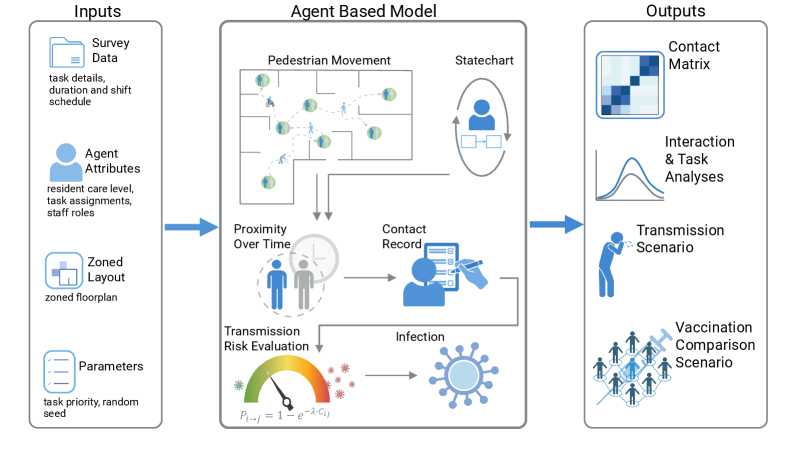
IN SHORT: This study addresses the critical gap in understanding heterogeneous contact patterns within aged care facilities, where existing population-level contact matrices fail to capture the nuanced interactions that drive infection transmission in these high-risk environments.
核心创新
- Methodology Developed a transferable agent-based modeling framework specifically for aged care settings, parameterized with empirical survey data from 21 aged care workers to capture realistic staff-resident interaction patterns.
- Methodology Integrated proximity-based contact definitions (1.5m and 3m thresholds with 3-second duration) with temporal analysis to identify high-risk contact clustering during structured daily routines like communal activities and care tasks.
- Biology Demonstrated that medium care residents experience the highest infection risk despite not having the highest contact frequency, revealing non-linear relationships between contact patterns and transmission outcomes.
主要结论
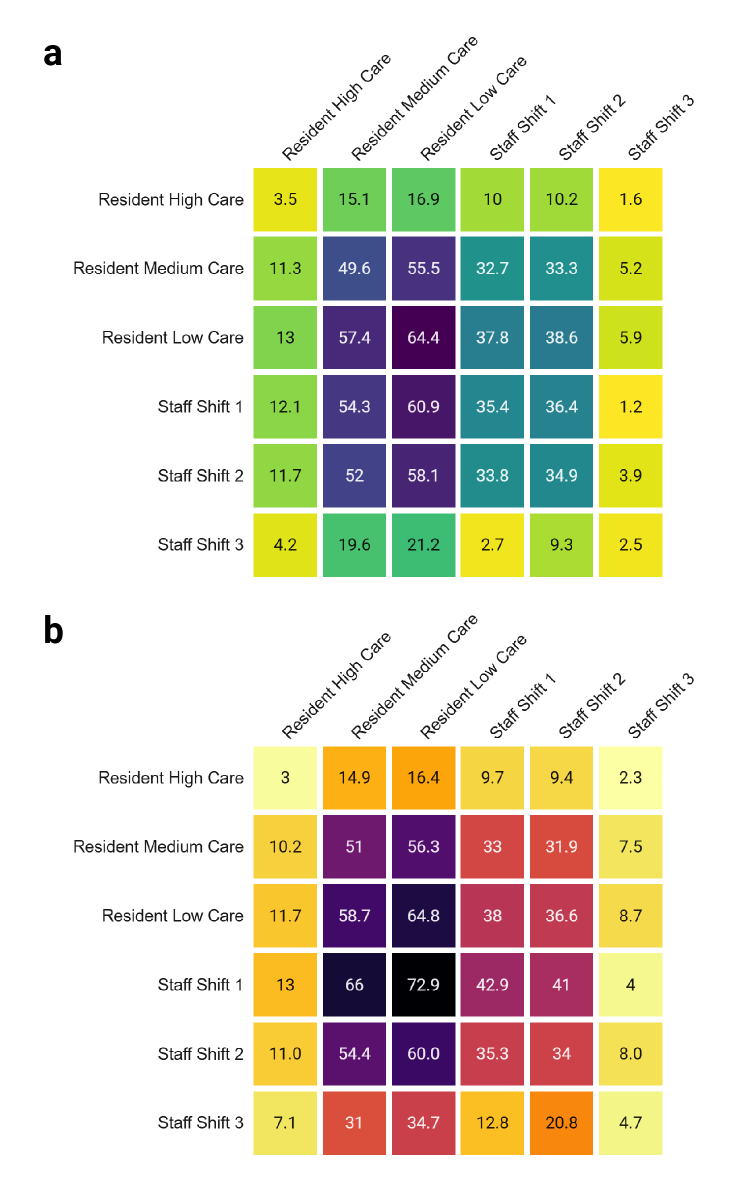
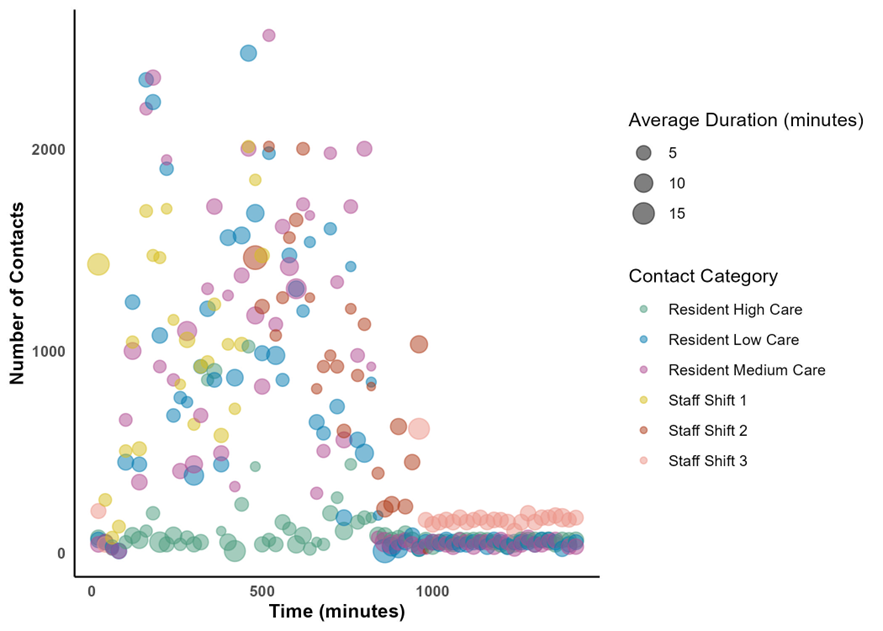
- Low and medium care residents had the highest contact frequencies (particularly with morning/afternoon shift staff), while high care residents and night staff had substantially fewer contacts, with Poisson regression confirming significant variation by care level and shift (p<0.001).
- Vaccination scenarios reduced predicted transmission by up to 68%, with maximum impact achieved when both staff and residents were vaccinated, demonstrating the multiplicative protective effect of comprehensive vaccination coverage.
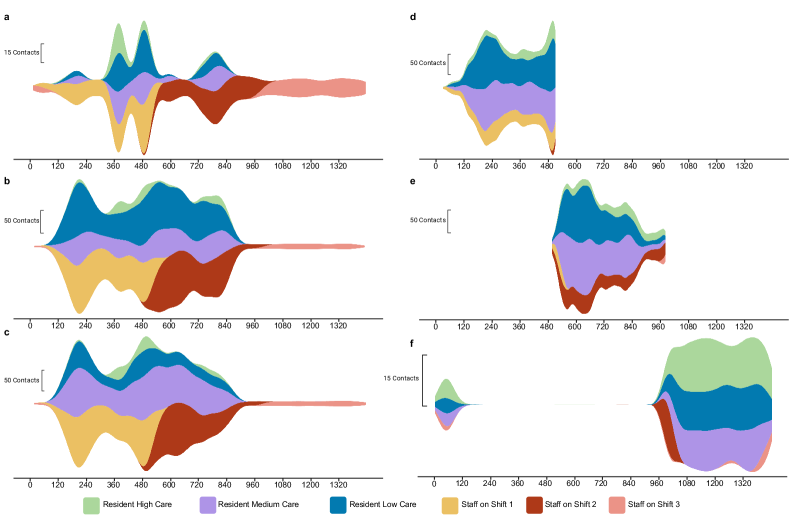
- Temporal analysis revealed clustering of high-risk contacts during structured daily routines, with infection risk highest during high-contact shifts and among medium care residents, highlighting the importance of timing in intervention strategies.
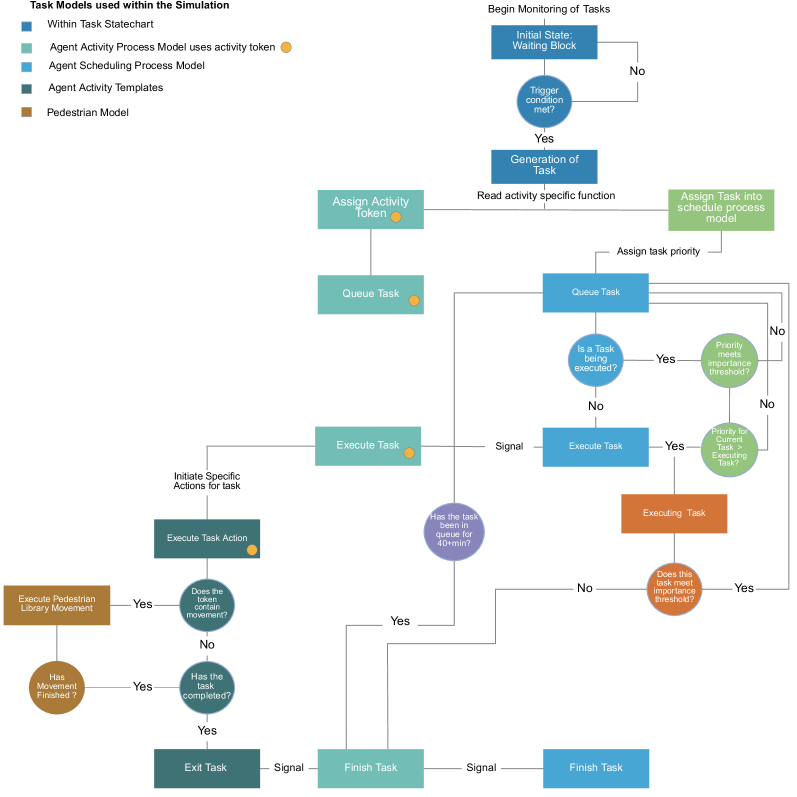
摘要: This study presents an agent-based model (ABM) developed to simulate staff and resident interactions within a synthetic aged care facility, capturing movement, task execution, and proximity-based contact events across three staff shifts and varying levels of resident care. Contacts were defined by spatial thresholds (1.5 m and 3 m) and cumulative duration, enabling the generation of detailed contact matrices. Simulation results showed that low and medium care residents experienced the highest frequency of interactions, particularly with staff on morning and afternoon shifts, while high care residents and night staff had substantially fewer contacts. Contact rates varied significantly by care level and shift, confirmed through Poisson-based regression modelling. Temporal analyses revealed clustering of high-risk contacts during structured daily routines, especially communal and care activities. An integrated airborne transmission module, seeded with a single infectious staff member, demonstrated that infection risk was highest during high-contact shifts and among medium care residents. Vaccination scenarios reduced predicted transmission by up to 68%, with the greatest impact observed when both staff and residents were vaccinated. These findings highlight the importance of accounting for contact heterogeneity in aged care and demonstrate the utility of ABMs for evaluating targeted infection control strategies in high-risk, enclosed environments.