
Paper List
-
Autonomous Agents Coordinating Distributed Discovery Through Emergent Artifact Exchange
This paper addresses the fundamental limitation of current AI-assisted scientific research by enabling truly autonomous, decentralized investigation w...
-
D-MEM: Dopamine-Gated Agentic Memory via Reward Prediction Error Routing
This paper addresses the fundamental scalability bottleneck in LLM agentic memory systems: the O(N²) computational complexity and unbounded API token ...
-
Countershading coloration in blue shark skin emerges from hierarchically organized and spatially tuned photonic architectures inside skin denticles
This paper solves the core problem of how blue sharks achieve their striking dorsoventral countershading camouflage, revealing that coloration origina...
-
Human-like Object Grouping in Self-supervised Vision Transformers
This paper addresses the core challenge of quantifying how well self-supervised vision models capture human-like object grouping in natural scenes, br...
-
Hierarchical pp-Adic Framework for Gene Regulatory Networks: Theory and Stability Analysis
This paper addresses the core challenge of mathematically capturing the inherent hierarchical organization and multi-scale stability of gene regulator...
-
Towards unified brain-to-text decoding across speech production and perception
This paper addresses the core challenge of developing a unified brain-to-text decoding framework that works across both speech production and percepti...
-
Dual-Laws Model for a theory of artificial consciousness
This paper addresses the core challenge of developing a comprehensive, testable theory of consciousness that bridges biological and artificial systems...
-
Pulse desynchronization of neural populations by targeting the centroid of the limit cycle in phase space
This work addresses the core challenge of determining optimal pulse timing and intensity for desynchronizing pathological neural oscillations when the...
Generative design and validation of therapeutic peptides for glioblastoma based on a potential target ATP5A
Shanghai Jiao Tong University | QuietD Biotech
30秒速读
IN SHORT: This paper addresses the critical bottleneck in therapeutic peptide design: how to efficiently optimize lead peptides with geometric constraints while bridging the gap between computational generation and experimental validation.
核心创新
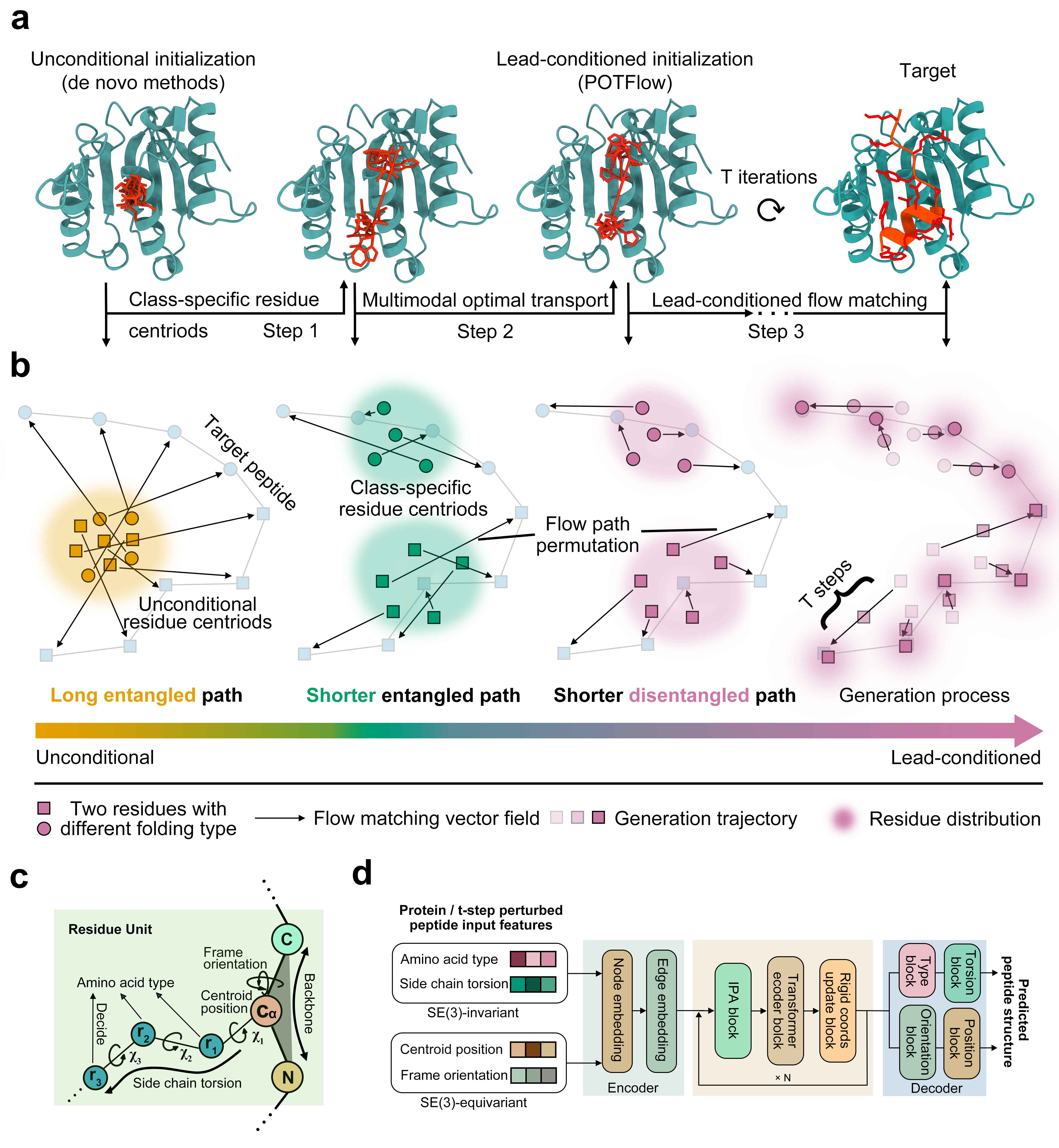
- Methodology Introduces POTFlow, the first lead peptide-conditioned flow matching model that incorporates secondary structure priors and optimal transport for shorter, disentangled generation paths
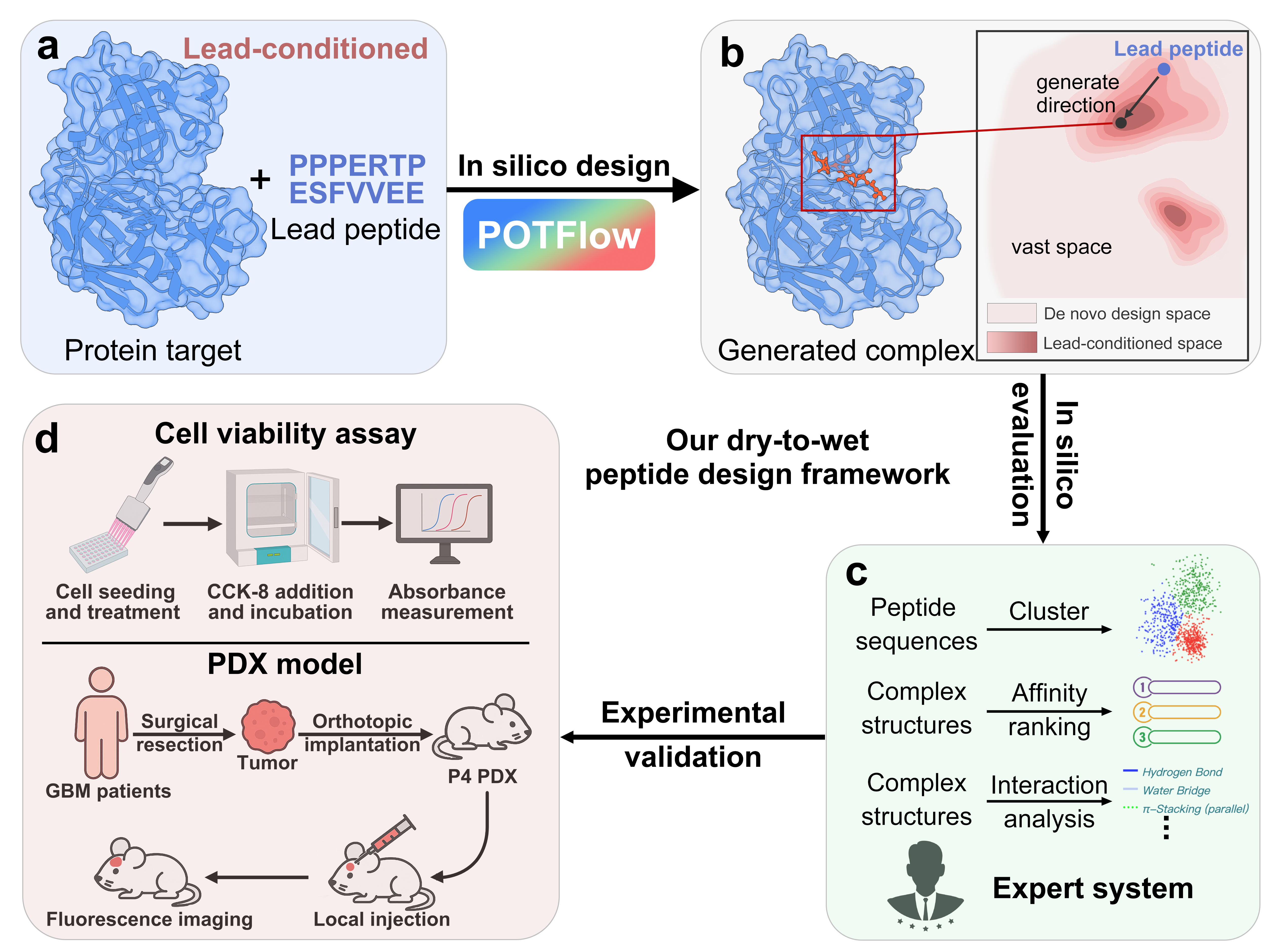
- Methodology Proposes a dry-to-wet framework that integrates computational design with experimental validation spanning in vitro assays and in vivo PDX models
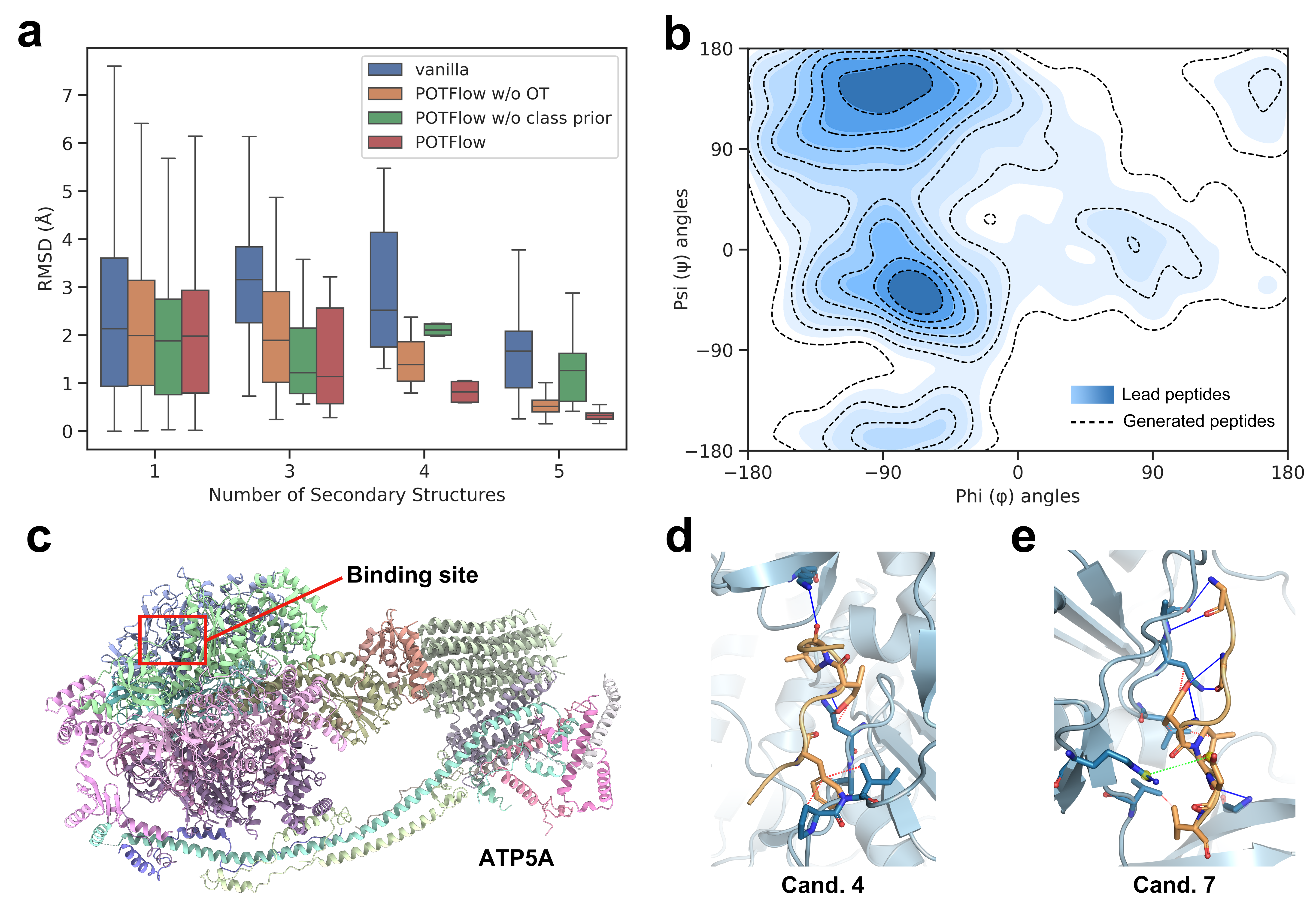
- Biology Demonstrates successful optimization of ATP5A-binding peptides for glioblastoma, achieving improved tumor selectivity and in vivo efficacy
主要结论
- POTFlow outperforms five state-of-the-art methods across multiple metrics, achieving 53.44% similarity, 95.07% compactness, 30.56% affinity, and 1.66Å RMSD on benchmark datasets

- Generated peptide candidates showed 18-68% higher inhibition of viability rate (IVR) in GBM cells compared to non-cancerous cells (<10%), demonstrating improved tumor selectivity
- High-dose candidate 4 (20mg/kg) significantly prolonged survival in PDX models (p-value = 0.02) with 40% of mice surviving beyond week 18 compared to 0% in control group
摘要: Glioblastoma (GBM) remains the most aggressive tumor, urgently requiring novel therapeutic strategies. Here, we present a dry-to-wet framework combining generative modeling and experimental validation to optimize peptides targeting ATP5A, a potential peptide-binding protein for GBM. Our framework introduces the first lead-conditioned generative model, which focuses exploration on geometrically relevant regions around lead peptides and mitigates the combinatorial complexity of de novo methods. Specifically, we propose POTFlow, a Prior and Optimal Transport-based Flow-matching model for peptide optimization. POTFlow employs secondary structure information (e.g., helix, sheet, loop) as geometric constraints, which are further refined by optimal transport to produce shorter flow paths. With this design, our method achieves state-of-the-art performance compared with five popular approaches. When applied to GBM, our method generates peptides that selectively inhibit cell viability and significantly prolong survival in a patient-derived xenograft (PDX) model. As the first lead peptide-conditioned flow matching model, POTFlow holds strong potential as a generalizable framework for therapeutic peptide design.