
Paper List
-
Macroscopic Dominance from Microscopic Extremes: Symmetry Breaking in Spatial Competition
This paper addresses the fundamental question of how microscopic stochastic advantages in spatial exploration translate into macroscopic resource domi...
-
Linear Readout of Neural Manifolds with Continuous Variables
This paper addresses the core challenge of quantifying how the geometric structure of high-dimensional neural population activity (neural manifolds) d...
-
Theory of Cell Body Lensing and Phototaxis Sign Reversal in “Eyeless” Mutants of Chlamydomonas
This paper solves the core puzzle of how eyeless mutants of Chlamydomonas exhibit reversed phototaxis by quantitatively modeling the competition betwe...
-
Cross-Species Transfer Learning for Electrophysiology-to-Transcriptomics Mapping in Cortical GABAergic Interneurons
This paper addresses the challenge of predicting transcriptomic identity from electrophysiological recordings in human cortical interneurons, where li...
-
Uncovering statistical structure in large-scale neural activity with Restricted Boltzmann Machines
This paper addresses the core challenge of modeling large-scale neural population activity (1500-2000 neurons) with interpretable higher-order interac...
-
Realizing Common Random Numbers: Event-Keyed Hashing for Causally Valid Stochastic Models
This paper addresses the critical problem that standard stateful PRNG implementations in agent-based models violate causal validity by making random d...
-
A Standardized Framework for Evaluating Gene Expression Generative Models
This paper addresses the critical lack of standardized evaluation protocols for single-cell gene expression generative models, where inconsistent metr...
-
Single Molecule Localization Microscopy Challenge: A Biologically Inspired Benchmark for Long-Sequence Modeling
This paper addresses the core challenge of evaluating state-space models on biologically realistic, sparse, and stochastic temporal processes, which a...
The Effective Reproduction Number in the Kermack-McKendrick model with age of infection and reinfection
School of Mathematical Sciences, Beijing Normal University, Beijing 100875, People’s Republic of China.
30秒速读
IN SHORT: This paper addresses the challenge of accurately estimating the time-varying effective reproduction number ℛ(t) in epidemics by incorporating two critical real-world complexities: the age of infection (time since infection) and the possibility of reinfection.
核心创新
- Methodology Introduces a novel extension of the classical Kermack-McKendrick SIRS model by formally incorporating both infection-age structure (a) and a reinfection term (δ), moving beyond constant transmission rate assumptions.
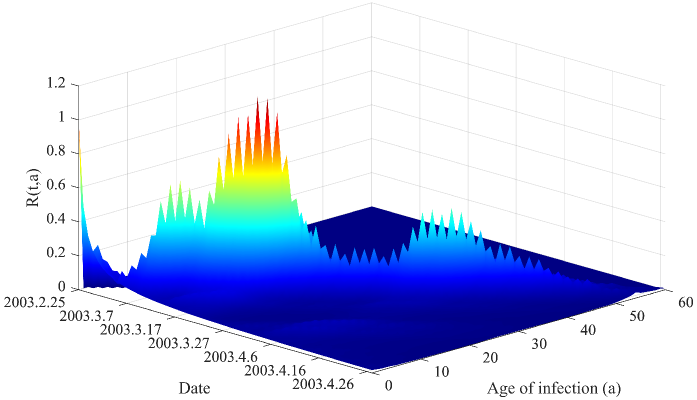
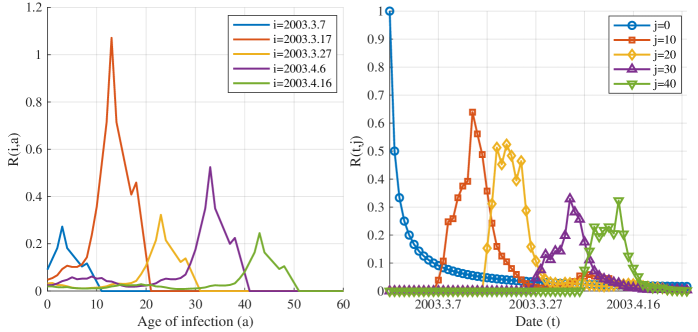
- Methodology Derives a rigorous mathematical framework using Volterra integral equations, the contraction mapping principle, and measure-valued solutions (e.g., Dirac mass for initial cohorts) to connect the flow of new infections N(t) to the reproductive power ℛ(t,a) and ultimately ℛ(t).
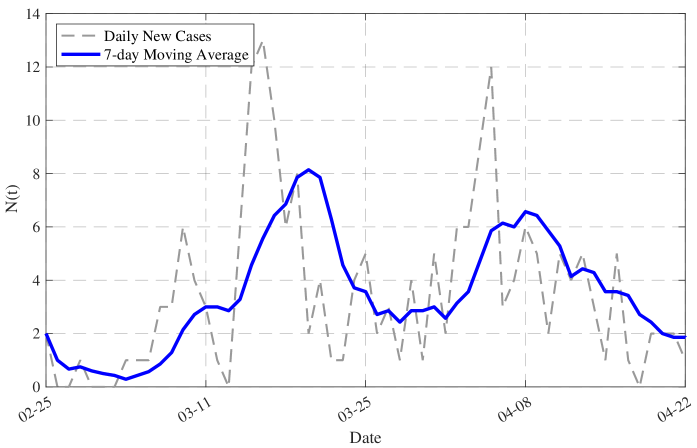
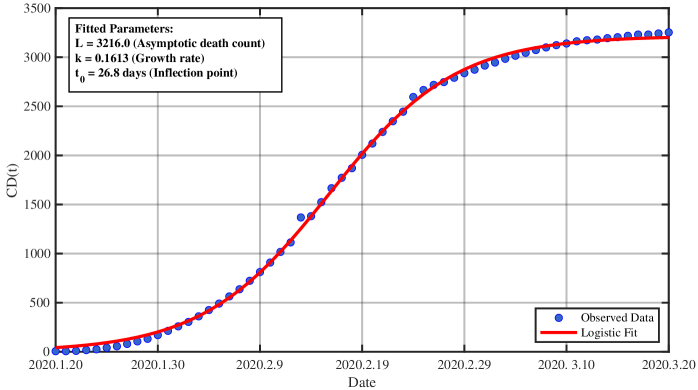
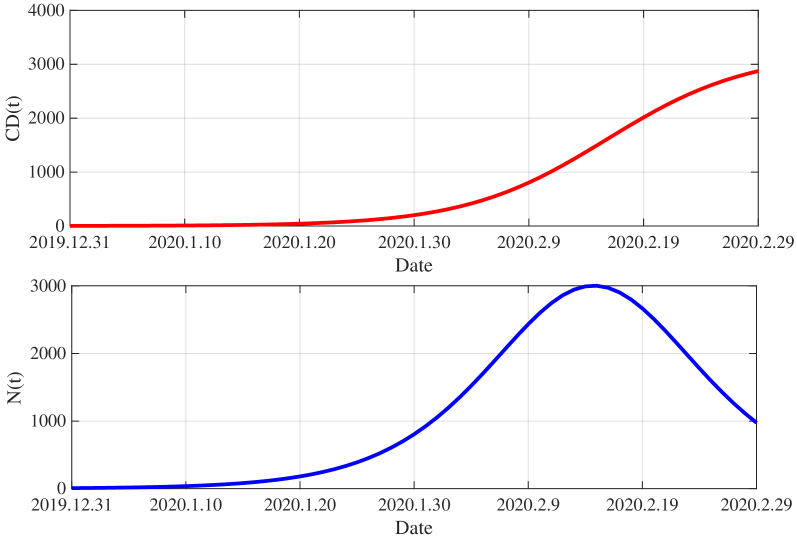
- Methodology/Biology Develops a practical parameter identification methodology that works with two common but challenging data types: 1) direct daily new case counts (applied to 2003 SARS in Singapore) and 2) cumulative death counts when new infection data is unreliable (applied to COVID-19 in China).
主要结论
- The model successfully formulates the infection dynamics as a nonlinear Volterra integral equation of the second kind for N(t) (Eq. 2.14), providing a solvable link between observable data and the underlying transmission parameters.
- Theoretical analysis justifies the use of a Dirac mass initial condition (representing a single cohort infected at time t0) via a limiting process of approximating functions i_κ(a), proving uniform convergence of the solution N_κ(t) to N(t) (Theorem 3.2).
- The derived framework enables the identification of the effective reproduction number ℛ(t) from epidemic curves, demonstrated through application to real-world SARS and COVID-19 datasets, bridging theoretical constructs with practical public health analytics.
摘要: This study introduces a novel epidemiological model that expands upon the Kermack-McKendrick model by incorporating the age of infection and reinfection. By including infection age, we can classify participants, which enables a more targeted analysis within the modeling framework. The reinfection term addresses the real-world occurrences of secondary or recurrent viral infections. In the theoretical part, we apply the contraction mapping principle, the dominated convergence theorem, and the properties of Volterra integral equations to derive analytical expressions for the number of newly infected individuals denoted by N(t). Then, we establish a Volterra integral equation for N(t) and study its initial conditions for both a single cohort and multiple cohorts. From this equation, we derive a method for identifying the effective reproduction number, denoted as ℛ(t). In the practical aspect, we present two distinct methods and separately apply them to analyze the daily new infection cases from the 2003 SARS outbreak in Singapore and the cumulative number of deaths from the COVID-19 epidemic in China. This work effectively bridges theoretical epidemiology and computational modeling, providing a robust framework for analyzing infection dynamics influenced by infection-age-structured transmission and reinfection mechanisms.