
Paper List
-
Evolutionarily Stable Stackelberg Equilibrium
通过要求追随者策略对突变入侵具有鲁棒性,弥合了斯塔克尔伯格领导力模型与演化稳定性之间的鸿沟。
-
Recovering Sparse Neural Connectivity from Partial Measurements: A Covariance-Based Approach with Granger-Causality Refinement
通过跨多个实验会话累积协方差统计,实现从部分记录到完整神经连接性的重建。
-
Atomic Trajectory Modeling with State Space Models for Biomolecular Dynamics
ATMOS通过提供一个基于SSM的高效框架,用于生物分子的原子级轨迹生成,弥合了计算昂贵的MD模拟与时间受限的深度生成模型之间的差距。
-
Slow evolution towards generalism in a model of variable dietary range
通过证明是种群统计噪声(而非确定性动力学)驱动了模式形成和泛化食性的演化,解决了间接竞争下物种形成的悖论。
-
Grounded Multimodal Retrieval-Augmented Drafting of Radiology Impressions Using Case-Based Similarity Search
通过将印象草稿基于检索到的历史病例,并采用明确引用和基于置信度的拒绝机制,解决放射学报告生成中的幻觉问题。
-
Unified Policy–Value Decomposition for Rapid Adaptation
通过双线性分解在策略和价值函数之间共享低维目标嵌入,实现对新颖任务的零样本适应。
-
Mathematical Modeling of Cancer–Bacterial Therapy: Analysis and Numerical Simulation via Physics-Informed Neural Networks
提供了一个严格的、无网格的PINN框架,用于模拟和分析细菌癌症疗法中复杂的、空间异质的相互作用。
-
Sample-Efficient Adaptation of Drug-Response Models to Patient Tumors under Strong Biological Domain Shift
通过从无标记分子谱中学习可迁移表征,利用最少的临床数据实现患者药物反应的有效预测。
MCP-AI: Protocol-Driven Intelligence Framework for Autonomous Reasoning in Healthcare
Organizations not explicitly listed in provided content
30秒速读
IN SHORT: This paper addresses the critical gap in healthcare AI systems that lack contextual reasoning, long-term state management, and verifiable workflows by introducing a protocol-driven framework that enables autonomous, explainable clinical decision-making.
核心创新
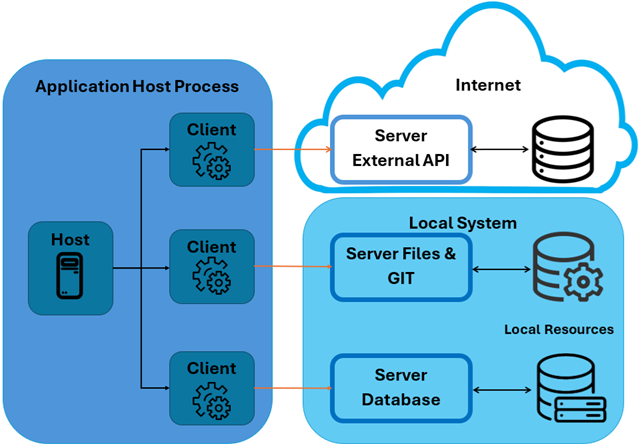
- Methodology Introduces the Model Context Protocol (MCP) as a structured, version-controlled file format that captures patient state, clinical objectives, and reasoning history, creating reusable and auditable memory objects.
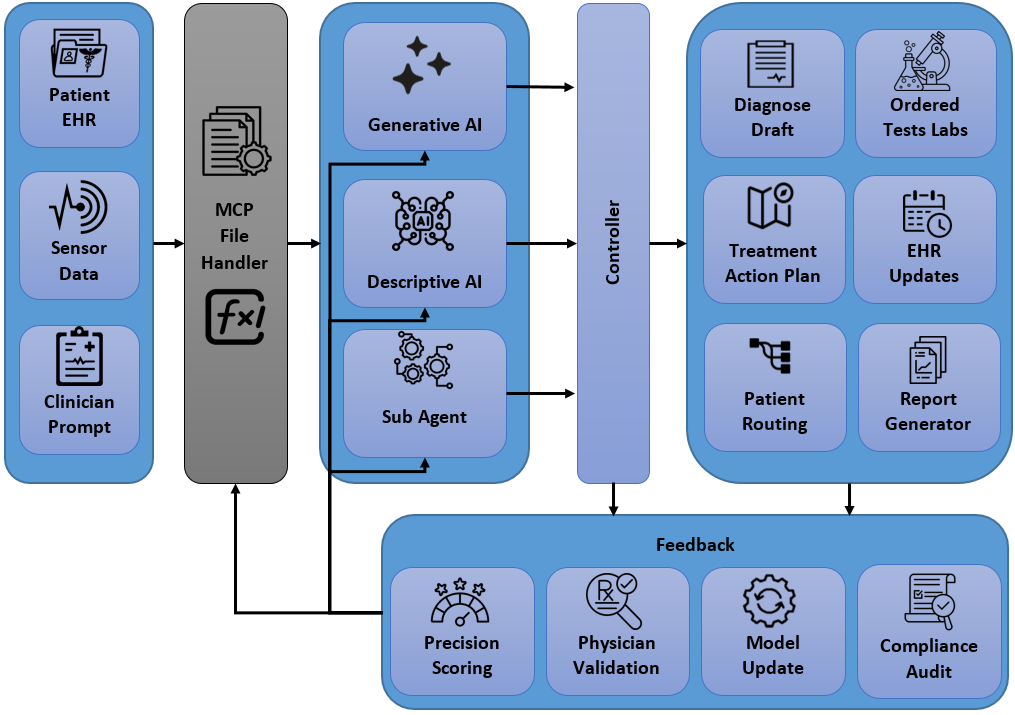
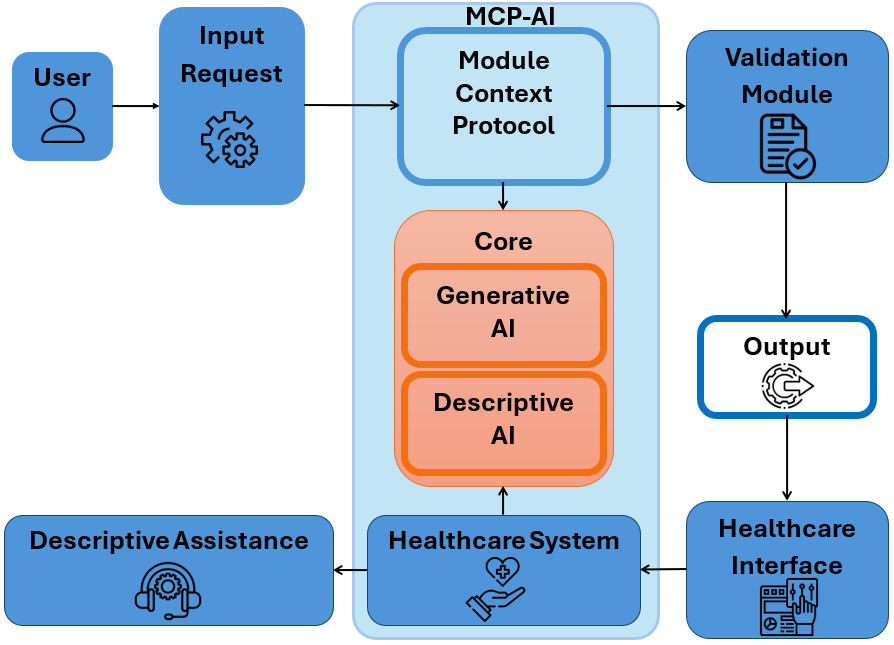
- Methodology Develops a hybrid architecture combining generative AI (for narrative diagnosis and planning) with descriptive AI (for rule validation and scoring) within a persistent reasoning context.
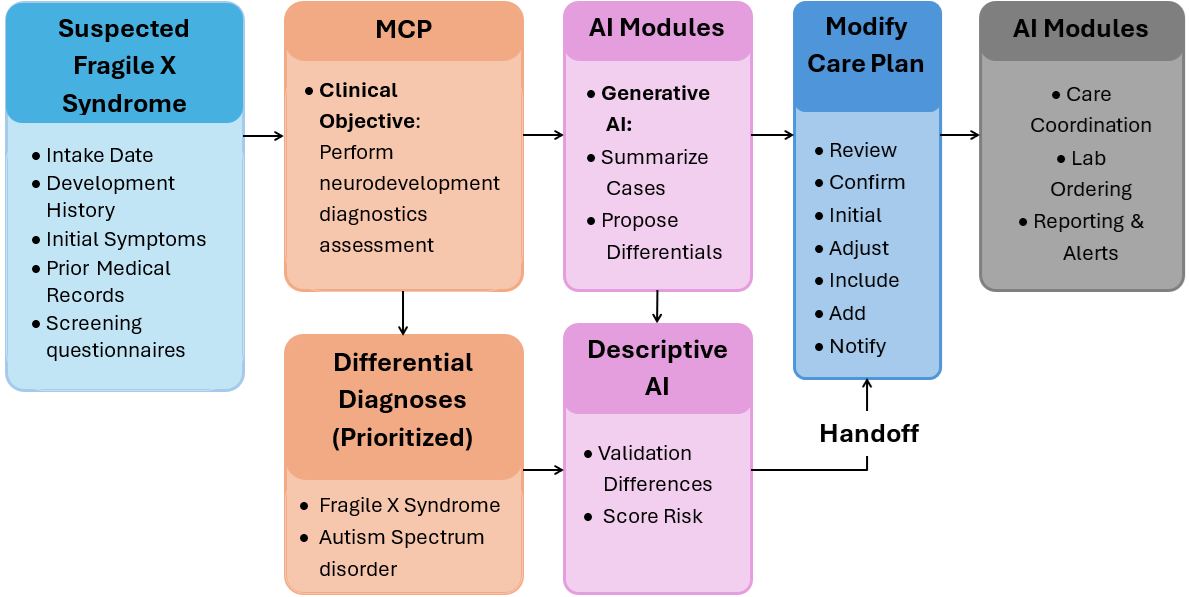
- Biology Demonstrates clinical utility through two complex use cases: Fragile X Syndrome with comorbid depression (rare neurodevelopmental disorder) and Type 2 Diabetes with hypertension (chronic care coordination).
主要结论
- MCP-AI enables adaptive, longitudinal reasoning across care settings, demonstrated through successful simulation of complex diagnostic pathways for Fragile X Syndrome with comorbid depression.
- The framework supports secure transitions of AI responsibilities between healthcare providers while maintaining clinical context, validated in chronic disease coordination scenarios for diabetes and hypertension.
- MCP-AI provides traceable, auditable decision-making with built-in physician verification, aligning with regulatory standards including HIPAA and FDA SaMD guidelines for clinical deployment.
摘要: Healthcare AI systems have historically faced challenges in merging contextual reasoning, long-term state management, and human-verifiable workflows into a cohesive framework. This paper introduces a completely innovative architecture and concept: combining the Model Context Protocol (MCP) with a specific clinical application, known as MCP-AI. This integration allows intelligent agents to reason over extended periods, collaborate securely, and adhere to authentic clinical logic, representing a significant shift away from traditional Clinical Decision Support Systems (CDSS) and prompt-based Large Language Models (LLMs). As healthcare systems become more complex, the need for autonomous, context-aware clinical reasoning frameworks has become urgent. We present MCP-AI, a novel architecture for explainable medical decision-making built upon the Model Context Protocol (MCP) a modular, executable specification for orchestrating generative and descriptive AI agents in real-time workflows. Each MCP file captures clinical objectives, patient context, reasoning state, and task logic, forming a reusable and auditable memory object. Unlike conventional CDSS or stateless prompt-based AI systems, MCP-AI supports adaptive, longitudinal, and collaborative reasoning across care settings. MCP-AI is validated through two use cases: (1) diagnostic modeling of Fragile X Syndrome with comorbid depression, and (2) remote coordination for Type 2 Diabetes and hypertension. In either scenario, the protocol facilitates physician-in-the-loop validation, streamlines clinical processes, and guarantees secure transitions of AI responsibilities between healthcare providers. The system connects with HL7/FHIR interfaces and adheres to regulatory standards, such as HIPAA and FDA SaMD guidelines. MCP-AI provides a scalable basis for interpretable, composable, and safety-oriented AI within upcoming clinical environments.