
Paper List
-
Macroscopic Dominance from Microscopic Extremes: Symmetry Breaking in Spatial Competition
This paper addresses the fundamental question of how microscopic stochastic advantages in spatial exploration translate into macroscopic resource domi...
-
Linear Readout of Neural Manifolds with Continuous Variables
This paper addresses the core challenge of quantifying how the geometric structure of high-dimensional neural population activity (neural manifolds) d...
-
Theory of Cell Body Lensing and Phototaxis Sign Reversal in “Eyeless” Mutants of Chlamydomonas
This paper solves the core puzzle of how eyeless mutants of Chlamydomonas exhibit reversed phototaxis by quantitatively modeling the competition betwe...
-
Cross-Species Transfer Learning for Electrophysiology-to-Transcriptomics Mapping in Cortical GABAergic Interneurons
This paper addresses the challenge of predicting transcriptomic identity from electrophysiological recordings in human cortical interneurons, where li...
-
Uncovering statistical structure in large-scale neural activity with Restricted Boltzmann Machines
This paper addresses the core challenge of modeling large-scale neural population activity (1500-2000 neurons) with interpretable higher-order interac...
-
Realizing Common Random Numbers: Event-Keyed Hashing for Causally Valid Stochastic Models
This paper addresses the critical problem that standard stateful PRNG implementations in agent-based models violate causal validity by making random d...
-
A Standardized Framework for Evaluating Gene Expression Generative Models
This paper addresses the critical lack of standardized evaluation protocols for single-cell gene expression generative models, where inconsistent metr...
-
Single Molecule Localization Microscopy Challenge: A Biologically Inspired Benchmark for Long-Sequence Modeling
This paper addresses the core challenge of evaluating state-space models on biologically realistic, sparse, and stochastic temporal processes, which a...
Collective adsorption of pheromones at the water-air interface
Aix Marseille Univ, CNRS, Centrale Med, IRPHE (UMR 7342), Marseille, France | ICSM, CEA, CNRS, ENSCM, Univ. Montpellier, Marcoule, France | Institut de Recherche sur la Biologie de l’Insecte, UMR 7261, CNRS-Université de Tours, Tours, France


30秒速读
IN SHORT: This paper addresses the core challenge of understanding how amphiphilic pheromones, previously assumed to be transported in the gas phase, can be stabilized and concentrated at the water-air interface of atmospheric aerosols through collective adsorption and a 2D phase transition.
核心创新
- Methodology Presents state-of-the-art all-atom molecular dynamics simulations to construct a full Langmuir adsorption isotherm for a pheromone monolayer, a comprehensive approach rare in the field.
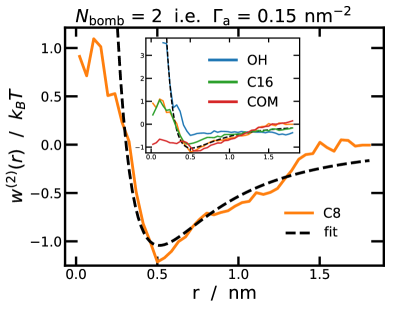
- Biology Quantifies the collective adsorption free energy gain (~2kBT per molecule) for bombykol at the water-air interface, providing a mechanistic explanation for pheromone enrichment on atmospheric aerosols.
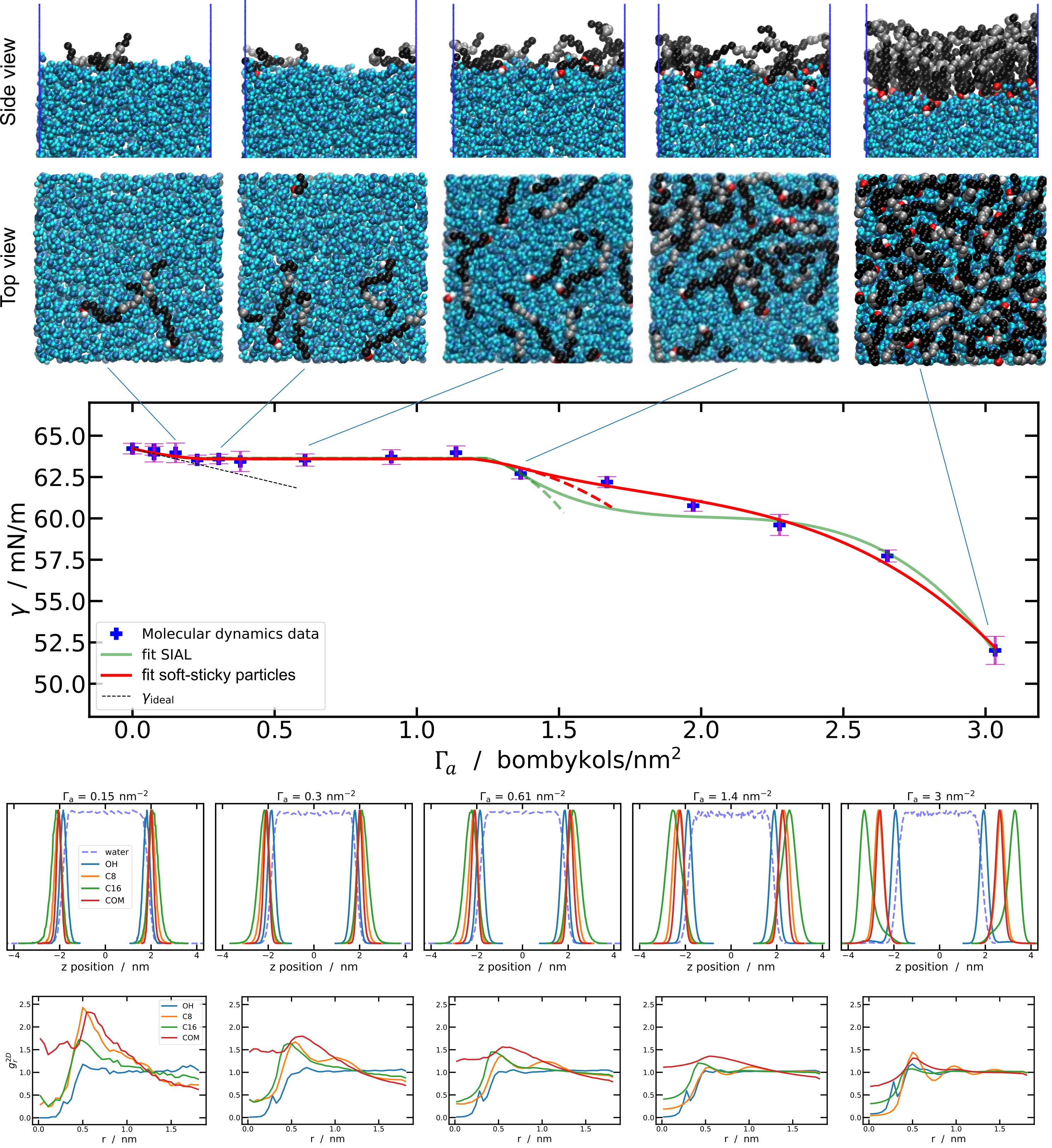
- Theory Identifies and characterizes a two-dimensional liquid-gas phase transition within the pheromone monolayer, modeled successfully with a soft-sticky particle equation of state.
主要结论
- Collective interactions within a bombykol monolayer at the water-air interface provide a stabilization free energy of approximately 2kBT per molecule, significantly enhancing adsorption compared to individual molecules.
- The monolayer exhibits a clear two-dimensional liquid-gas phase transition, accurately described by a soft-sticky particle equation of state, with the transition plateau evident in the surface tension vs. concentration isotherm.
- The calculated adsorption free energy increases under lower estimates of the condensing surface concentration (ΓC), indicating that pheromone adsorption onto aerosols is more favorable in dilute regimes, relevant for atmospheric conditions.
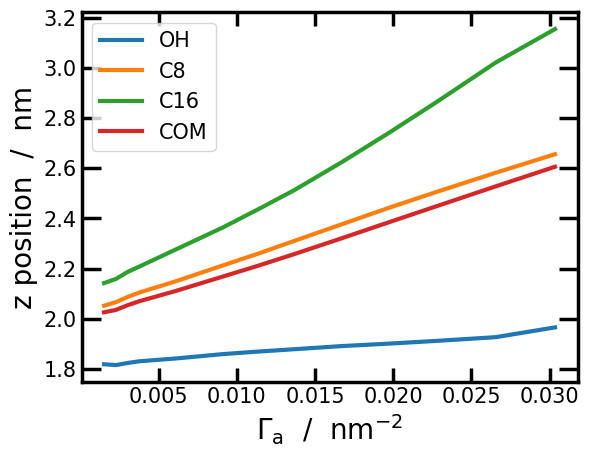
摘要: Understanding the phase behaviour of pheromones and other messaging molecules remains a significant and largely unexplored challenge, even though it plays a central role in chemical communication. Here, we present all-atom molecular dynamics simulations to investigate the behavior of bombykol, a model insect pheromone, adsorbed at the water–air interface. This system serves as a proxy for studying the amphiphilic nature of pheromones and their interactions with aerosol particles in the atmosphere. Our simulations reveal the molecular organization of the bombykol monolayer and its adsorption isotherm. A soft-sticky particle equation of state accurately describes the monolayer’s behavior. The analysis uncovers a two-dimensional liquid–gas phase transition within the monolayer. Collective adsorption stabilises the molecules at the interface and the calculated free energy gain is approximately 2kBT. This value increases under lower estimates of the condensing surface concentration, thereby enhancing pheromone adsorption onto aerosols. Overall, our findings hold broad relevance for molecular interface science, atmospheric chemistry, and organismal chemical communication, particularly in highlighting the critical role of phase transition phenomena.