
Paper List
-
Macroscopic Dominance from Microscopic Extremes: Symmetry Breaking in Spatial Competition
This paper addresses the fundamental question of how microscopic stochastic advantages in spatial exploration translate into macroscopic resource domi...
-
Linear Readout of Neural Manifolds with Continuous Variables
This paper addresses the core challenge of quantifying how the geometric structure of high-dimensional neural population activity (neural manifolds) d...
-
Theory of Cell Body Lensing and Phototaxis Sign Reversal in “Eyeless” Mutants of Chlamydomonas
This paper solves the core puzzle of how eyeless mutants of Chlamydomonas exhibit reversed phototaxis by quantitatively modeling the competition betwe...
-
Cross-Species Transfer Learning for Electrophysiology-to-Transcriptomics Mapping in Cortical GABAergic Interneurons
This paper addresses the challenge of predicting transcriptomic identity from electrophysiological recordings in human cortical interneurons, where li...
-
Uncovering statistical structure in large-scale neural activity with Restricted Boltzmann Machines
This paper addresses the core challenge of modeling large-scale neural population activity (1500-2000 neurons) with interpretable higher-order interac...
-
Realizing Common Random Numbers: Event-Keyed Hashing for Causally Valid Stochastic Models
This paper addresses the critical problem that standard stateful PRNG implementations in agent-based models violate causal validity by making random d...
-
A Standardized Framework for Evaluating Gene Expression Generative Models
This paper addresses the critical lack of standardized evaluation protocols for single-cell gene expression generative models, where inconsistent metr...
-
Single Molecule Localization Microscopy Challenge: A Biologically Inspired Benchmark for Long-Sequence Modeling
This paper addresses the core challenge of evaluating state-space models on biologically realistic, sparse, and stochastic temporal processes, which a...
Learning From Limited Data and Feedback for Cell Culture Process Monitoring: A Comparative Study
Complex Adaptive Systems Laboratory, The Data Science Institute, University of Technology Sydney, NSW 2007, Australia | CSL Innovation, Melbourne, VIC 3000, Australia

30秒速读
IN SHORT: This paper addresses the core challenge of developing accurate real-time bioprocess monitoring soft sensors under severe data constraints: limited historical batches, infrequent offline measurements (once/twice daily), heterogeneous process conditions, and high-dimensional Raman spectral inputs (3,325 wavenumbers).
核心创新
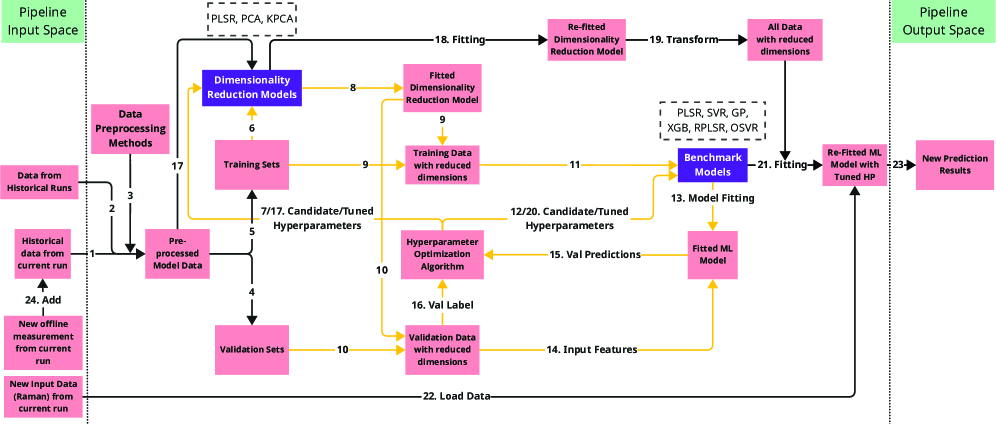
- Methodology Systematic benchmarking of three ML strategies (Dimensionality Reduction, Just-In-Time Learning, Online Learning) specifically tailored for cold-start bioprocess monitoring across simulated and real industrial datasets.
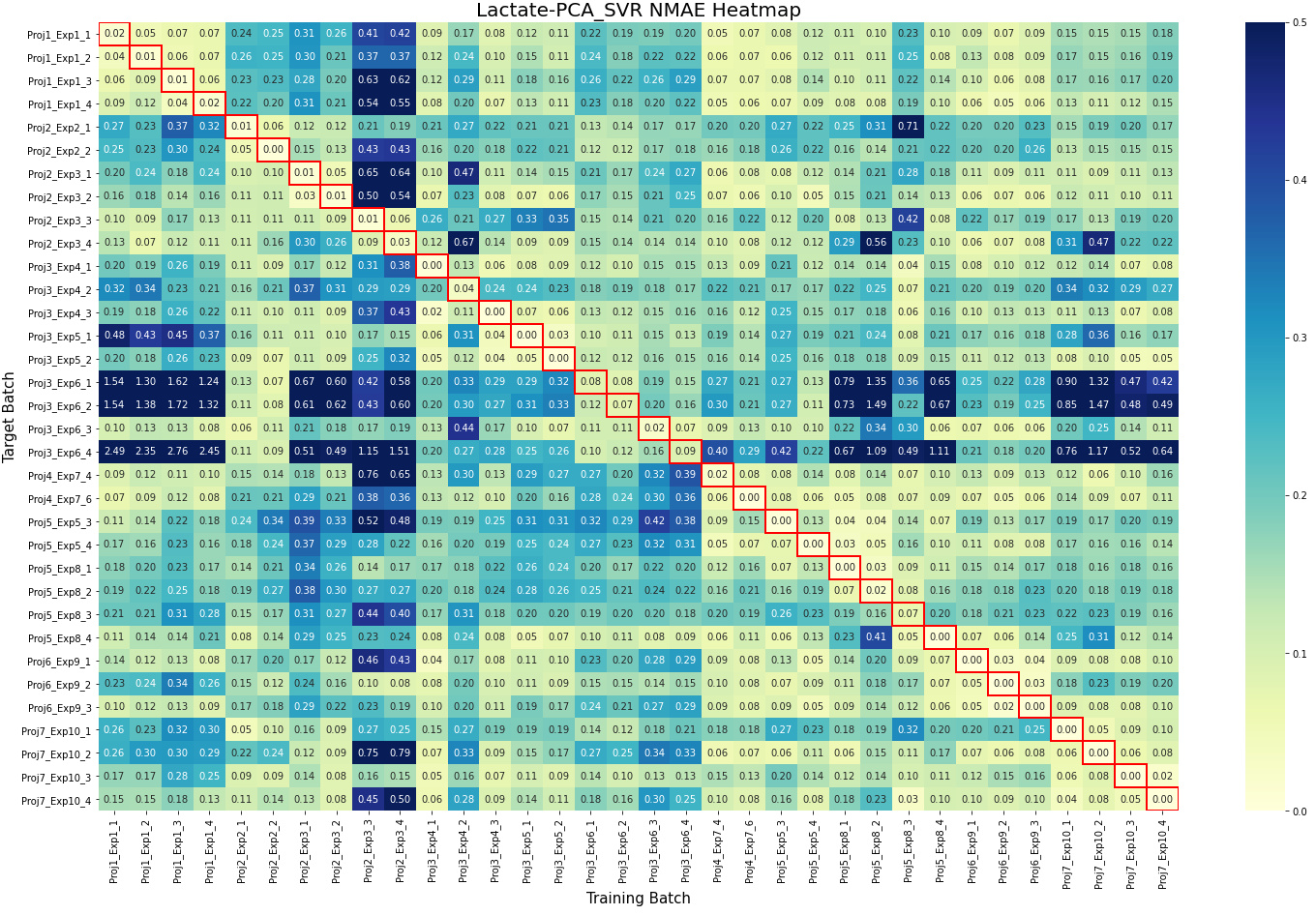
- Methodology Identification of key meta-features (feed media composition, process control strategies) that significantly impact model transferability between heterogeneous bioreactor runs.
- Methodology Demonstration that integrating Raman-based real-time predictions with lagged offline measurements enhances monitoring accuracy, providing a hybrid approach to overcome infrequent feedback.
主要结论
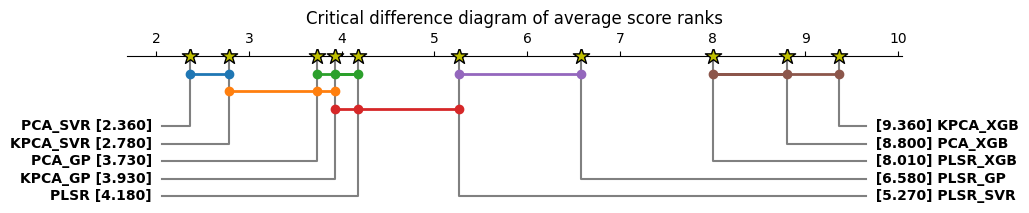
- Batch learning methods (e.g., PLSR, SVR) perform well in homogeneous settings but struggle in cold-start scenarios, where Just-In-Time Learning (JITL) and Online Learning (OL) show superior adaptability with statistically significant improvements (p<0.05 in Friedman tests).
- Dimensionality Reduction is critical for handling high-dimensional Raman data (3,325 features vs. <30 samples), with supervised methods like PLSR outperforming unsupervised PCA when offline measurements are available.
- Model transferability depends heavily on process meta-features; feed media composition explains up to 40% of performance variance across runs, highlighting the need for context-aware training strategies.
摘要: In cell culture bioprocessing, real-time batch process monitoring (BPM) refers to the continuous tracking and analysis of key process variables—such as viable cell density, nutrient levels, metabolite concentrations, and product titer—throughout the duration of a batch run. This enables early detection of deviations and supports timely control actions to ensure optimal cell growth and product quality. BPM plays a critical role in ensuring the quality and regulatory compliance of biopharmaceutical manufacturing processes. However, the development of accurate soft sensors for BPM is hindered by key challenges, including limited historical data, infrequent feedback, heterogeneous process conditions, and high-dimensional sensory inputs. This study presents a comprehensive benchmarking analysis of machine learning (ML) methods designed to address these challenges, with a focus on learning from historical data with limited volume and relevance in the context of bioprocess monitoring. We evaluate multiple ML approaches—including feature dimensionality reduction, online learning, and just-in-time learning—across three datasets, one in silico dataset and two real-world experimental datasets. Our findings highlight the importance of training strategies in handling limited data and feedback, with batch learning proving effective in homogeneous settings, while just-in-time learning and online learning demonstrate superior adaptability in cold-start scenarios. Additionally, we identify key meta-features, such as feed media composition and process control strategies, that significantly impact model transferability. The results also suggest that integrating Raman-based predictions with lagged offline measurements enhances monitoring accuracy, offering a promising direction for future bioprocess soft sensor development.