
Paper List
-
Macroscopic Dominance from Microscopic Extremes: Symmetry Breaking in Spatial Competition
This paper addresses the fundamental question of how microscopic stochastic advantages in spatial exploration translate into macroscopic resource domi...
-
Linear Readout of Neural Manifolds with Continuous Variables
This paper addresses the core challenge of quantifying how the geometric structure of high-dimensional neural population activity (neural manifolds) d...
-
Theory of Cell Body Lensing and Phototaxis Sign Reversal in “Eyeless” Mutants of Chlamydomonas
This paper solves the core puzzle of how eyeless mutants of Chlamydomonas exhibit reversed phototaxis by quantitatively modeling the competition betwe...
-
Cross-Species Transfer Learning for Electrophysiology-to-Transcriptomics Mapping in Cortical GABAergic Interneurons
This paper addresses the challenge of predicting transcriptomic identity from electrophysiological recordings in human cortical interneurons, where li...
-
Uncovering statistical structure in large-scale neural activity with Restricted Boltzmann Machines
This paper addresses the core challenge of modeling large-scale neural population activity (1500-2000 neurons) with interpretable higher-order interac...
-
Realizing Common Random Numbers: Event-Keyed Hashing for Causally Valid Stochastic Models
This paper addresses the critical problem that standard stateful PRNG implementations in agent-based models violate causal validity by making random d...
-
A Standardized Framework for Evaluating Gene Expression Generative Models
This paper addresses the critical lack of standardized evaluation protocols for single-cell gene expression generative models, where inconsistent metr...
-
Single Molecule Localization Microscopy Challenge: A Biologically Inspired Benchmark for Long-Sequence Modeling
This paper addresses the core challenge of evaluating state-space models on biologically realistic, sparse, and stochastic temporal processes, which a...
The BEAT-CF Causal Model: A model for guiding the design of trials and observational analyses of cystic fibrosis exacerbations
Bayesian Intelligence | Monash University | The Kids Research Institute Australia | University of Sydney | The Children's Hospital at Westmead
30秒速读
IN SHORT: This paper addresses the critical gap in cystic fibrosis exacerbation management by providing a formal causal framework that integrates expert knowledge to guide clinical trial design and enable robust causal inference.
核心创新
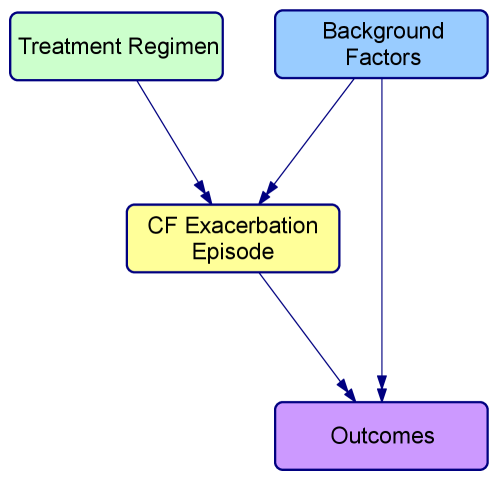
- Methodology Developed a comprehensive Bayesian causal model (DAG/BN) integrating 4 domains (background factors, treatments, exacerbation episode, outcomes) with 30+ nodes representing key pathophysiological processes
- Methodology Implemented a structured expert elicitation process involving 30+ CF clinicians across multiple workshops (2017-2019) using Delphi/nominal group techniques for variable selection and validation
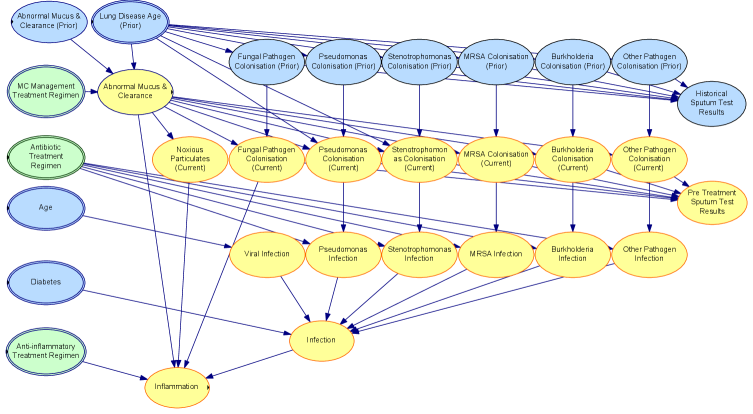
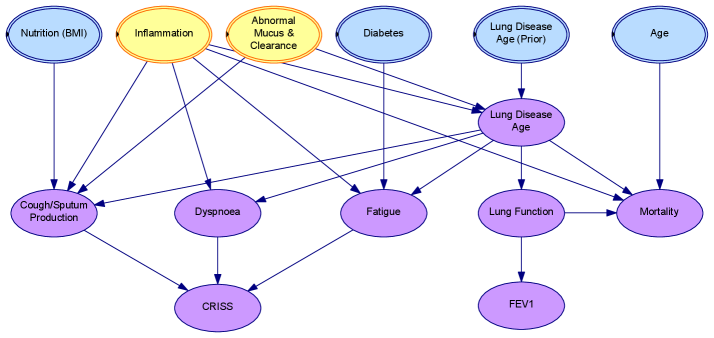
- Biology Explicitly models the causal pathways between abnormal mucus clearance, pathogen colonization (Pseudomonas aeruginosa, MRSA, etc.), infection, and inflammation - enabling targeted treatment effect analysis
主要结论
- The BEAT-CF causal model successfully integrates expert knowledge from 30+ clinicians into a formal DAG structure with 4 domains and 30+ nodes, validated through multiple workshops (2017-2019)
- The framework enables explicit causal inference by identifying necessary adjustments for statistical analyses, directly guiding data collection design for clinical trials
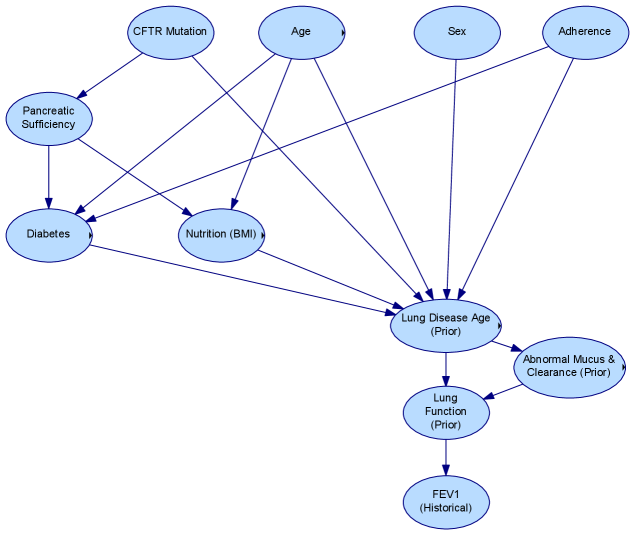
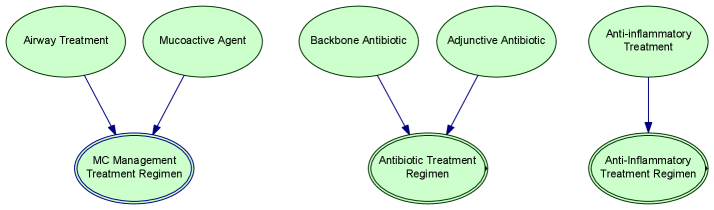
- The model provides a reusable, transparent framework that captures key relationships between background factors (lung disease age, CFTR mutations), treatments (antibiotics, anti-inflammatories), and outcomes (lung function decline, mortality)
摘要: Loss of lung function in cystic fibrosis (CF) occurs progressively, punctuated by acute pulmonary exacerbations (PEx) in which abrupt declines in lung function are not fully recovered. A key component of CF management over the past half century has been the treatment of PEx to slow lung function decline. This has been credited with improvements in survival for people with CF (PwCF), but there is no consensus on the optimal approach to PEx management. BEAT-CF (Bayesian evidence-adaptive treatment of CF) was established to build an evidence-informed knowledge base for CF management. The BEAT-CF causal model is a directed acyclic graph (DAG) and Bayesian network (BN) for PEx that aims to inform the design and analysis of clinical trials comparing the effectiveness of alternative approaches to PEx management. The causal model describes relationships between background risk factors, treatments, and pathogen colonisation of the airways that affect the outcome of an individual PEx episode. The key factors, outcomes, and causal relationships were elicited from CF clinical experts and together represent current expert understanding of the pathophysiology of a PEx episode, guiding the design of data collection and studies and enabling causal inference. Here, we present the DAG that documents this understanding, along with the processes used in its development, providing transparency around our trial design and study processes, as well as a reusable framework for others.