
Paper List
-
Nyxus: A Next Generation Image Feature Extraction Library for the Big Data and AI Era
This paper addresses the core pain point of efficiently extracting standardized, comparable features from massive (terabyte to petabyte-scale) biomedi...
-
Topological Enhancement of Protein Kinetic Stability
This work addresses the long-standing puzzle of why knotted proteins exist by demonstrating that deep knots provide a functional advantage through enh...
-
A Multi-Label Temporal Convolutional Framework for Transcription Factor Binding Characterization
This paper addresses the critical limitation of existing TF binding prediction methods that treat transcription factors as independent entities, faili...
-
Social Distancing Equilibria in Games under Conventional SI Dynamics
This paper solves the core problem of proving the existence and uniqueness of Nash equilibria in finite-duration SI epidemic games, showing they are a...
-
Binding Free Energies without Alchemy
This paper addresses the core bottleneck of computational expense in Absolute Binding Free Energy calculations by eliminating the need for numerous al...
-
SHREC: A Spectral Embedding-Based Approach for Ab-Initio Reconstruction of Helical Molecules
This paper addresses the core bottleneck in cryo-EM helical reconstruction: eliminating the dependency on accurate initial symmetry parameter estimati...
-
Budget-Sensitive Discovery Scoring: A Formally Verified Framework for Evaluating AI-Guided Scientific Selection
This paper addresses the critical gap in evaluating AI-guided scientific selection strategies under realistic budget constraints, where existing metri...
-
Probabilistic Joint and Individual Variation Explained (ProJIVE) for Data Integration
This paper addresses the core challenge of accurately decomposing shared (joint) and dataset-specific (individual) sources of variation in multi-modal...
PanFoMa: A Lightweight Foundation Model and Benchmark for Pan-Cancer
Extracted from affiliations in the content snippet (specific institutions not fully listed in provided text)
30秒速读
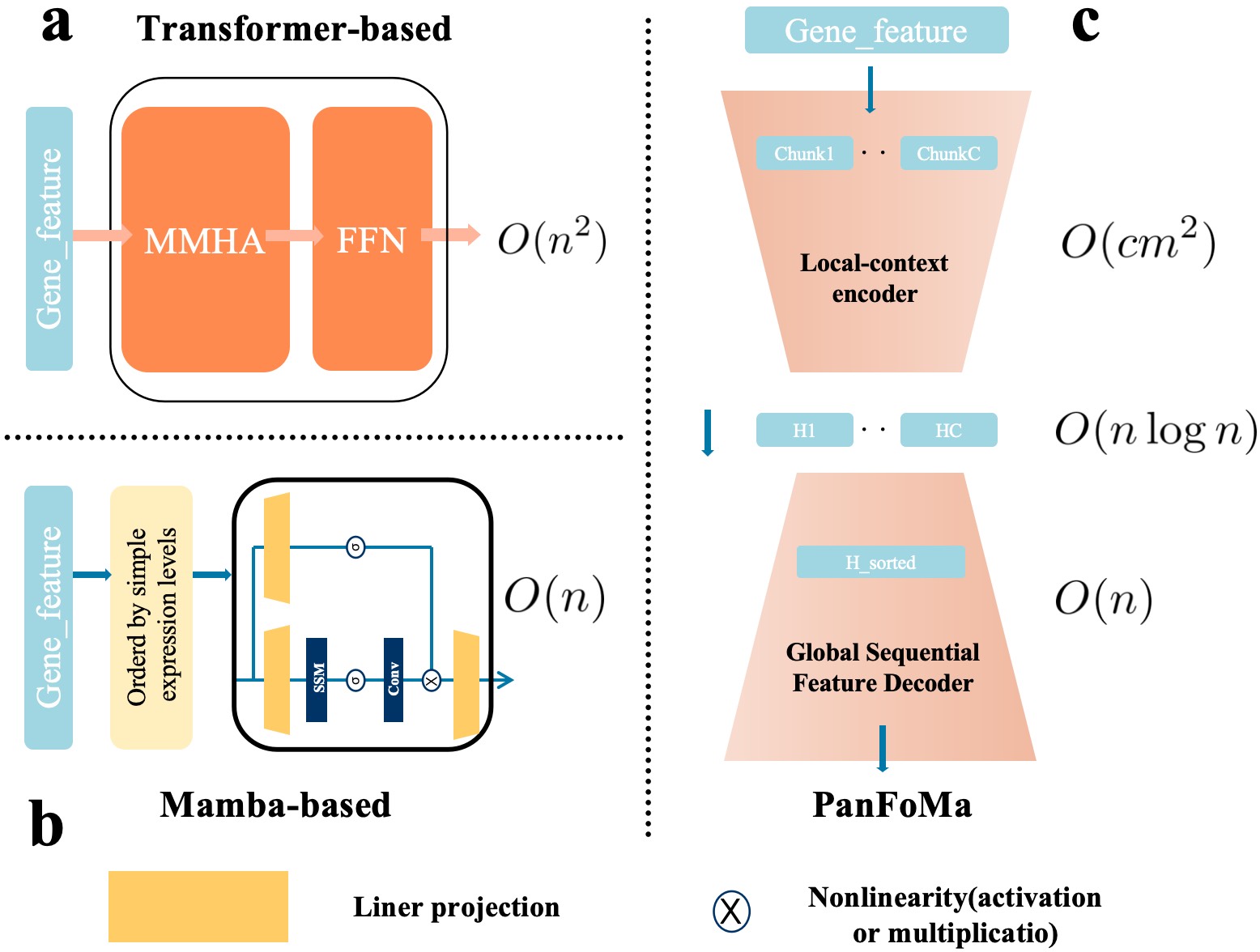
IN SHORT: This paper addresses the dual challenge of achieving computational efficiency without sacrificing accuracy in whole-transcriptome single-cell representation learning for pan-cancer analysis, moving beyond the limitations of pure Transformer or Mamba architectures.
核心创新
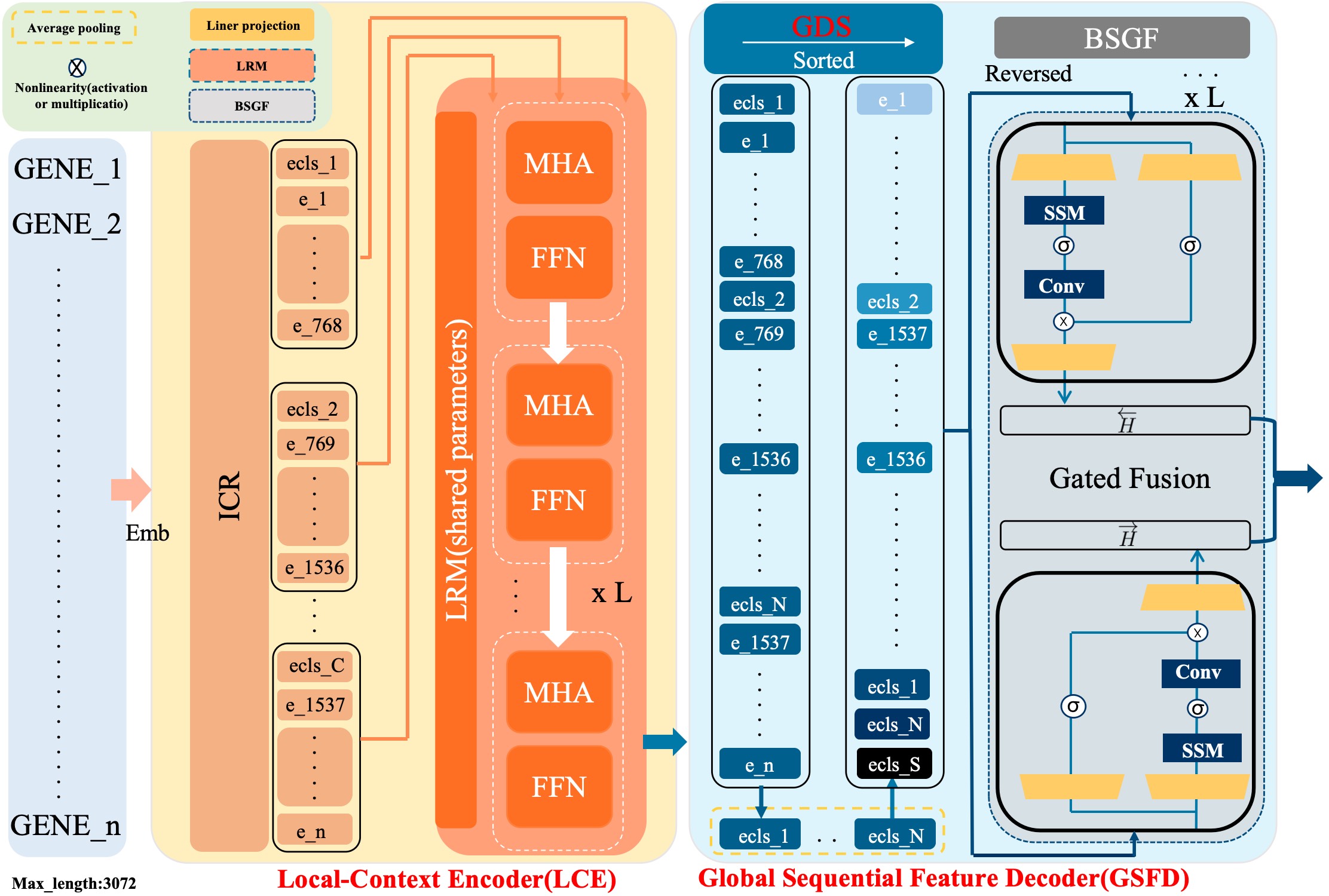
- Methodology Proposes a novel hybrid architecture (PanFoMa) that decouples local gene interaction modeling (via a lightweight, chunked Transformer encoder) from global context integration (via a bidirectional Mamba decoder), achieving O(C·M² + N log N) complexity.
- Methodology Introduces a Global-informed Dynamic Sorting (GDS) mechanism that adaptively orders genes for the Mamba decoder based on a learned global cell state vector, moving beyond static, heuristic gene ordering (e.g., by mean expression).
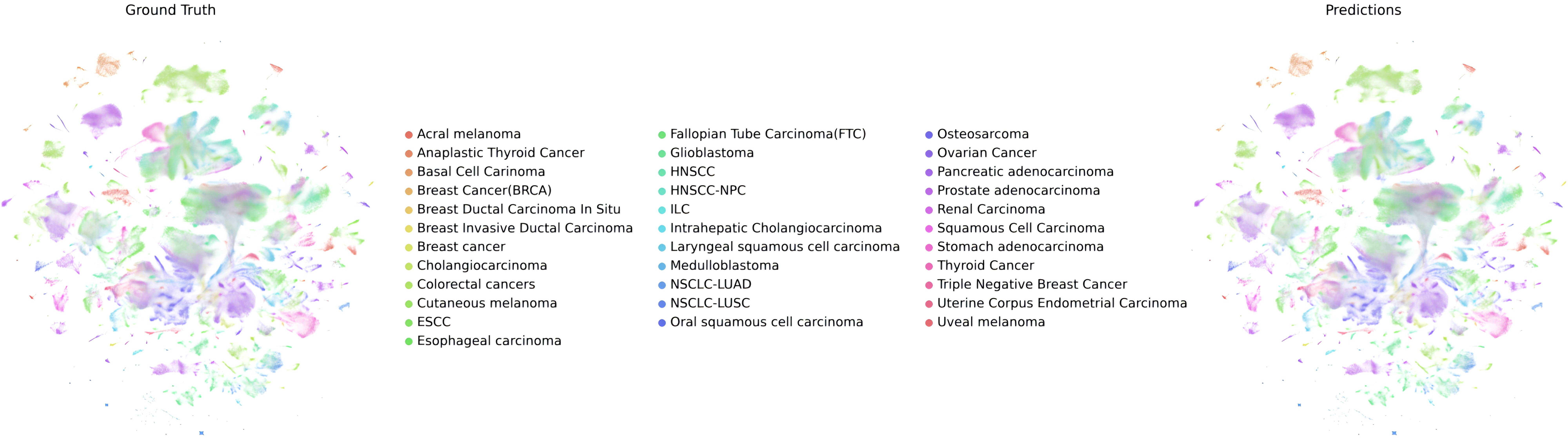
- Biology Constructs and releases PanFoMaBench, a large-scale, rigorously curated pan-cancer single-cell benchmark comprising over 3.5 million high-quality cells across 33 cancer subtypes from 23 tissues, addressing the lack of comprehensive evaluation resources.
主要结论
- PanFoMa achieves state-of-the-art pan-cancer classification accuracy of 94.74% (ACC) and 92.5% (Macro-F1) on PanFoMaBench, outperforming GeneFormer by +3.5% ACC and +4.0% F1.
- The model demonstrates superior generalizability across foundational tasks, showing improvements of +7.4% in cell type annotation, +4.0% in batch integration, and +3.1% in multi-omics integration over baselines.
- The hybrid local-global design and dynamic sorting are validated as effective, enabling efficient processing of full transcriptome-scale data (~3000 genes) while capturing both fine-grained local interactions and broad global regulatory patterns.
摘要: Single-cell RNA sequencing (scRNA-seq) is essential for decoding tumor heterogeneity. However, pan-cancer research still faces two key challenges: learning discriminative and efficient single-cell representations, and establishing a comprehensive evaluation benchmark. In this paper, we introduce PanFoMa, a lightweight hybrid neural network that combines the strengths of Transformers and state-space models to achieve a balance between performance and efficiency. PanFoMa consists of a front-end local-context encoder with shared self-attention layers to capture complex, order-independent gene interactions; and a back-end global sequential feature decoder that efficiently integrates global context using a linear-time state-space model. This modular design preserves the expressive power of Transformers while leveraging the scalability of Mamba to enable transcriptome modeling, effectively capturing both local and global regulatory signals. To enable robust evaluation, we also construct a large-scale pan-cancer single-cell benchmark, PanFoMaBench, containing over 3.5 million high-quality cells across 33 cancer subtypes, curated through a rigorous preprocessing pipeline. Experimental results show that PanFoMa outperforms state-of-the-art models on our pan-cancer benchmark (+4.0%) and across multiple public tasks, including cell type annotation (+7.4%), batch integration (+4.0%) and multi-omics integration (+3.1%). The code is available at https://github.com/Xiaoshui-Huang/PanFoMa.