
Paper List
-
Nyxus: A Next Generation Image Feature Extraction Library for the Big Data and AI Era
This paper addresses the core pain point of efficiently extracting standardized, comparable features from massive (terabyte to petabyte-scale) biomedi...
-
Topological Enhancement of Protein Kinetic Stability
This work addresses the long-standing puzzle of why knotted proteins exist by demonstrating that deep knots provide a functional advantage through enh...
-
A Multi-Label Temporal Convolutional Framework for Transcription Factor Binding Characterization
This paper addresses the critical limitation of existing TF binding prediction methods that treat transcription factors as independent entities, faili...
-
Social Distancing Equilibria in Games under Conventional SI Dynamics
This paper solves the core problem of proving the existence and uniqueness of Nash equilibria in finite-duration SI epidemic games, showing they are a...
-
Binding Free Energies without Alchemy
This paper addresses the core bottleneck of computational expense in Absolute Binding Free Energy calculations by eliminating the need for numerous al...
-
SHREC: A Spectral Embedding-Based Approach for Ab-Initio Reconstruction of Helical Molecules
This paper addresses the core bottleneck in cryo-EM helical reconstruction: eliminating the dependency on accurate initial symmetry parameter estimati...
-
Budget-Sensitive Discovery Scoring: A Formally Verified Framework for Evaluating AI-Guided Scientific Selection
This paper addresses the critical gap in evaluating AI-guided scientific selection strategies under realistic budget constraints, where existing metri...
-
Probabilistic Joint and Individual Variation Explained (ProJIVE) for Data Integration
This paper addresses the core challenge of accurately decomposing shared (joint) and dataset-specific (individual) sources of variation in multi-modal...
The BEAT-CF Causal Model: A model for guiding the design of trials and observational analyses of cystic fibrosis exacerbations
Bayesian Intelligence | Monash University | The Kids Research Institute Australia | University of Sydney | The Children's Hospital at Westmead
30秒速读
IN SHORT: This paper addresses the critical gap in cystic fibrosis exacerbation management by providing a formal causal framework that integrates expert knowledge to guide clinical trial design and enable robust causal inference.
核心创新
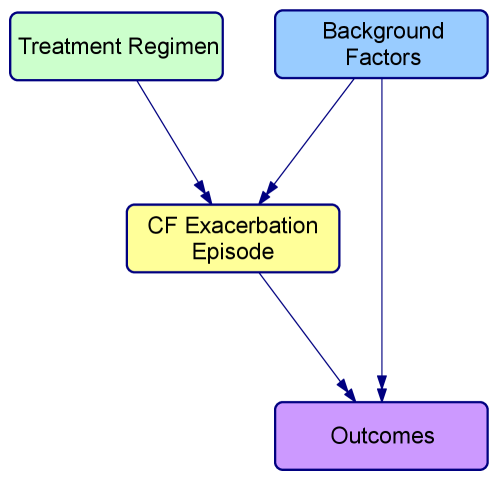
- Methodology Developed a comprehensive Bayesian causal model (DAG/BN) integrating 4 domains (background factors, treatments, exacerbation episode, outcomes) with 30+ nodes representing key pathophysiological processes
- Methodology Implemented a structured expert elicitation process involving 30+ CF clinicians across multiple workshops (2017-2019) using Delphi/nominal group techniques for variable selection and validation
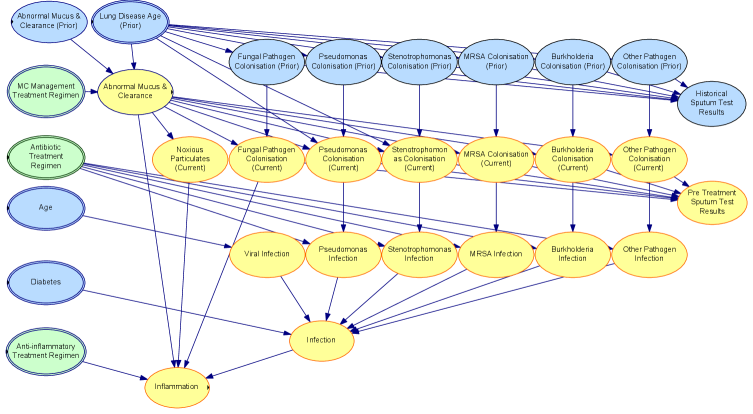
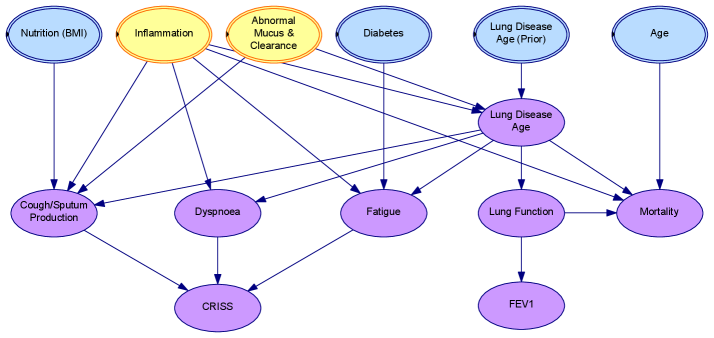
- Biology Explicitly models the causal pathways between abnormal mucus clearance, pathogen colonization (Pseudomonas aeruginosa, MRSA, etc.), infection, and inflammation - enabling targeted treatment effect analysis
主要结论
- The BEAT-CF causal model successfully integrates expert knowledge from 30+ clinicians into a formal DAG structure with 4 domains and 30+ nodes, validated through multiple workshops (2017-2019)
- The framework enables explicit causal inference by identifying necessary adjustments for statistical analyses, directly guiding data collection design for clinical trials
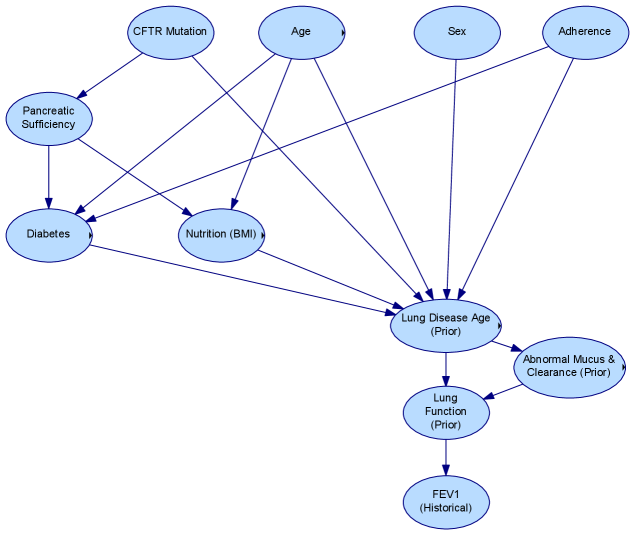
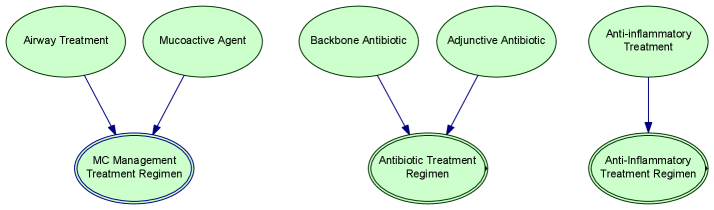
- The model provides a reusable, transparent framework that captures key relationships between background factors (lung disease age, CFTR mutations), treatments (antibiotics, anti-inflammatories), and outcomes (lung function decline, mortality)
摘要: Loss of lung function in cystic fibrosis (CF) occurs progressively, punctuated by acute pulmonary exacerbations (PEx) in which abrupt declines in lung function are not fully recovered. A key component of CF management over the past half century has been the treatment of PEx to slow lung function decline. This has been credited with improvements in survival for people with CF (PwCF), but there is no consensus on the optimal approach to PEx management. BEAT-CF (Bayesian evidence-adaptive treatment of CF) was established to build an evidence-informed knowledge base for CF management. The BEAT-CF causal model is a directed acyclic graph (DAG) and Bayesian network (BN) for PEx that aims to inform the design and analysis of clinical trials comparing the effectiveness of alternative approaches to PEx management. The causal model describes relationships between background risk factors, treatments, and pathogen colonisation of the airways that affect the outcome of an individual PEx episode. The key factors, outcomes, and causal relationships were elicited from CF clinical experts and together represent current expert understanding of the pathophysiology of a PEx episode, guiding the design of data collection and studies and enabling causal inference. Here, we present the DAG that documents this understanding, along with the processes used in its development, providing transparency around our trial design and study processes, as well as a reusable framework for others.