
Paper List
-
Nyxus: A Next Generation Image Feature Extraction Library for the Big Data and AI Era
This paper addresses the core pain point of efficiently extracting standardized, comparable features from massive (terabyte to petabyte-scale) biomedi...
-
Topological Enhancement of Protein Kinetic Stability
This work addresses the long-standing puzzle of why knotted proteins exist by demonstrating that deep knots provide a functional advantage through enh...
-
A Multi-Label Temporal Convolutional Framework for Transcription Factor Binding Characterization
This paper addresses the critical limitation of existing TF binding prediction methods that treat transcription factors as independent entities, faili...
-
Social Distancing Equilibria in Games under Conventional SI Dynamics
This paper solves the core problem of proving the existence and uniqueness of Nash equilibria in finite-duration SI epidemic games, showing they are a...
-
Binding Free Energies without Alchemy
This paper addresses the core bottleneck of computational expense in Absolute Binding Free Energy calculations by eliminating the need for numerous al...
-
SHREC: A Spectral Embedding-Based Approach for Ab-Initio Reconstruction of Helical Molecules
This paper addresses the core bottleneck in cryo-EM helical reconstruction: eliminating the dependency on accurate initial symmetry parameter estimati...
-
Budget-Sensitive Discovery Scoring: A Formally Verified Framework for Evaluating AI-Guided Scientific Selection
This paper addresses the critical gap in evaluating AI-guided scientific selection strategies under realistic budget constraints, where existing metri...
-
Probabilistic Joint and Individual Variation Explained (ProJIVE) for Data Integration
This paper addresses the core challenge of accurately decomposing shared (joint) and dataset-specific (individual) sources of variation in multi-modal...
Vessel Network Topology in Molecular Communication: Insights from Experiments and Theory
Friedrich-Alexander-Universität Erlangen-Nürnberg (FAU)
30秒速读
IN SHORT: This work addresses the critical lack of experimentally validated channel models for molecular communication within complex vessel networks, which is a prerequisite for designing reliable biomedical applications.
核心创新
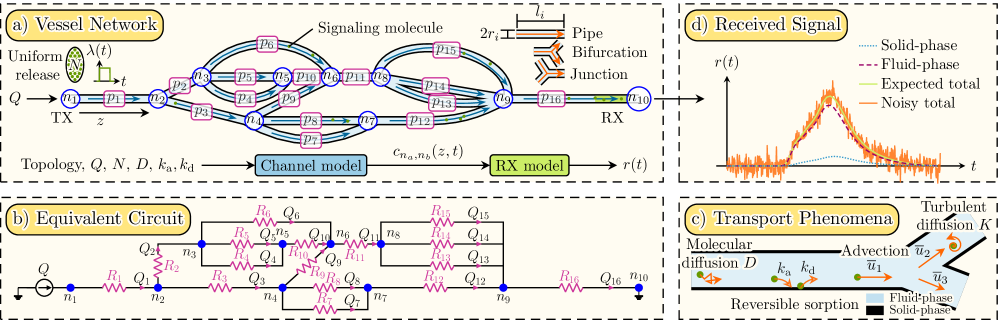
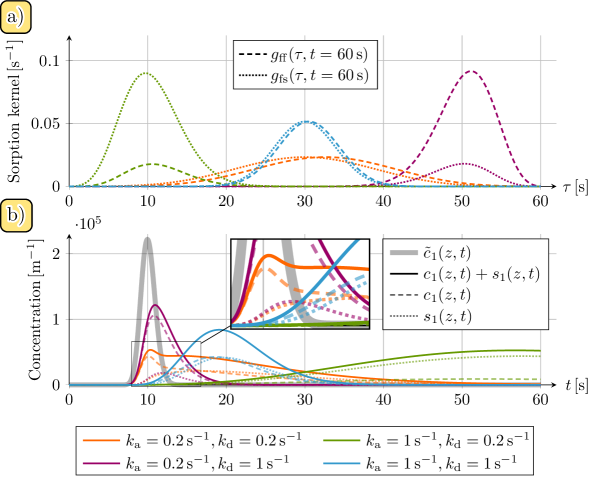
- Methodology Proposes a novel, comprehensive channel model for molecular communication in vessel networks, incorporating advection, molecular/turbulent diffusion, and adsorption/desorption at vessel walls.
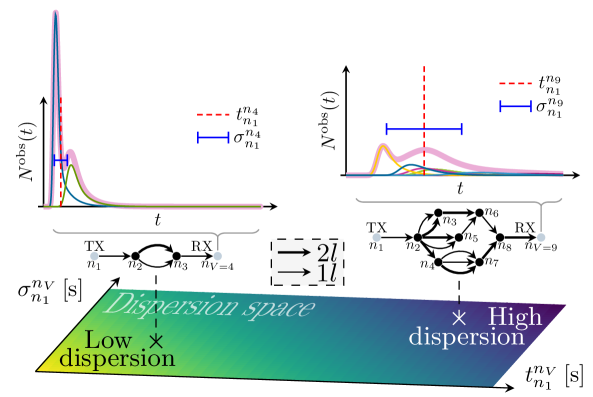
- Methodology Introduces two novel metrics—molecule delay and multi-path spread—to quantify the impact of vessel network topology on signal dispersion and the resulting signal-to-noise ratio (SNR).
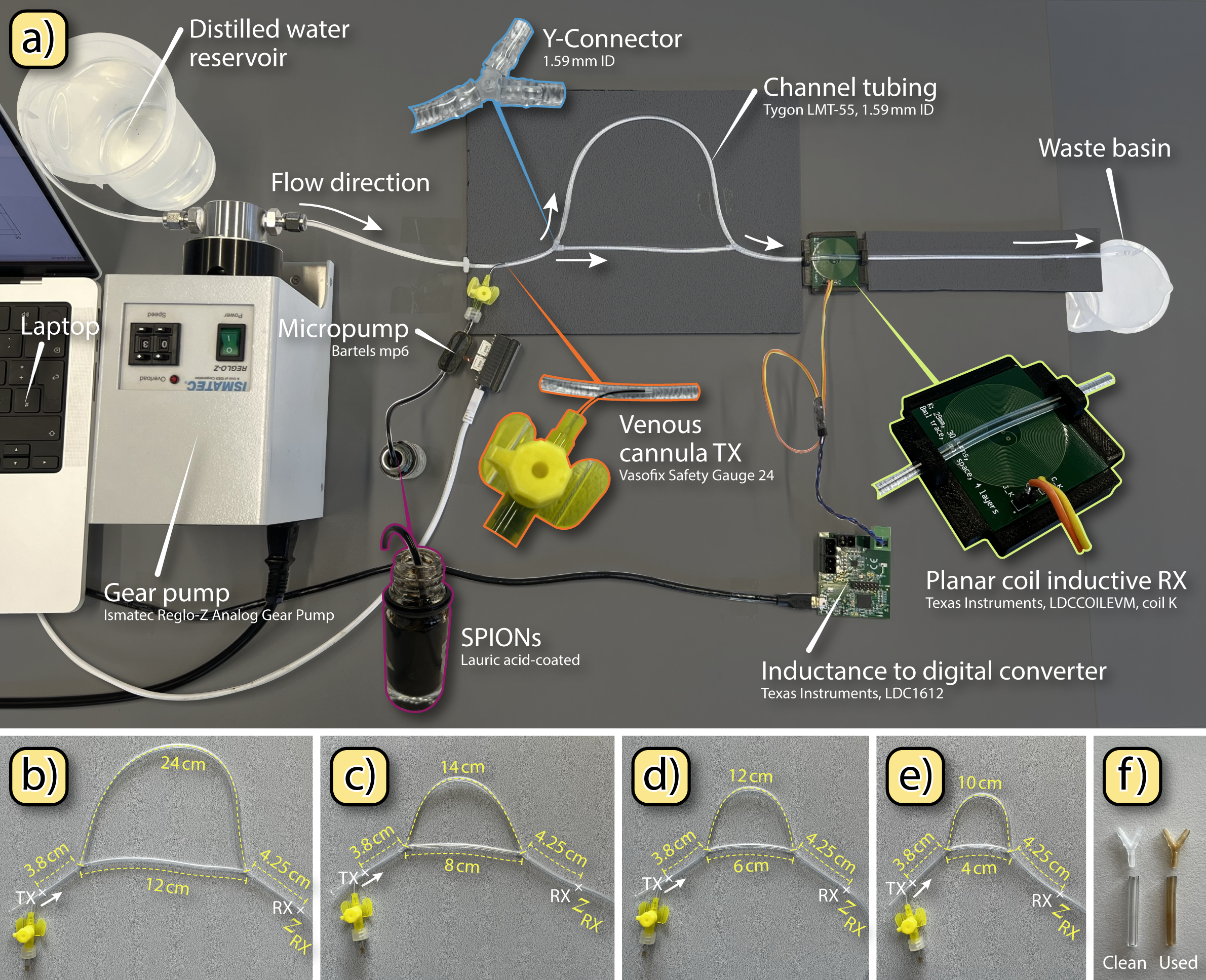
- Methodology Provides the first end-to-end experimental validation of a molecular communication model in branched vessel network topologies using a dedicated SPION (superparamagnetic iron-oxide nanoparticle) testbed.
主要结论
- The proposed channel model, validated against experimental data from branched topologies, accurately captures key transport dynamics (advection, diffusion, sorption) in vessel networks.
- The introduced metrics (molecule delay, multi-path spread) successfully establish a quantifiable link between vessel network structure and the resulting signal-to-noise ratio (SNR) at the receiver.
- The framework enables practical applications such as optimizing sensor placement in the cardiovascular system under specific SNR constraints and guiding the design of experimental testbeds.
摘要: The notion of synthetic molecular communication (MC) refers to the transmission of information via signaling molecules and is foreseen to enable innovative medical applications in the human cardiovascular system (CVS). Crucially, the design of such applications requires accurate and experimentally validated channel models that characterize the propagation of signaling molecules, not just in individual blood vessels, but in complex vessel networks, as prevalent in the CVS. However, experimentally validated models for MC in VNs remain scarce. To address this gap, we propose a novel channel model for MC in complex VN topologies, which captures molecular transport via advection, molecular and turbulent diffusion, as well as adsorption and desorption at the vessel walls. We specialize this model for superparamagnetic iron-oxide nanoparticles as signaling molecules by introducing a new receiver (RX) model for planar coil inductive sensors, enabling end-to-end experimental validation with a dedicated SPION testbed. Validation covers a range of channel topologies, from single-vessel topologies to branched VNs with multiple paths between transmitter (TX) and RX. Additionally, to quantify how the VN topology impacts signal quality, and inspired by multi-path propagation models in conventional wireless communications, we introduce two metrics, namely molecule delay and multi-path spread. We show that these metrics link the VN structure to molecule dispersion induced by the VN and mediately to the resulting signal-to-noise ratio (SNR) at the RX. The proposed VN structure-SNR link is validated experimentally, demonstrating that the proposed framework can support tasks such as optimal sensor placement in the CVS or the identification of suitable testbed topologies for specific SNR requirements. All experimental data are openly available on Zenodo.