
Paper List
-
Evolutionarily Stable Stackelberg Equilibrium
通过要求追随者策略对突变入侵具有鲁棒性,弥合了斯塔克尔伯格领导力模型与演化稳定性之间的鸿沟。
-
Recovering Sparse Neural Connectivity from Partial Measurements: A Covariance-Based Approach with Granger-Causality Refinement
通过跨多个实验会话累积协方差统计,实现从部分记录到完整神经连接性的重建。
-
Atomic Trajectory Modeling with State Space Models for Biomolecular Dynamics
ATMOS通过提供一个基于SSM的高效框架,用于生物分子的原子级轨迹生成,弥合了计算昂贵的MD模拟与时间受限的深度生成模型之间的差距。
-
Slow evolution towards generalism in a model of variable dietary range
通过证明是种群统计噪声(而非确定性动力学)驱动了模式形成和泛化食性的演化,解决了间接竞争下物种形成的悖论。
-
Grounded Multimodal Retrieval-Augmented Drafting of Radiology Impressions Using Case-Based Similarity Search
通过将印象草稿基于检索到的历史病例,并采用明确引用和基于置信度的拒绝机制,解决放射学报告生成中的幻觉问题。
-
Unified Policy–Value Decomposition for Rapid Adaptation
通过双线性分解在策略和价值函数之间共享低维目标嵌入,实现对新颖任务的零样本适应。
-
Mathematical Modeling of Cancer–Bacterial Therapy: Analysis and Numerical Simulation via Physics-Informed Neural Networks
提供了一个严格的、无网格的PINN框架,用于模拟和分析细菌癌症疗法中复杂的、空间异质的相互作用。
-
Sample-Efficient Adaptation of Drug-Response Models to Patient Tumors under Strong Biological Domain Shift
通过从无标记分子谱中学习可迁移表征,利用最少的临床数据实现患者药物反应的有效预测。
EcoCast: A Spatio-Temporal Model for Continual Biodiversity and Climate Risk Forecasting
Concordia University | Algoma University
30秒速读
IN SHORT: This paper addresses the critical bottleneck in conservation: the lack of timely, high-resolution, near-term forecasts of species distribution shifts under rapidly changing environmental conditions, moving beyond static models to operational, data-driven decision support.
核心创新
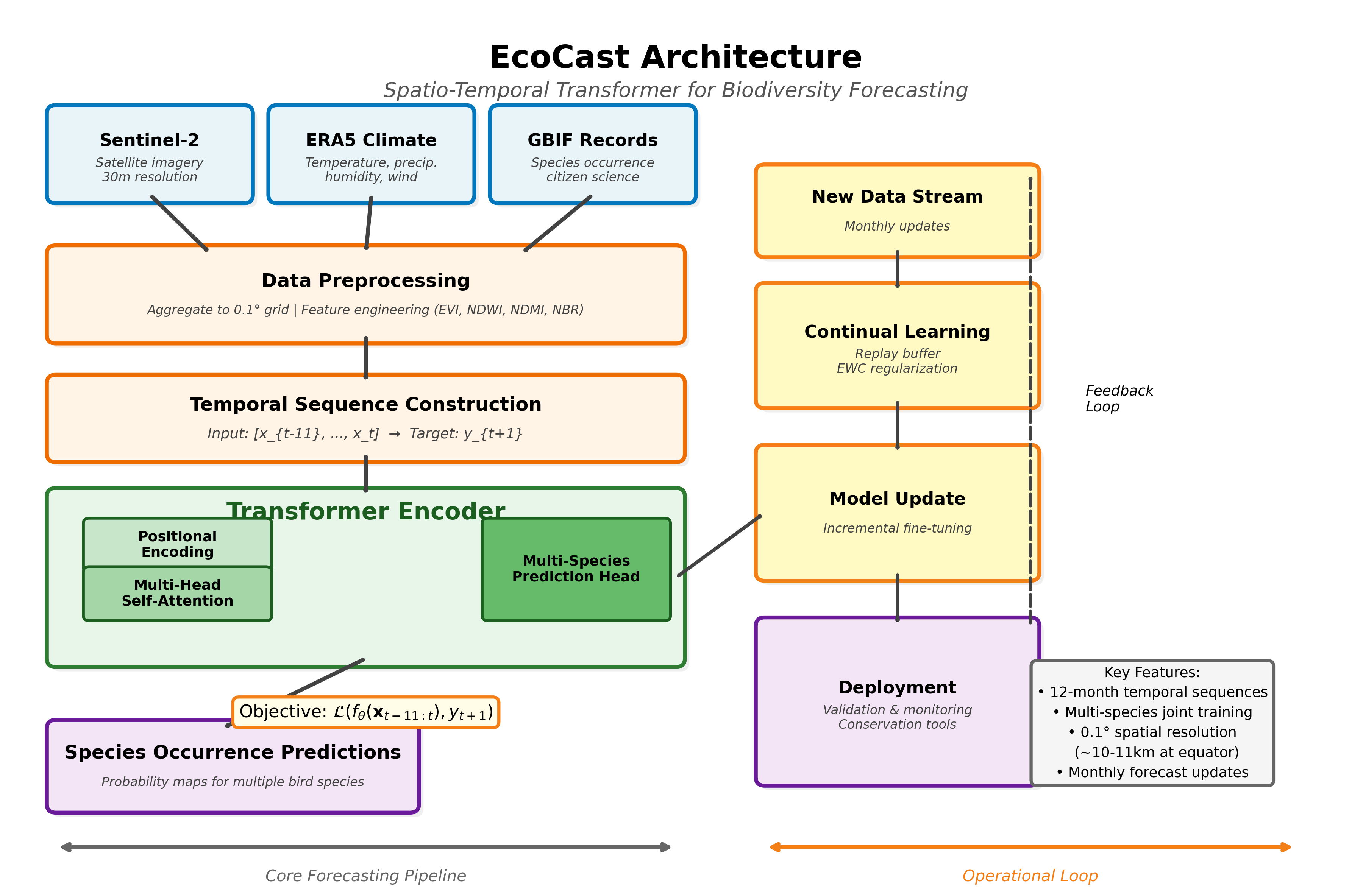
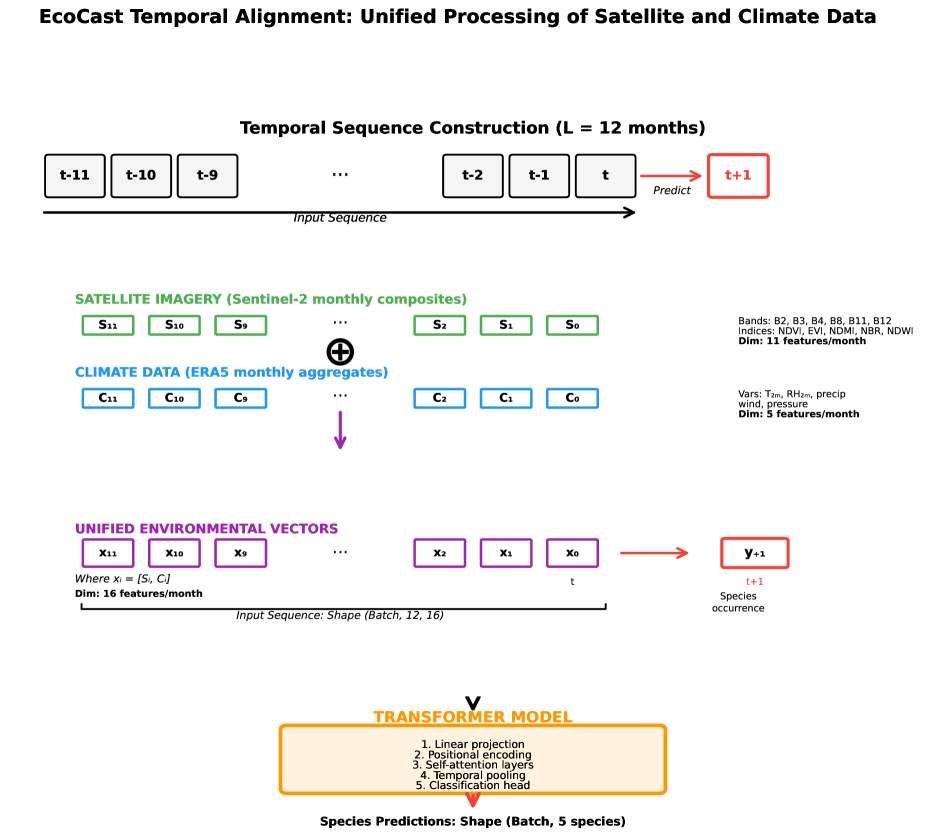
- Methodology First transformer-based model applied to ecological and climate risk forecasting in Africa, using sequence-to-point prediction (12-month environmental sequences → next-month species occurrence) with explicit temporal dependency modeling via self-attention.
- Methodology Integration of continual learning (rehearsal + EWC) into biodiversity forecasting, enabling model updates with new data streams without catastrophic forgetting, crucial for non-stationary climate impacts.
- Biology Operational near-term forecasting paradigm (monthly to seasonal) that requires no future climate projections, using observed environmental sequences to predict immediate conservation-relevant shifts, bridging geophysical forecasting architectures with species distribution modeling.
主要结论
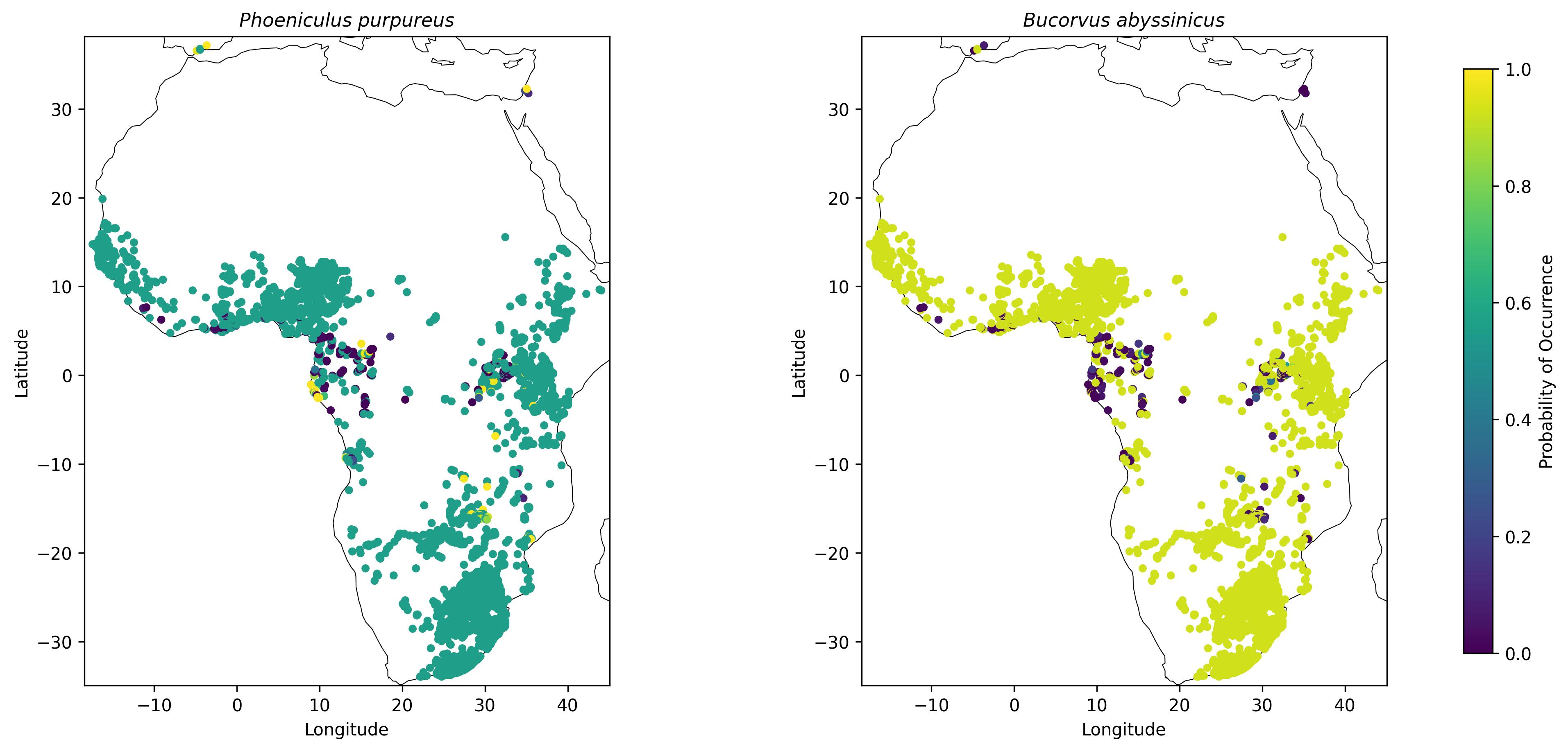
- EcoCast achieves macro-averaged F1 score of 0.65 and PR-AUC of 0.72 on 2023 holdout data for five African bird species, representing +34 and +43 percentage point improvements respectively over Random Forest baseline (F1=0.31, PR-AUC=0.29).
- Transformer architecture successfully captures critical temporal dependencies: annual seasonality via positional encoding, lagged environmental responses (2-4 month delays), and cross-species ecological signals through joint multi-label training.
- The framework demonstrates operational feasibility with monthly forecast updates using near-real-time data (ERA5 available within 5 days, final data 2-3 months later), enabling alignment with conservation planning cycles rather than static decadal projections.
摘要: Increasing climate change and habitat loss are driving unprecedented shifts in species distributions. Conservation professionals urgently need timely, high-resolution predictions of biodiversity risks, especially in ecologically diverse regions like Africa. We propose EcoCast, a spatio-temporal model designed for continual biodiversity and climate risk forecasting. Utilizing multisource satellite imagery, climate data, and citizen science occurrence records, EcoCast predicts near-term (monthly to seasonal) shifts in species distributions through sequence-based transformers that model spatio-temporal environmental dependencies. The architecture is designed with support for continual learning to enable future operational deployment with new data streams. Our pilot study in Africa shows promising improvements in forecasting distributions of selected bird species compared to a Random Forest baseline, highlighting EcoCast's potential to inform targeted conservation policies. By demonstrating an end-to-end pipeline from multi-modal data ingestion to operational forecasting, EcoCast bridges the gap between cutting-edge machine learning and biodiversity management, ultimately guiding data-driven strategies for climate resilience and ecosystem conservation throughout Africa.