
Paper List
-
Ill-Conditioning in Dictionary-Based Dynamic-Equation Learning: A Systems Biology Case Study
This paper addresses the critical challenge of numerical ill-conditioning and multicollinearity in library-based sparse regression methods (e.g., SIND...
-
Hybrid eTFCE–GRF: Exact Cluster-Size Retrieval with Analytical pp-Values for Voxel-Based Morphometry
This paper addresses the computational bottleneck in voxel-based neuroimaging analysis by providing a method that delivers exact cluster-size retrieva...
-
abx_amr_simulator: A simulation environment for antibiotic prescribing policy optimization under antimicrobial resistance
This paper addresses the critical challenge of quantitatively evaluating antibiotic prescribing policies under realistic uncertainty and partial obser...
-
PesTwin: a biology-informed Digital Twin for enabling precision farming
This paper addresses the critical bottleneck in precision agriculture: the inability to accurately forecast pest outbreaks in real-time, leading to su...
-
Equivariant Asynchronous Diffusion: An Adaptive Denoising Schedule for Accelerated Molecular Conformation Generation
This paper addresses the core challenge of generating physically plausible 3D molecular structures by bridging the gap between autoregressive methods ...
-
Omics Data Discovery Agents
This paper addresses the core challenge of making published omics data computationally reusable by automating the extraction, quantification, and inte...
-
Single-cell directional sensing at ultra-low chemoattractant concentrations from extreme first-passage events
This work addresses the core challenge of how a cell can rapidly and accurately determine the direction of a chemoattractant source when the signal is...
-
SDSR: A Spectral Divide-and-Conquer Approach for Species Tree Reconstruction
This paper addresses the computational bottleneck in reconstructing species trees from thousands of species and multiple genes by introducing a scalab...
Generative design and validation of therapeutic peptides for glioblastoma based on a potential target ATP5A
Shanghai Jiao Tong University | QuietD Biotech
30秒速读
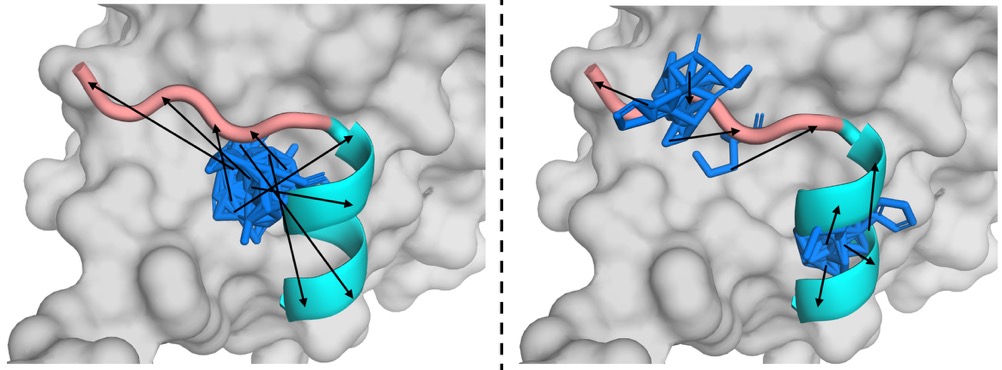
IN SHORT: This paper addresses the critical bottleneck in therapeutic peptide design: how to efficiently optimize lead peptides with geometric constraints while bridging the gap between computational generation and experimental validation.
核心创新
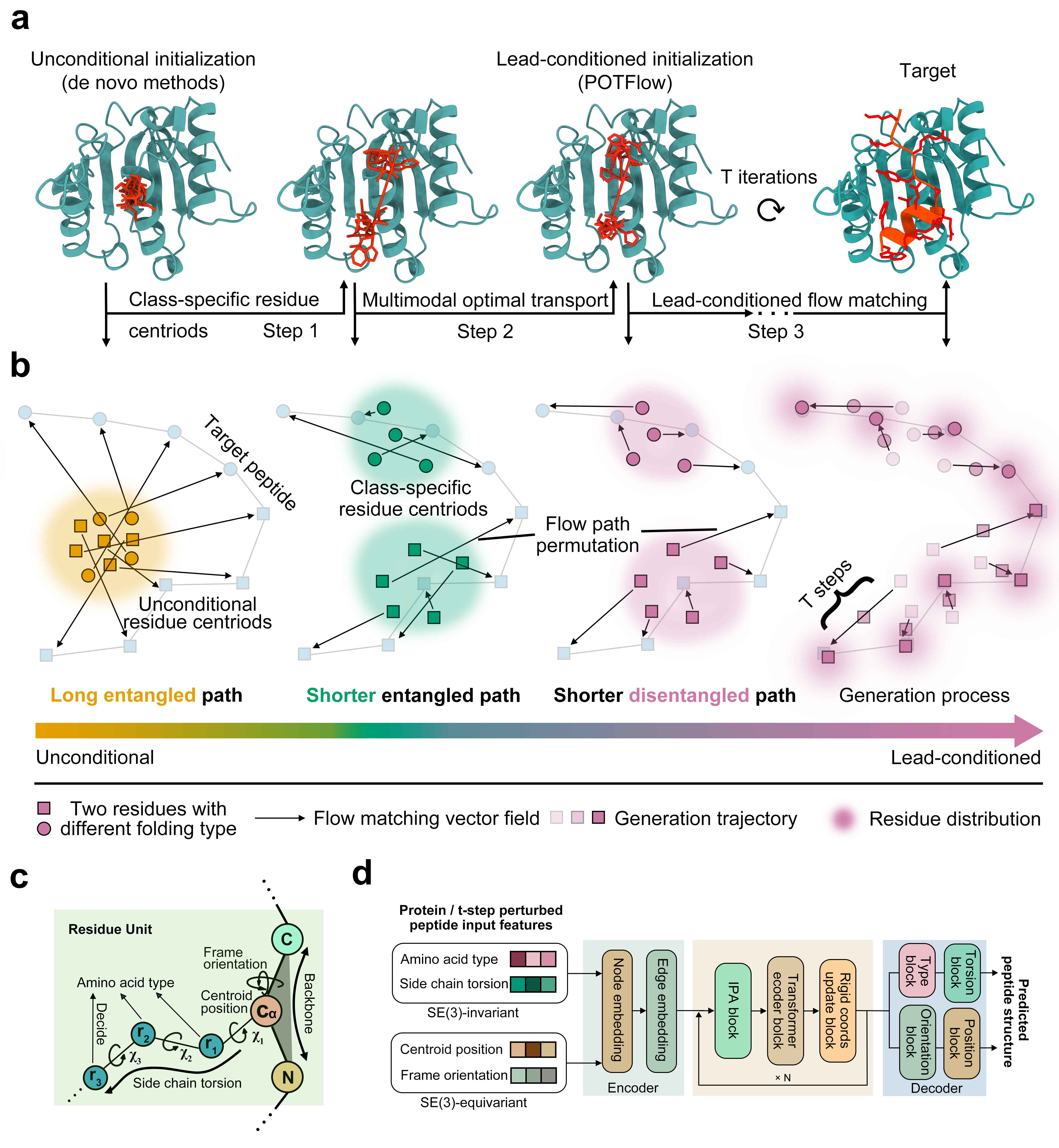
- Methodology Introduces POTFlow, the first lead peptide-conditioned flow matching model that incorporates secondary structure priors and optimal transport for shorter, disentangled generation paths
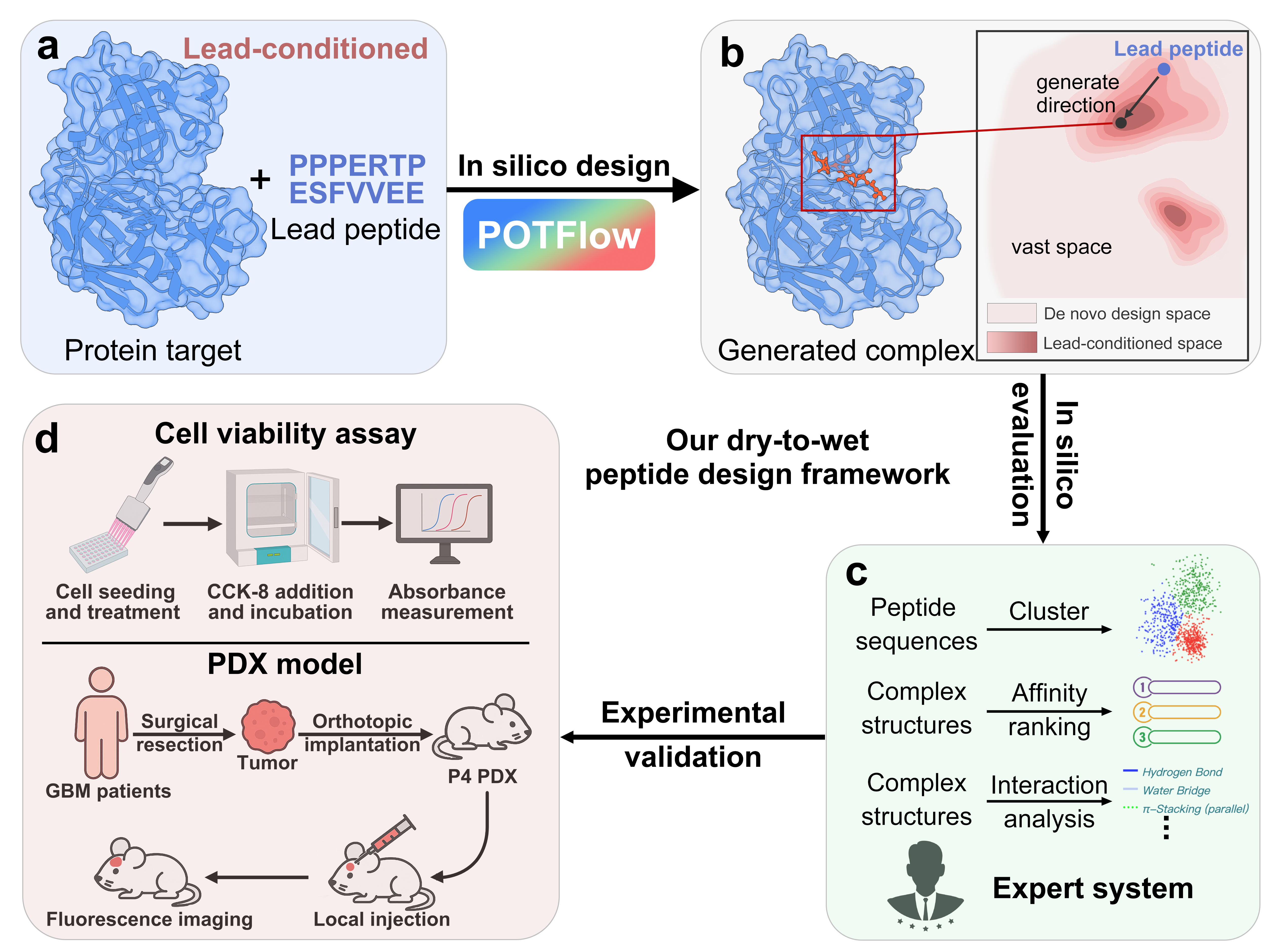
- Methodology Proposes a dry-to-wet framework that integrates computational design with experimental validation spanning in vitro assays and in vivo PDX models
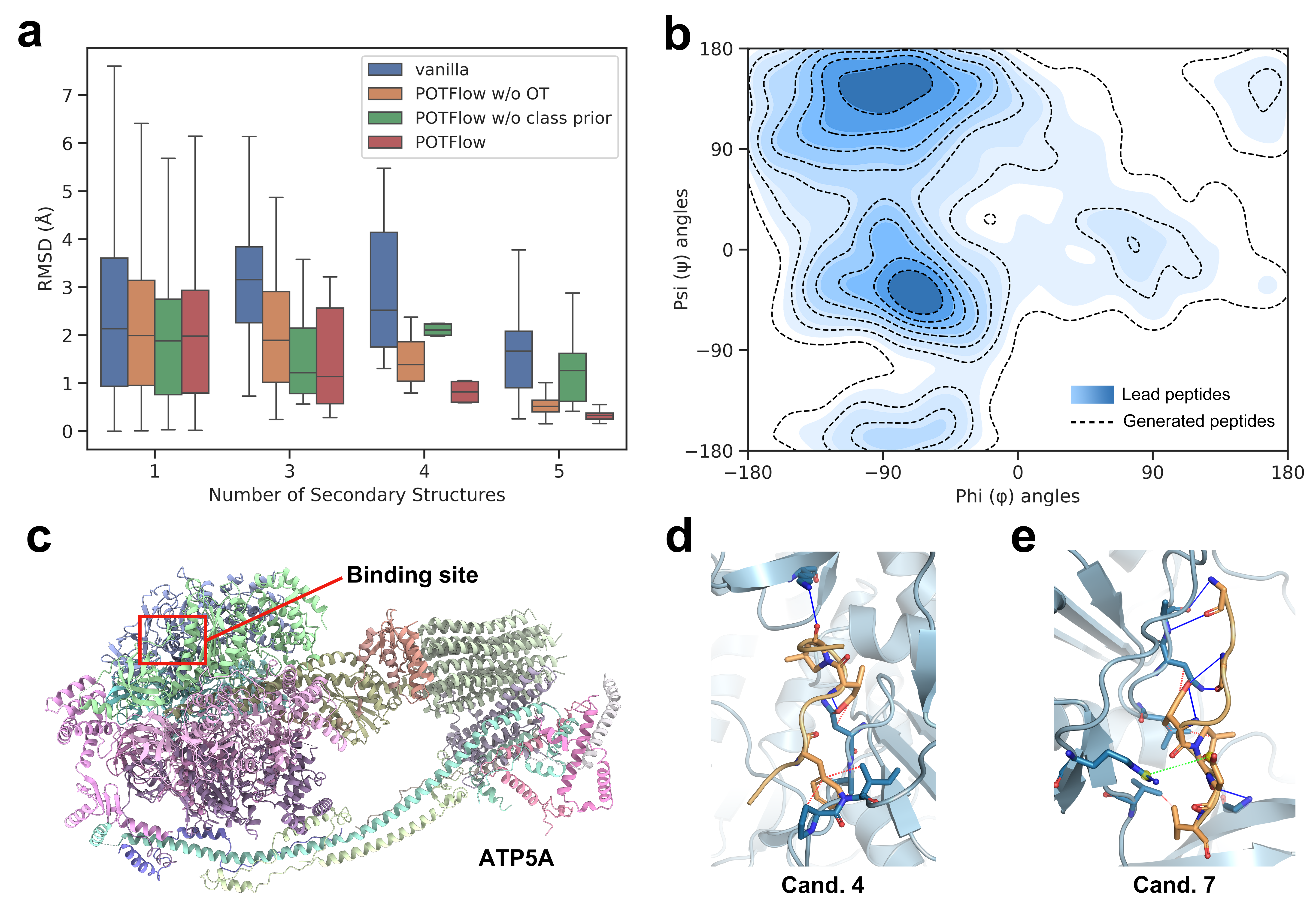
- Biology Demonstrates successful optimization of ATP5A-binding peptides for glioblastoma, achieving improved tumor selectivity and in vivo efficacy
主要结论
- POTFlow outperforms five state-of-the-art methods across multiple metrics, achieving 53.44% similarity, 95.07% compactness, 30.56% affinity, and 1.66Å RMSD on benchmark datasets

- Generated peptide candidates showed 18-68% higher inhibition of viability rate (IVR) in GBM cells compared to non-cancerous cells (<10%), demonstrating improved tumor selectivity
- High-dose candidate 4 (20mg/kg) significantly prolonged survival in PDX models (p-value = 0.02) with 40% of mice surviving beyond week 18 compared to 0% in control group
摘要: Glioblastoma (GBM) remains the most aggressive tumor, urgently requiring novel therapeutic strategies. Here, we present a dry-to-wet framework combining generative modeling and experimental validation to optimize peptides targeting ATP5A, a potential peptide-binding protein for GBM. Our framework introduces the first lead-conditioned generative model, which focuses exploration on geometrically relevant regions around lead peptides and mitigates the combinatorial complexity of de novo methods. Specifically, we propose POTFlow, a Prior and Optimal Transport-based Flow-matching model for peptide optimization. POTFlow employs secondary structure information (e.g., helix, sheet, loop) as geometric constraints, which are further refined by optimal transport to produce shorter flow paths. With this design, our method achieves state-of-the-art performance compared with five popular approaches. When applied to GBM, our method generates peptides that selectively inhibit cell viability and significantly prolong survival in a patient-derived xenograft (PDX) model. As the first lead peptide-conditioned flow matching model, POTFlow holds strong potential as a generalizable framework for therapeutic peptide design.