
Paper List
-
Ill-Conditioning in Dictionary-Based Dynamic-Equation Learning: A Systems Biology Case Study
This paper addresses the critical challenge of numerical ill-conditioning and multicollinearity in library-based sparse regression methods (e.g., SIND...
-
Hybrid eTFCE–GRF: Exact Cluster-Size Retrieval with Analytical pp-Values for Voxel-Based Morphometry
This paper addresses the computational bottleneck in voxel-based neuroimaging analysis by providing a method that delivers exact cluster-size retrieva...
-
abx_amr_simulator: A simulation environment for antibiotic prescribing policy optimization under antimicrobial resistance
This paper addresses the critical challenge of quantitatively evaluating antibiotic prescribing policies under realistic uncertainty and partial obser...
-
PesTwin: a biology-informed Digital Twin for enabling precision farming
This paper addresses the critical bottleneck in precision agriculture: the inability to accurately forecast pest outbreaks in real-time, leading to su...
-
Equivariant Asynchronous Diffusion: An Adaptive Denoising Schedule for Accelerated Molecular Conformation Generation
This paper addresses the core challenge of generating physically plausible 3D molecular structures by bridging the gap between autoregressive methods ...
-
Omics Data Discovery Agents
This paper addresses the core challenge of making published omics data computationally reusable by automating the extraction, quantification, and inte...
-
Single-cell directional sensing at ultra-low chemoattractant concentrations from extreme first-passage events
This work addresses the core challenge of how a cell can rapidly and accurately determine the direction of a chemoattractant source when the signal is...
-
SDSR: A Spectral Divide-and-Conquer Approach for Species Tree Reconstruction
This paper addresses the computational bottleneck in reconstructing species trees from thousands of species and multiple genes by introducing a scalab...
The BEAT-CF Causal Model: A model for guiding the design of trials and observational analyses of cystic fibrosis exacerbations
Bayesian Intelligence | Monash University | The Kids Research Institute Australia | University of Sydney | The Children's Hospital at Westmead
30秒速读
IN SHORT: This paper addresses the critical gap in cystic fibrosis exacerbation management by providing a formal causal framework that integrates expert knowledge to guide clinical trial design and enable robust causal inference.
核心创新
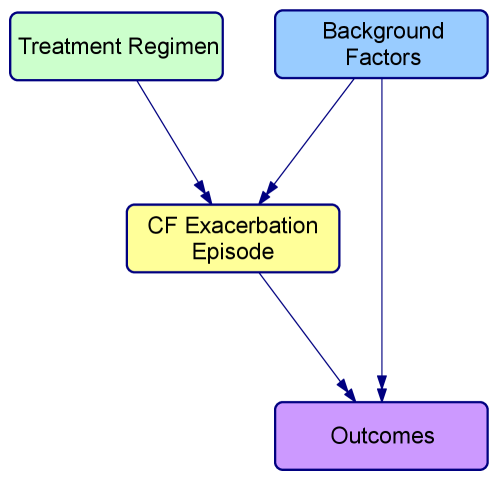
- Methodology Developed a comprehensive Bayesian causal model (DAG/BN) integrating 4 domains (background factors, treatments, exacerbation episode, outcomes) with 30+ nodes representing key pathophysiological processes
- Methodology Implemented a structured expert elicitation process involving 30+ CF clinicians across multiple workshops (2017-2019) using Delphi/nominal group techniques for variable selection and validation
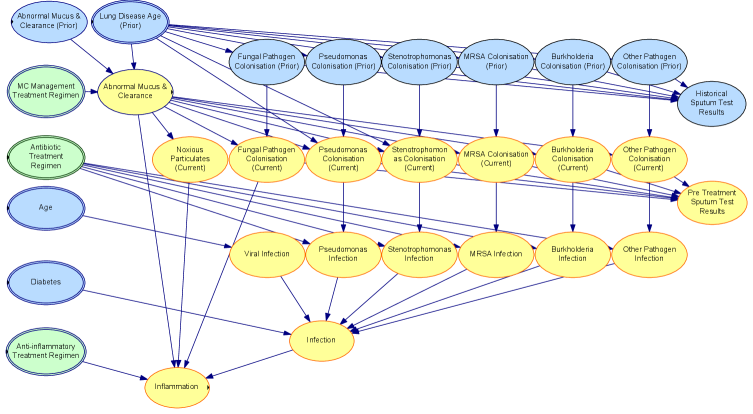
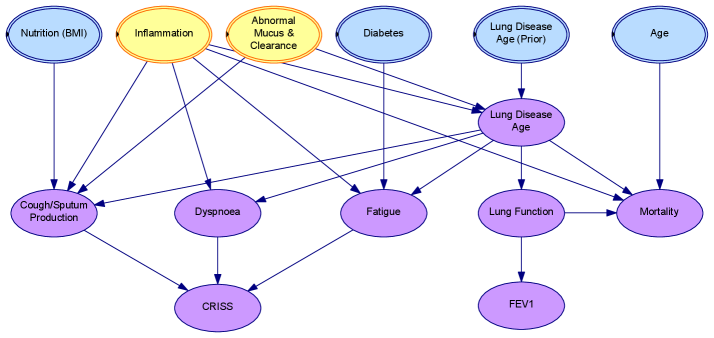
- Biology Explicitly models the causal pathways between abnormal mucus clearance, pathogen colonization (Pseudomonas aeruginosa, MRSA, etc.), infection, and inflammation - enabling targeted treatment effect analysis
主要结论
- The BEAT-CF causal model successfully integrates expert knowledge from 30+ clinicians into a formal DAG structure with 4 domains and 30+ nodes, validated through multiple workshops (2017-2019)
- The framework enables explicit causal inference by identifying necessary adjustments for statistical analyses, directly guiding data collection design for clinical trials
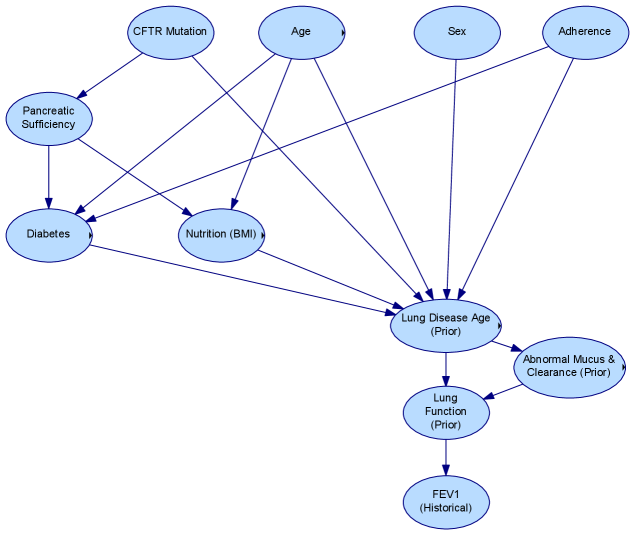
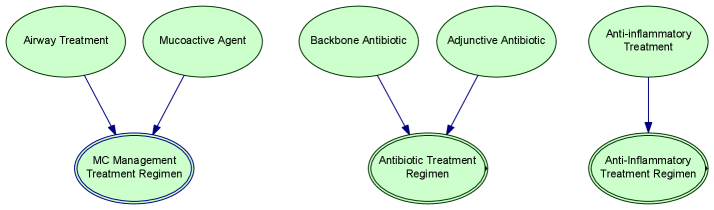
- The model provides a reusable, transparent framework that captures key relationships between background factors (lung disease age, CFTR mutations), treatments (antibiotics, anti-inflammatories), and outcomes (lung function decline, mortality)
摘要: Loss of lung function in cystic fibrosis (CF) occurs progressively, punctuated by acute pulmonary exacerbations (PEx) in which abrupt declines in lung function are not fully recovered. A key component of CF management over the past half century has been the treatment of PEx to slow lung function decline. This has been credited with improvements in survival for people with CF (PwCF), but there is no consensus on the optimal approach to PEx management. BEAT-CF (Bayesian evidence-adaptive treatment of CF) was established to build an evidence-informed knowledge base for CF management. The BEAT-CF causal model is a directed acyclic graph (DAG) and Bayesian network (BN) for PEx that aims to inform the design and analysis of clinical trials comparing the effectiveness of alternative approaches to PEx management. The causal model describes relationships between background risk factors, treatments, and pathogen colonisation of the airways that affect the outcome of an individual PEx episode. The key factors, outcomes, and causal relationships were elicited from CF clinical experts and together represent current expert understanding of the pathophysiology of a PEx episode, guiding the design of data collection and studies and enabling causal inference. Here, we present the DAG that documents this understanding, along with the processes used in its development, providing transparency around our trial design and study processes, as well as a reusable framework for others.