
Paper List
-
Nyxus: A Next Generation Image Feature Extraction Library for the Big Data and AI Era
This paper addresses the core pain point of efficiently extracting standardized, comparable features from massive (terabyte to petabyte-scale) biomedi...
-
Topological Enhancement of Protein Kinetic Stability
This work addresses the long-standing puzzle of why knotted proteins exist by demonstrating that deep knots provide a functional advantage through enh...
-
A Multi-Label Temporal Convolutional Framework for Transcription Factor Binding Characterization
This paper addresses the critical limitation of existing TF binding prediction methods that treat transcription factors as independent entities, faili...
-
Social Distancing Equilibria in Games under Conventional SI Dynamics
This paper solves the core problem of proving the existence and uniqueness of Nash equilibria in finite-duration SI epidemic games, showing they are a...
-
Binding Free Energies without Alchemy
This paper addresses the core bottleneck of computational expense in Absolute Binding Free Energy calculations by eliminating the need for numerous al...
-
SHREC: A Spectral Embedding-Based Approach for Ab-Initio Reconstruction of Helical Molecules
This paper addresses the core bottleneck in cryo-EM helical reconstruction: eliminating the dependency on accurate initial symmetry parameter estimati...
-
Budget-Sensitive Discovery Scoring: A Formally Verified Framework for Evaluating AI-Guided Scientific Selection
This paper addresses the critical gap in evaluating AI-guided scientific selection strategies under realistic budget constraints, where existing metri...
-
Probabilistic Joint and Individual Variation Explained (ProJIVE) for Data Integration
This paper addresses the core challenge of accurately decomposing shared (joint) and dataset-specific (individual) sources of variation in multi-modal...
Generative design and validation of therapeutic peptides for glioblastoma based on a potential target ATP5A
Shanghai Jiao Tong University | QuietD Biotech
30秒速读
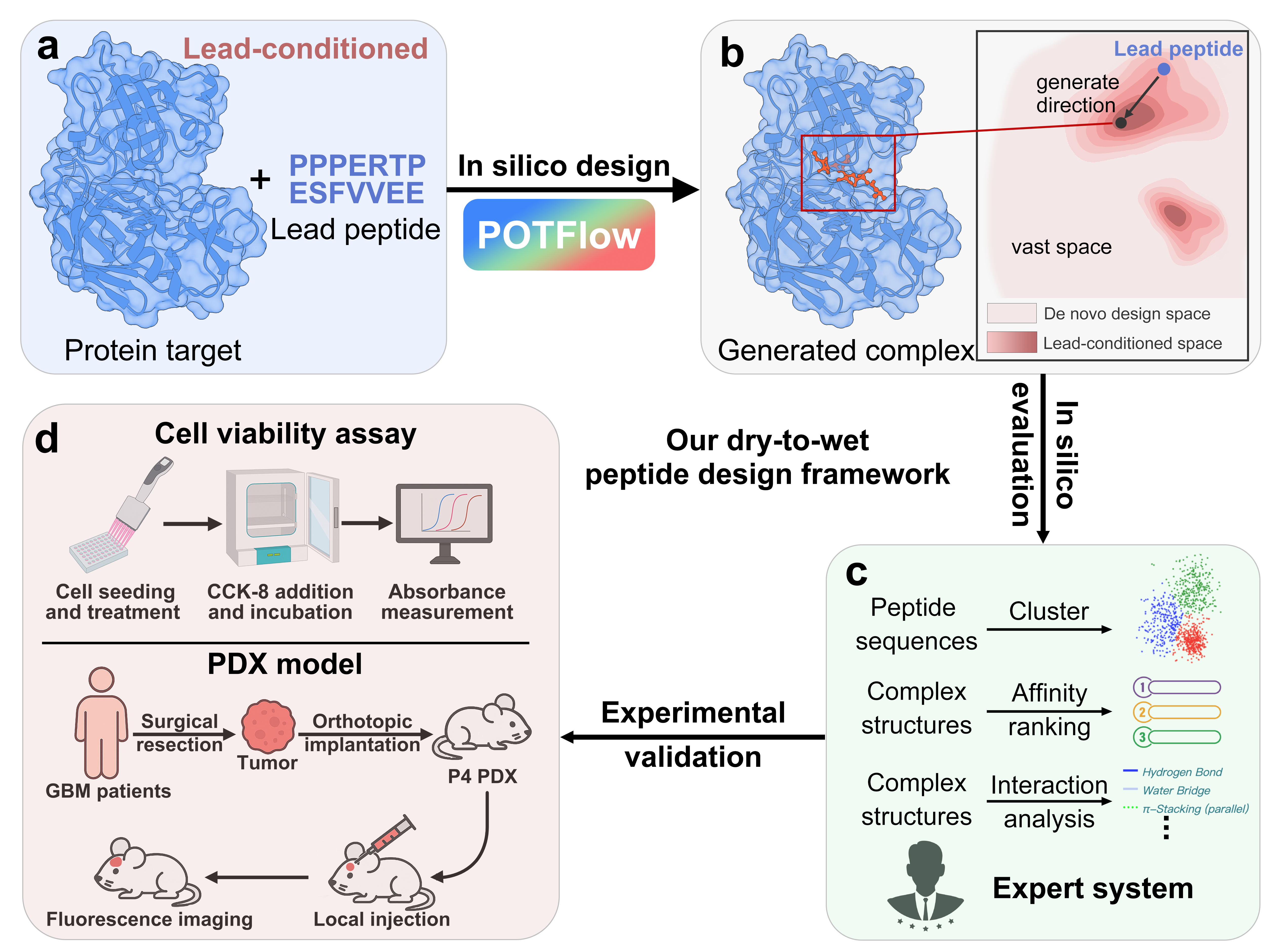
IN SHORT: This paper addresses the critical bottleneck in therapeutic peptide design: how to efficiently optimize lead peptides with geometric constraints while bridging the gap between computational generation and experimental validation.
核心创新
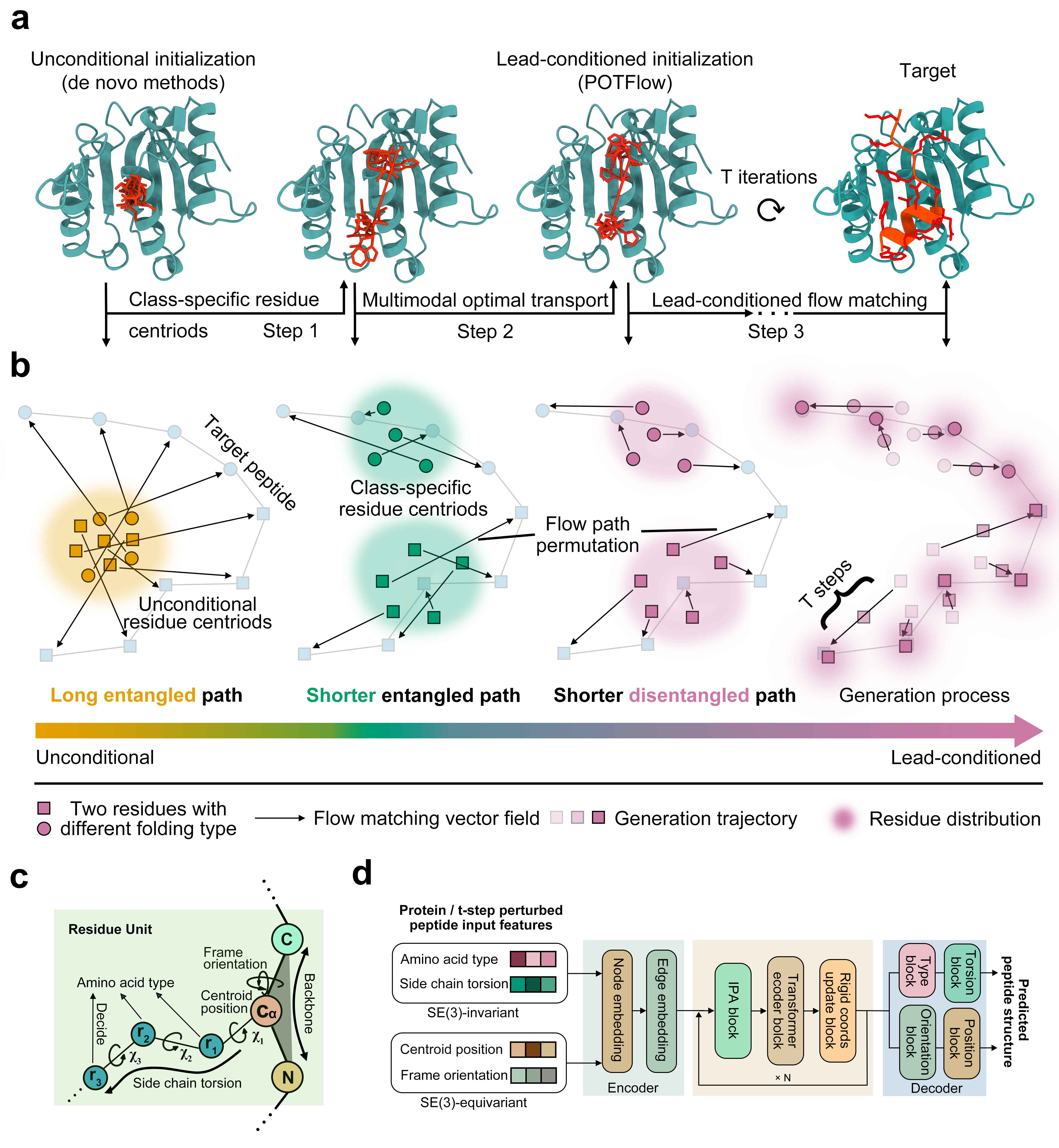
- Methodology Introduces POTFlow, the first lead peptide-conditioned flow matching model that incorporates secondary structure priors and optimal transport for shorter, disentangled generation paths
- Methodology Proposes a dry-to-wet framework that integrates computational design with experimental validation spanning in vitro assays and in vivo PDX models
- Biology Demonstrates successful optimization of ATP5A-binding peptides for glioblastoma, achieving improved tumor selectivity and in vivo efficacy
主要结论
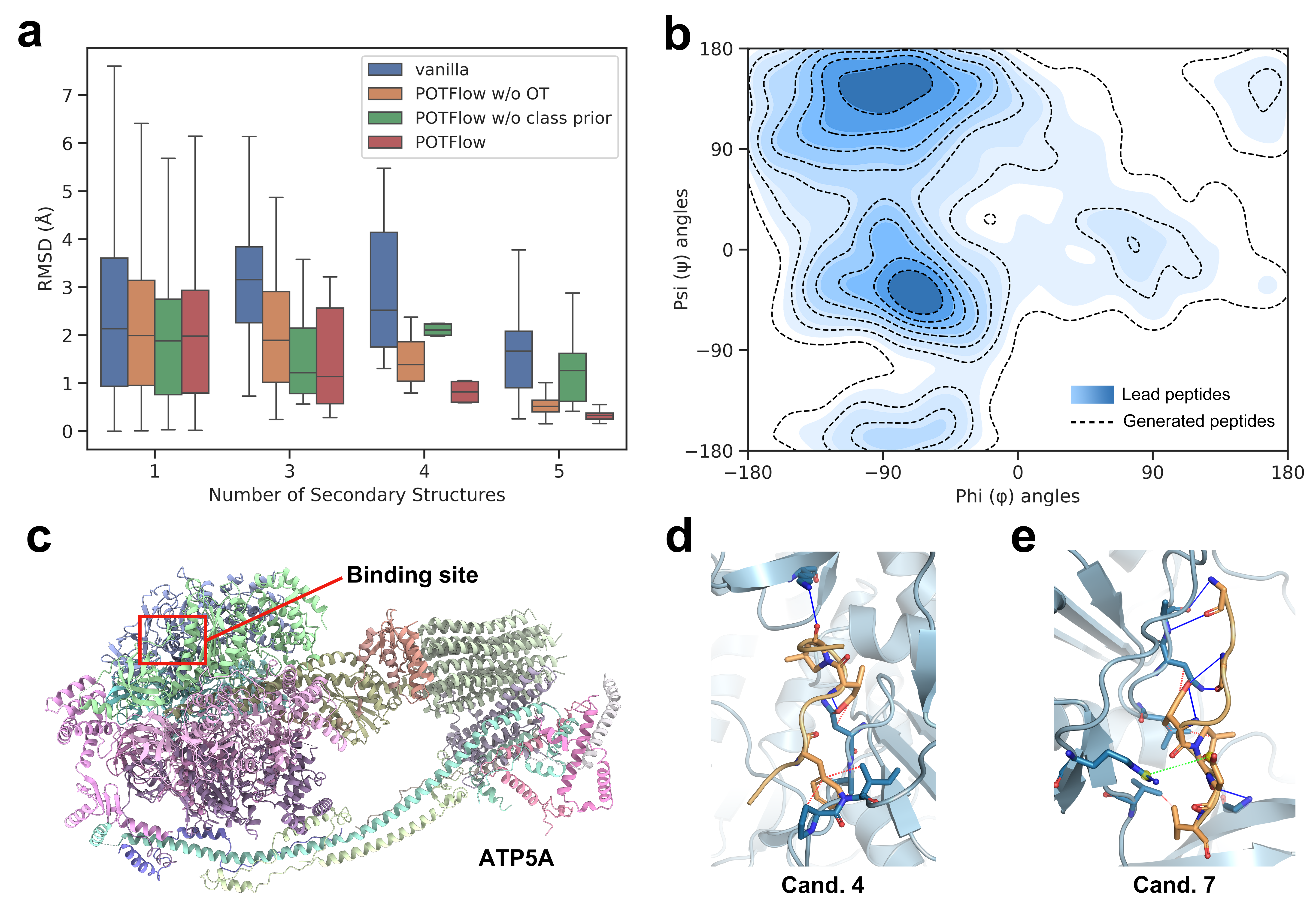
- POTFlow outperforms five state-of-the-art methods across multiple metrics, achieving 53.44% similarity, 95.07% compactness, 30.56% affinity, and 1.66Å RMSD on benchmark datasets

- Generated peptide candidates showed 18-68% higher inhibition of viability rate (IVR) in GBM cells compared to non-cancerous cells (<10%), demonstrating improved tumor selectivity
- High-dose candidate 4 (20mg/kg) significantly prolonged survival in PDX models (p-value = 0.02) with 40% of mice surviving beyond week 18 compared to 0% in control group
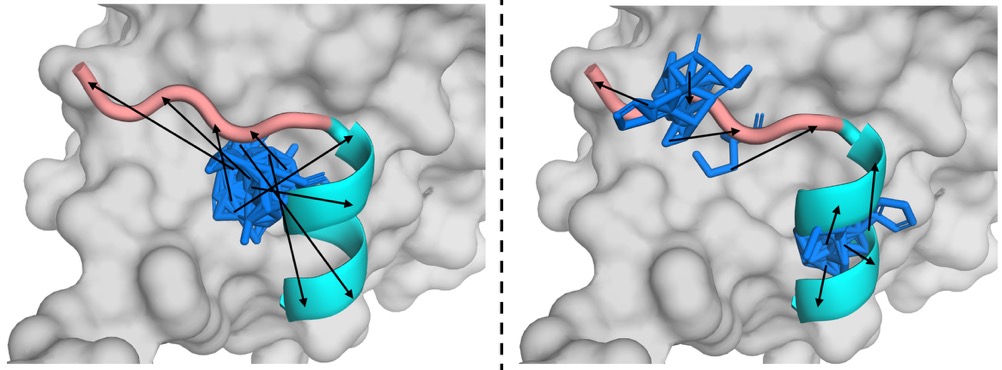
摘要: Glioblastoma (GBM) remains the most aggressive tumor, urgently requiring novel therapeutic strategies. Here, we present a dry-to-wet framework combining generative modeling and experimental validation to optimize peptides targeting ATP5A, a potential peptide-binding protein for GBM. Our framework introduces the first lead-conditioned generative model, which focuses exploration on geometrically relevant regions around lead peptides and mitigates the combinatorial complexity of de novo methods. Specifically, we propose POTFlow, a Prior and Optimal Transport-based Flow-matching model for peptide optimization. POTFlow employs secondary structure information (e.g., helix, sheet, loop) as geometric constraints, which are further refined by optimal transport to produce shorter flow paths. With this design, our method achieves state-of-the-art performance compared with five popular approaches. When applied to GBM, our method generates peptides that selectively inhibit cell viability and significantly prolong survival in a patient-derived xenograft (PDX) model. As the first lead peptide-conditioned flow matching model, POTFlow holds strong potential as a generalizable framework for therapeutic peptide design.