
Paper List
-
Nyxus: A Next Generation Image Feature Extraction Library for the Big Data and AI Era
This paper addresses the core pain point of efficiently extracting standardized, comparable features from massive (terabyte to petabyte-scale) biomedi...
-
Topological Enhancement of Protein Kinetic Stability
This work addresses the long-standing puzzle of why knotted proteins exist by demonstrating that deep knots provide a functional advantage through enh...
-
A Multi-Label Temporal Convolutional Framework for Transcription Factor Binding Characterization
This paper addresses the critical limitation of existing TF binding prediction methods that treat transcription factors as independent entities, faili...
-
Social Distancing Equilibria in Games under Conventional SI Dynamics
This paper solves the core problem of proving the existence and uniqueness of Nash equilibria in finite-duration SI epidemic games, showing they are a...
-
Binding Free Energies without Alchemy
This paper addresses the core bottleneck of computational expense in Absolute Binding Free Energy calculations by eliminating the need for numerous al...
-
SHREC: A Spectral Embedding-Based Approach for Ab-Initio Reconstruction of Helical Molecules
This paper addresses the core bottleneck in cryo-EM helical reconstruction: eliminating the dependency on accurate initial symmetry parameter estimati...
-
Budget-Sensitive Discovery Scoring: A Formally Verified Framework for Evaluating AI-Guided Scientific Selection
This paper addresses the critical gap in evaluating AI-guided scientific selection strategies under realistic budget constraints, where existing metri...
-
Probabilistic Joint and Individual Variation Explained (ProJIVE) for Data Integration
This paper addresses the core challenge of accurately decomposing shared (joint) and dataset-specific (individual) sources of variation in multi-modal...
Enhancing Clinical Note Generation with ICD-10, Clinical Ontology Knowledge Graphs, and Chain-of-Thought Prompting Using GPT-4
Computer Science, Old Dominion University | Biomedical Informatics, University of Arkansas for Medical Sciences

30秒速读
IN SHORT: This paper addresses the core challenge of generating accurate and clinically relevant patient notes from sparse inputs (ICD codes and basic demographics) by augmenting Chain-of-Thought prompting with semantic search and structured medical knowledge graphs.
核心创新
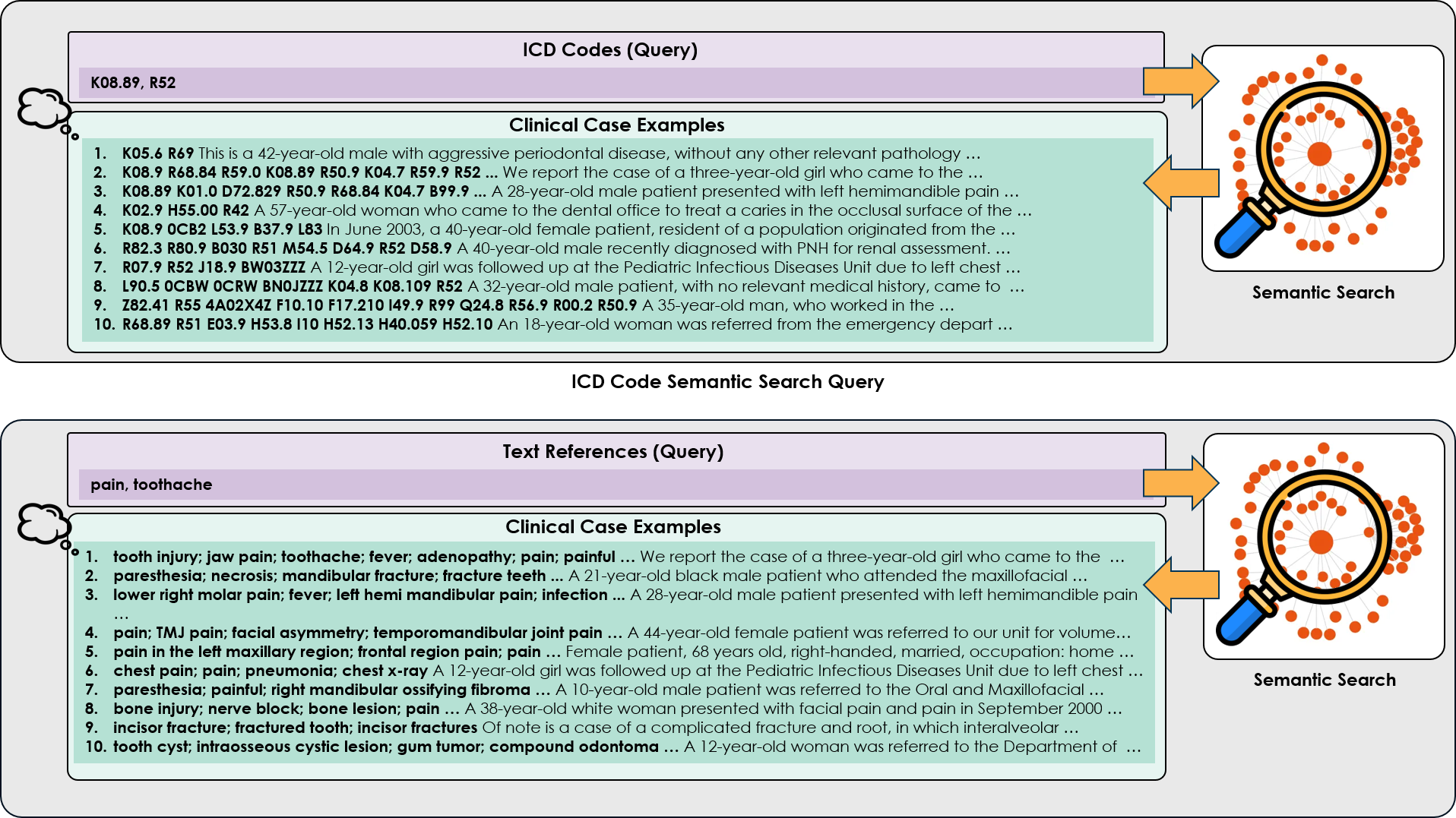
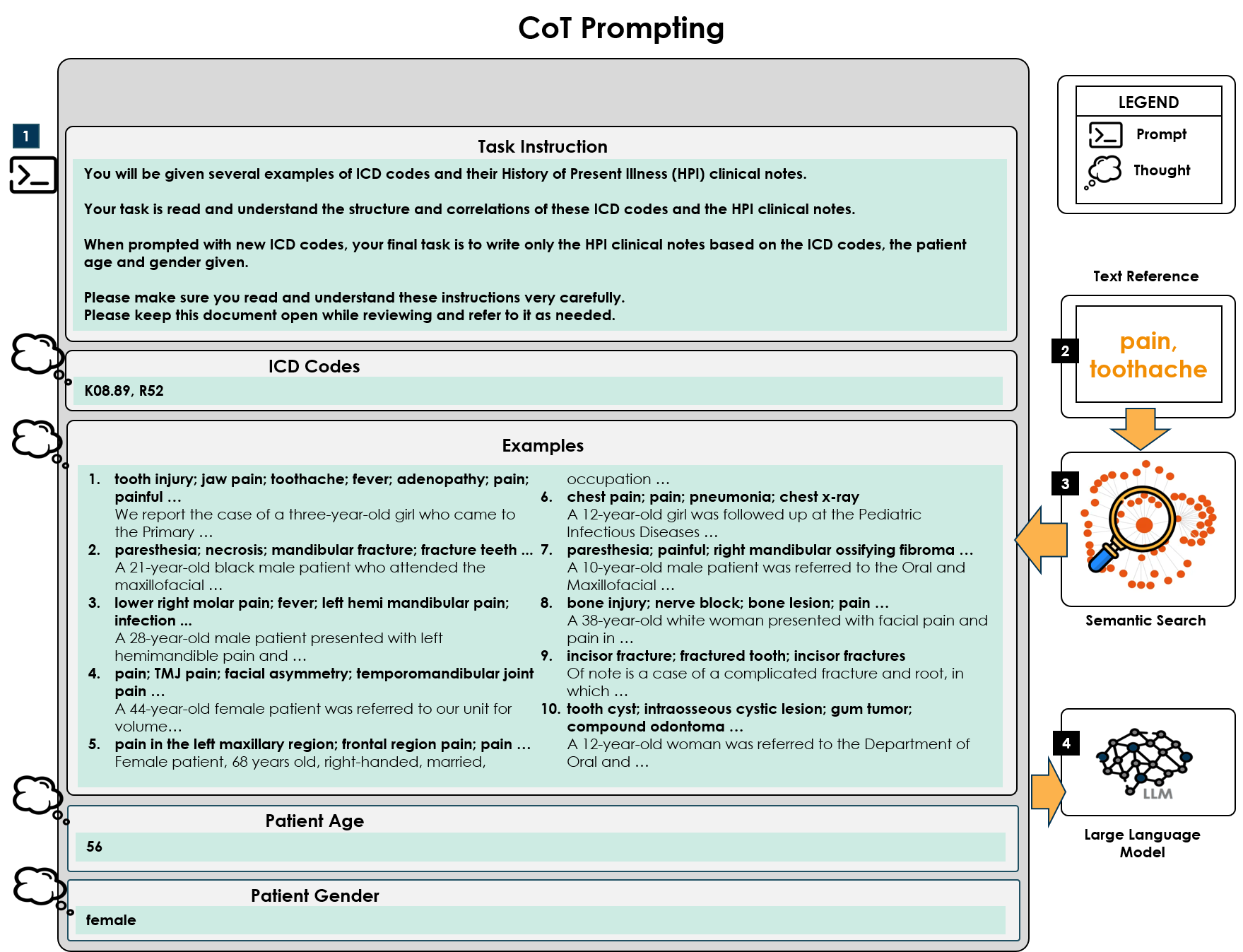
- Methodology Proposes a novel hybrid prompting framework that integrates traditional Chain-of-Thought reasoning with semantic search results from a clinical corpus (CodiEsp dataset) to provide contextual examples.
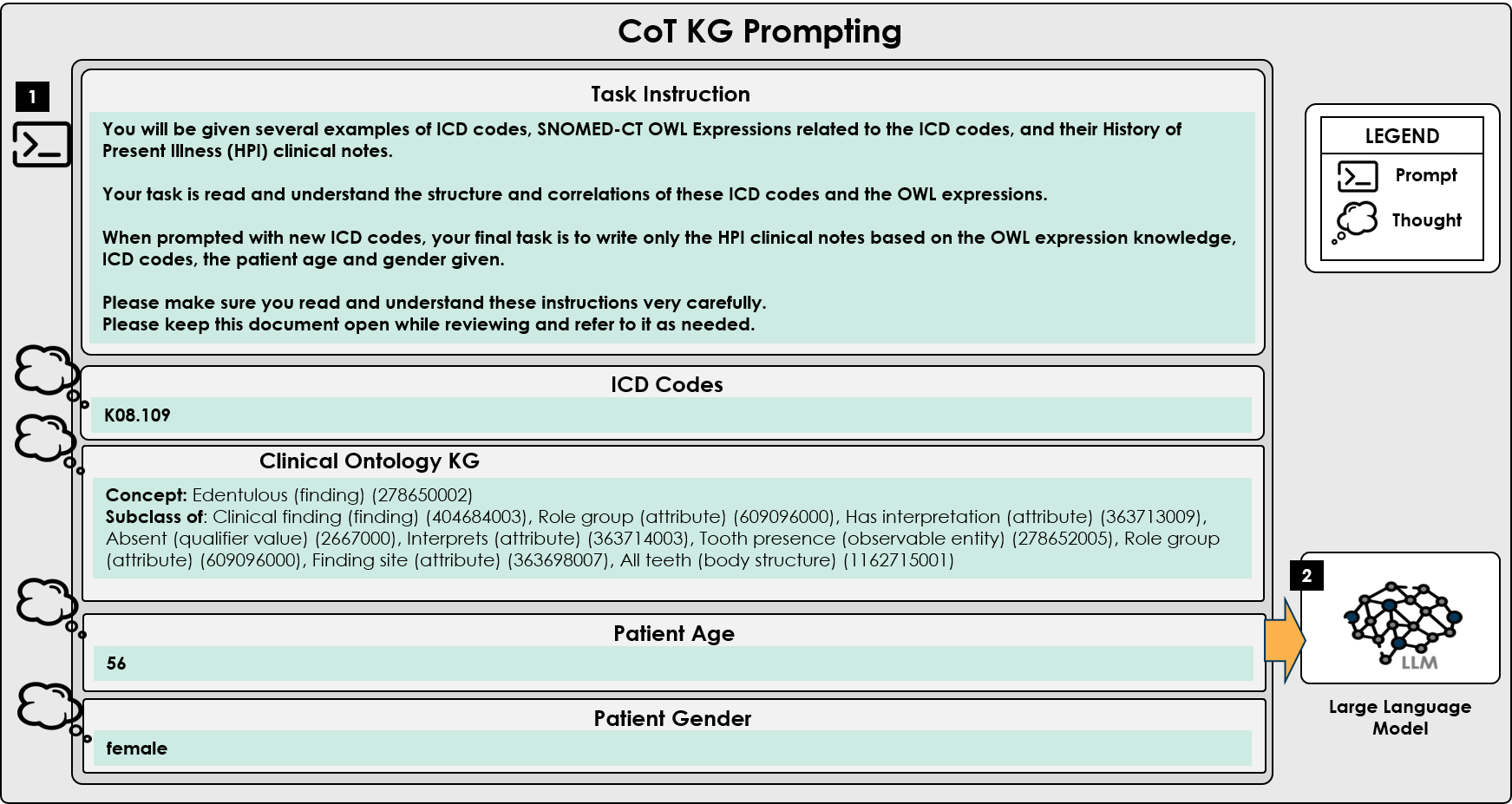
- Methodology Introduces the infusion of a structured clinical ontology knowledge graph (built from SNOMED CT OWL expressions) directly into the LLM prompt to ground generation in formal medical relationships and constraints.
- Methodology/Biology Demonstrates the first systematic approach to reverse the common ICD code classification task, instead generating comprehensive clinical notes from ICD codes as primary input, evaluated on six distinct clinical cases.
主要结论
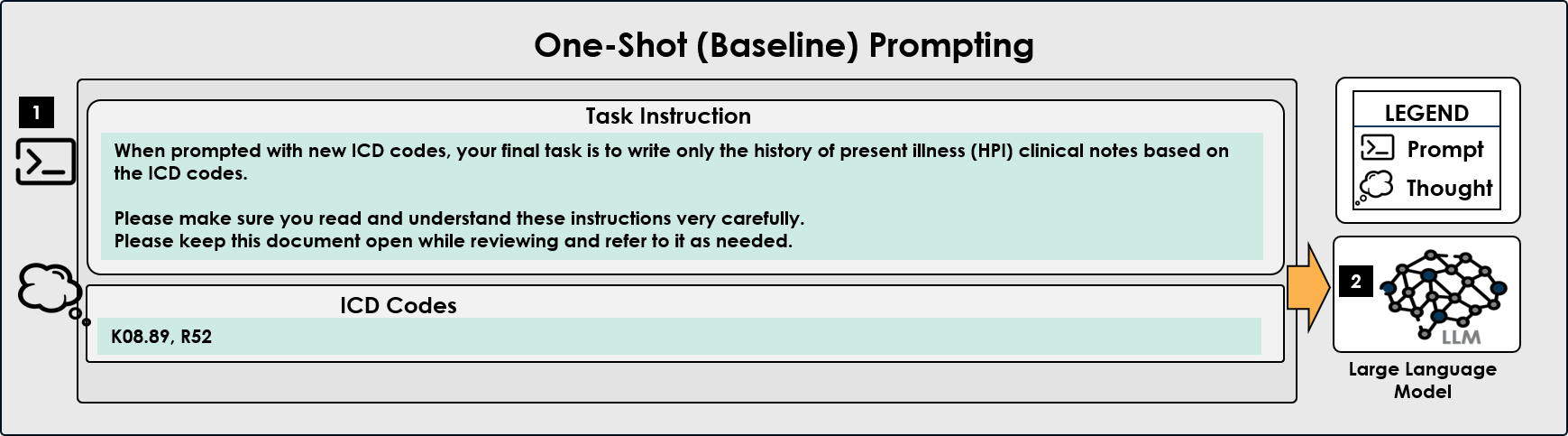
- The proposed CoT prompting with semantic search (using ICD codes as query) consistently outperformed the standard one-shot baseline across six clinical cases, as evidenced by lower cosine distance scores (e.g., Case C showed a clear leftward shift in KDE peak, indicating higher semantic similarity to ground truth).
- Incorporating a clinical knowledge graph (SNOMED CT OWL) into the prompt (CoT KG) provided structured medical relationships, enriching the generated notes with domain-specific terminology and logical constraints derived from formal ontologies.
- The hybrid approach (CoT Semantic Search + KG) leverages both in-context examples from similar cases and formal medical knowledge, offering a robust framework for improving the factual accuracy and clinical relevance of LLM-generated notes from coded inputs.
摘要: In the past decade a surge in the amount of electronic health record (EHR) data in the United States, attributed to a favorable policy environment created by the Health Information Technology for Economic and Clinical Health (HITECH) Act of 2009 and the 21st Century Cures Act of 2016. Clinical notes for patients’ assessments, diagnoses, and treatments are captured in these EHRs in free-form text by physicians, who spend a considerable amount of time entering and editing them. Manually writing clinical notes takes a considerable amount of a doctor’s valuable time, increasing the patient’s waiting time and possibly delaying diagnoses. Large language models (LLMs) possess the ability to generate news articles that closely resemble human-written ones. We investigate the usage of Chain-of-Thought (CoT) prompt engineering to improve the LLM’s response in clinical note generation. In our prompts, we use as input International Classification of Diseases (ICD) codes and basic patient information. We investigate a strategy that combines the traditional CoT with semantic search results to improve the quality of generated clinical notes. Additionally, we infuse a knowledge graph (KG) built from clinical ontology to further enrich the domain-specific knowledge of generated clinical notes. We test our prompting technique on six clinical cases from the CodiEsp test dataset using GPT-4 and our results show that it outperformed the clinical notes generated by standard one-shot prompts.