
Paper List
-
Nyxus: A Next Generation Image Feature Extraction Library for the Big Data and AI Era
This paper addresses the core pain point of efficiently extracting standardized, comparable features from massive (terabyte to petabyte-scale) biomedi...
-
Topological Enhancement of Protein Kinetic Stability
This work addresses the long-standing puzzle of why knotted proteins exist by demonstrating that deep knots provide a functional advantage through enh...
-
A Multi-Label Temporal Convolutional Framework for Transcription Factor Binding Characterization
This paper addresses the critical limitation of existing TF binding prediction methods that treat transcription factors as independent entities, faili...
-
Social Distancing Equilibria in Games under Conventional SI Dynamics
This paper solves the core problem of proving the existence and uniqueness of Nash equilibria in finite-duration SI epidemic games, showing they are a...
-
Binding Free Energies without Alchemy
This paper addresses the core bottleneck of computational expense in Absolute Binding Free Energy calculations by eliminating the need for numerous al...
-
SHREC: A Spectral Embedding-Based Approach for Ab-Initio Reconstruction of Helical Molecules
This paper addresses the core bottleneck in cryo-EM helical reconstruction: eliminating the dependency on accurate initial symmetry parameter estimati...
-
Budget-Sensitive Discovery Scoring: A Formally Verified Framework for Evaluating AI-Guided Scientific Selection
This paper addresses the critical gap in evaluating AI-guided scientific selection strategies under realistic budget constraints, where existing metri...
-
Probabilistic Joint and Individual Variation Explained (ProJIVE) for Data Integration
This paper addresses the core challenge of accurately decomposing shared (joint) and dataset-specific (individual) sources of variation in multi-modal...
Influence of Object Affordance on Action Language Understanding: Evidence from Dynamic Causal Modeling Analysis
Centre for Linguistic Science and Technology (CLST), Indian Institute of Technology Guwahati | Neural Engineering Lab, Department of Bio Sciences and Bio Engineering, IIT Guwahati | Biomimetic Robotics and Artificial Intelligence Lab (BRAIL), Department of Mechanical Engineering, IIT Guwahati
30秒速读
IN SHORT: This study addresses the core challenge of moving beyond correlational evidence to establish the *causal direction* and *temporal dynamics* of how object affordance processing in sensorimotor brain regions drives the comprehension of action-related language.
核心创新
- Methodology Applies Dynamic Causal Modeling (DCM) to EEG data to infer *directed, causal connectivity* between key brain regions during affordance-language processing, moving beyond traditional correlational analyses.
- Biology Identifies a specific feedforward causal architecture where the Ventral Premotor Cortex (PMv) acts as a driver, causally influencing the Inferior Parietal Lobule (IPL) and Posterior Superior Temporal Gyrus (pSTG) during action language comprehension.
- Theory Provides direct, mechanistic evidence supporting grounded/embodied cognition theories by showing that affordance-related motor regions (PMv) actively *drive* semantic hubs (pSTG, IPL), rather than merely co-activating with them.
主要结论
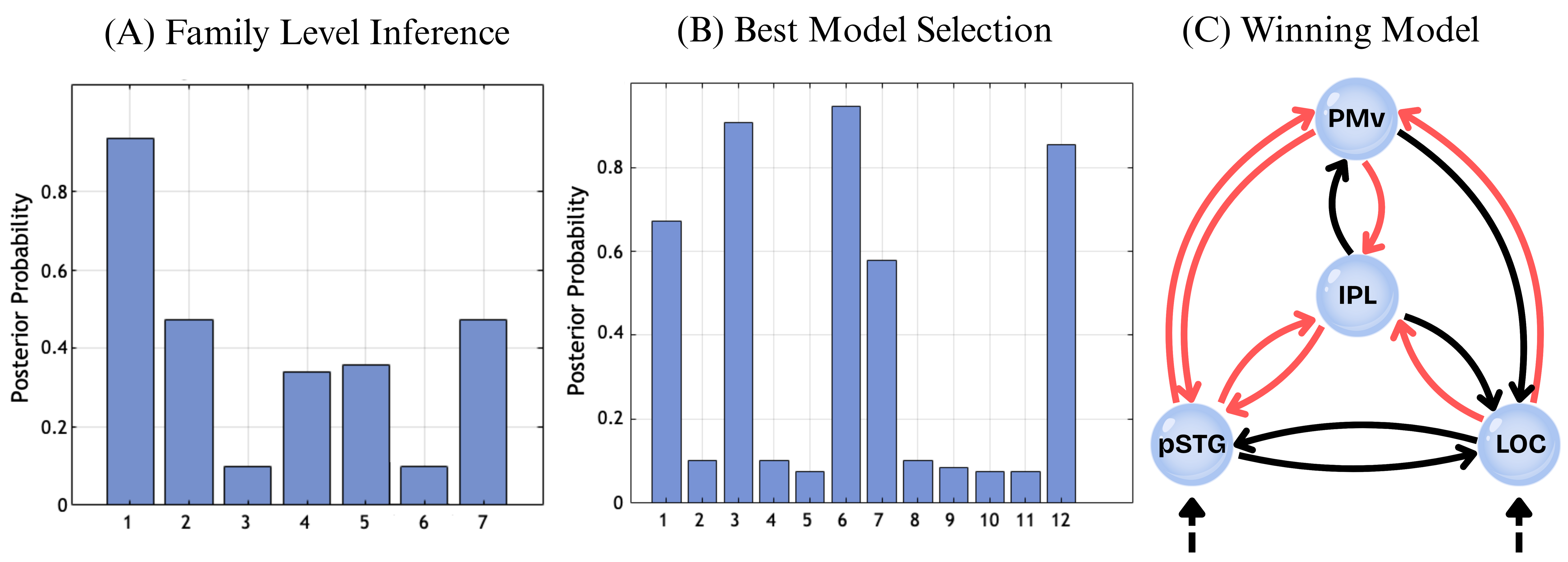
- Bayesian Model Selection identified a dominant model (M6, exceedance probability = 0.91) featuring strong modulatory influences from PMv to IPL (mean coupling strength = 0.28 Hz ± 0.05) and PMv to pSTG, establishing a causal feedforward pathway from motor to semantic regions.
- The video+text condition significantly strengthened the causal influence from PMv to IPL and pSTG compared to the text-only condition, demonstrating that multimodal (visual+linguistic) affordance cues amplify the driving role of premotor cortex.
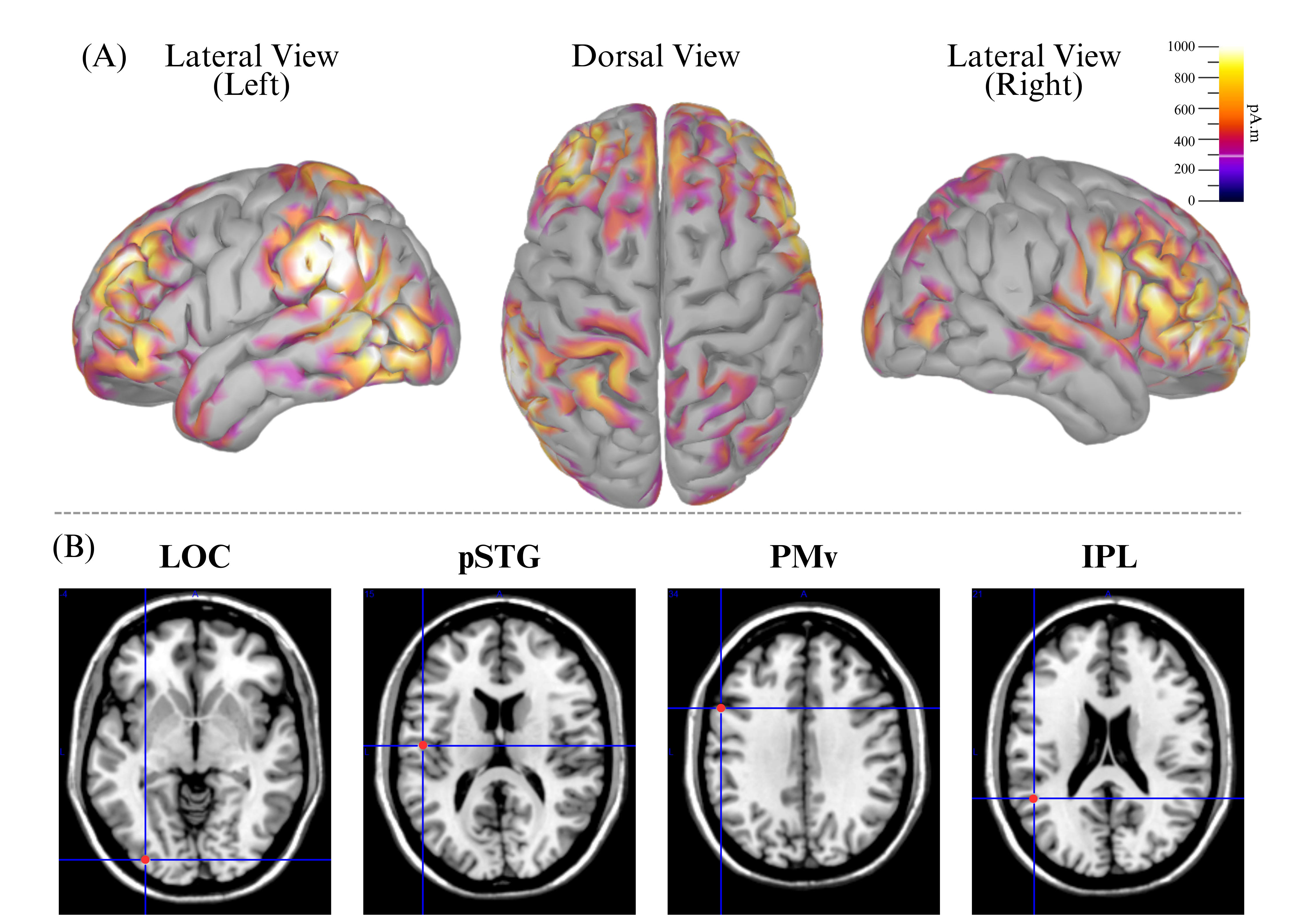
- Source localization (LORETA) and DCM together delineate a core left-hemisphere network (LOC, pSTg, PMv, IPL) where visual input (LOC) feeds into premotor affordance processing (PMv), which in turn causally drives semantic integration in parietal (IPL) and temporal (pSTG) hubs.
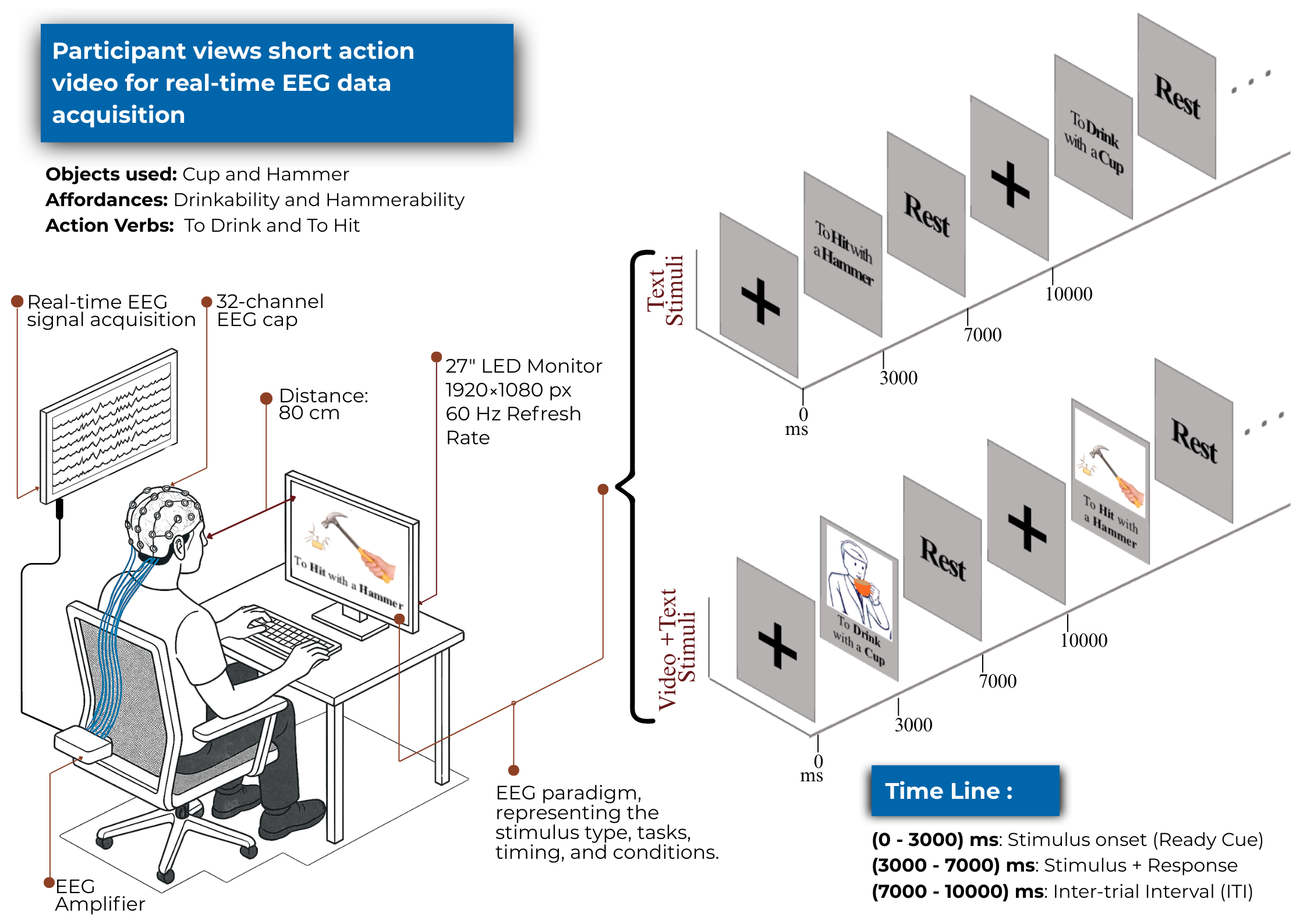
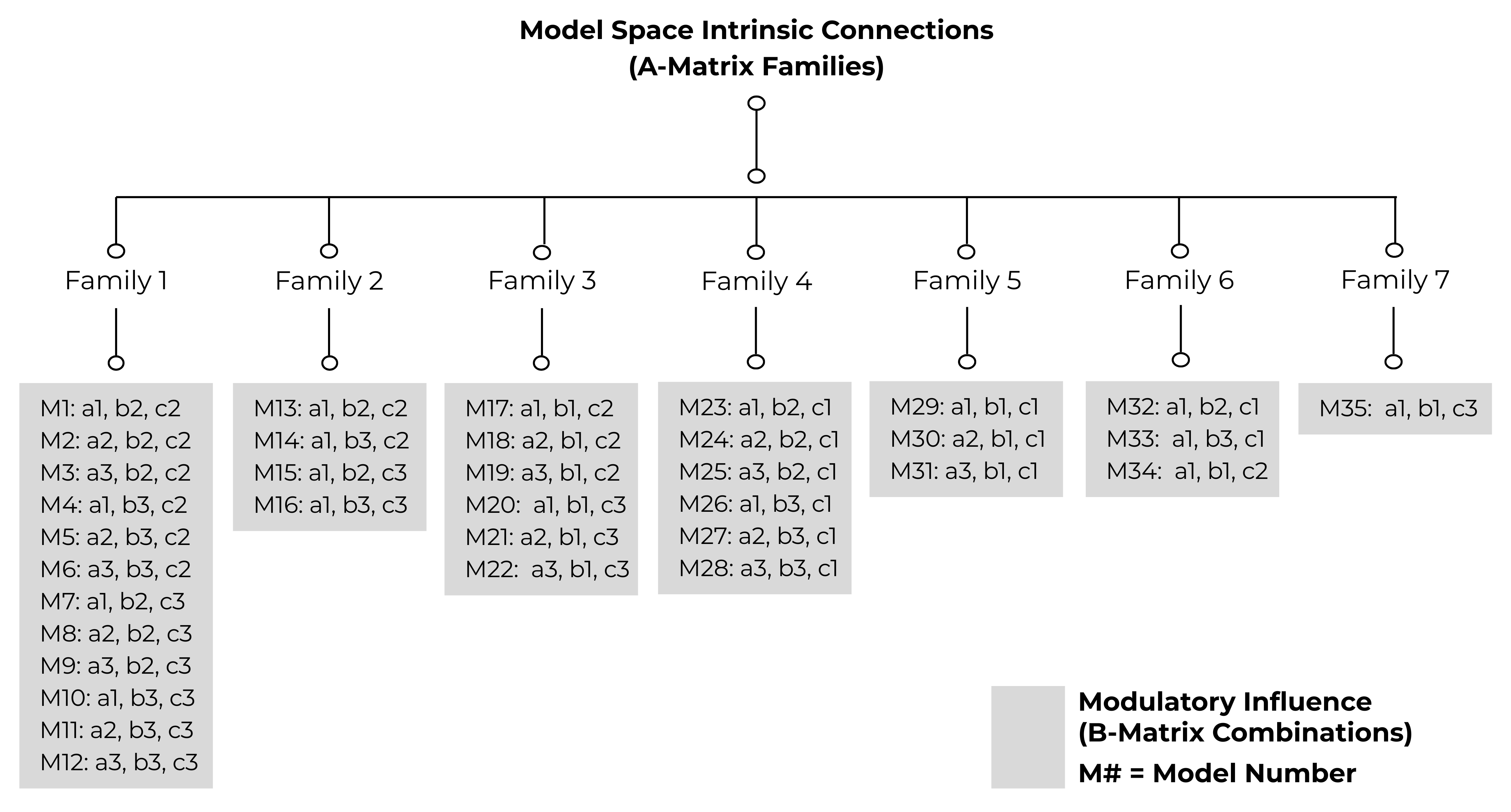
摘要: This study investigates the causal neural dynamics by which affordance representations influence action language comprehension. In this study, 18 participants observed stimuli displayed in two conditions during the experiment: text-only (e.g., ‘Hit with a hammer’) and video+text (visual clips with matching phrases). EEG data were recorded from 32 channels and analyzed for event-related potentials and source localization using LORETA, which identified four left-hemisphere regions of interest: the Lateral Occipital Cortex (LOC), Posterior Superior Temporal Gyrus (pSTG), Ventral Premotor Cortex (PMv), and Inferior Parietal Lobule (IPL). A space of dynamic causal modeling (DCM) was constructed with driving inputs to LOC and pSTG, and multiple connectivity configurations were tested. Bayesian Model Selection revealed a dominant model in which PMv causally influenced IPL and pSTG, reflecting a feedforward architecture from affordance-related motor regions to semantic hubs. Bayesian Model Averaging further confirmed strong endogenous connections from LOC to PMv and IPL, and significant modulation from PMv to IPL. These findings provide direct evidence that affordance processing in premotor regions drives action language understanding by engaging downstream parietal and temporal areas. The results support grounded cognition theories and offer a mechanistic account of how sensorimotor information contributes to linguistic comprehension.