
Paper List
-
A Theoretical Framework for the Formation of Large Animal Groups: Topological Coordination, Subgroup Merging, and Velocity Inheritance
This paper addresses the core problem of how large, coordinated animal groups form in nature, challenging the classical view of gradual aggregation by...
-
CONFIDE: Hallucination Assessment for Reliable Biomolecular Structure Prediction and Design
This paper addresses the critical limitation of current protein structure prediction models (like AlphaFold3) where high-confidence scores (pLDDT) can...
-
Generative design and validation of therapeutic peptides for glioblastoma based on a potential target ATP5A
This paper addresses the critical bottleneck in therapeutic peptide design: how to efficiently optimize lead peptides with geometric constraints while...
-
Pharmacophore-based design by learning on voxel grids
This paper addresses the computational bottleneck and limited novelty in conventional pharmacophore-based virtual screening by introducing a voxel cap...
-
Human-Centred Evaluation of Text-to-Image Generation Models for Self-expression of Mental Distress: A Dataset Based on GPT-4o
This paper addresses the critical gap in evaluating how AI-generated images can effectively support cross-cultural mental distress communication, part...
-
ANNE Apnea Paper
This paper addresses the core challenge of achieving accurate, event-level sleep apnea detection and characterization using a non-intrusive, multimoda...
-
DeeDeeExperiment: Building an infrastructure for integrating and managing omics data analysis results in R/Bioconductor
This paper addresses the critical bottleneck of managing and organizing the growing volume of differential expression and functional enrichment analys...
-
Cross-Species Antimicrobial Resistance Prediction from Genomic Foundation Models
This paper addresses the core challenge of predicting antimicrobial resistance across phylogenetically distinct bacterial species, where traditional m...
Exactly Solvable Population Model with Square-Root Growth Noise and Cell-Size Regulation
Institute for Theoretical Physics, Department of Physics, Utrecht University, Utrecht, Netherlands | Centre for Complex Systems Studies, Utrecht University, Utrecht, Netherlands

30秒速读
IN SHORT: This paper addresses the fundamental gap in understanding how microscopic growth fluctuations, specifically those with size-dependent (square-root) noise, shape population-level fitness and statistics in cell populations, providing an exactly solvable model that contrasts sharply with existing size-independent noise models.
核心创新
- Theory Demonstrates that the asymptotic population growth rate Λ is exactly equal to the mean single-cell growth rate k, independent of noise strength σ and division mechanisms, establishing square-root growth noise as neutral for long-term fitness.
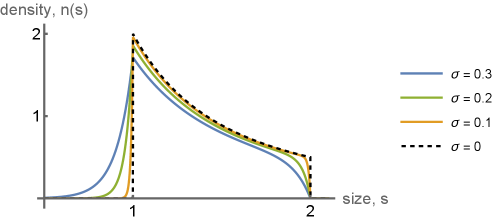
- Methodology Derives exact, closed-form expressions for the steady-state snapshot cell-size distribution, showing it results from a universal one-sided exponential convolution of the deterministic inverse-square-law solution, with kernel width σ².
- Theory Proves that the mean-rescaled population size Nt/⟨Nt⟩ converges to a stationary compound Poisson–exponential distribution determined solely by the growth noise parameter σ, independent of division or partitioning noise.
主要结论
- Population growth rate Λ = k exactly, demonstrating fitness neutrality of square-root noise (contrasting with models where Λ increases with variance of size-independent noise).
- Steady-state population mean cell size shifts by -σ² (e.g., ⟨s⟩pop = 2ln2 - σ² + O(e^{-1/σ²})), while variance is modified only at order σ⁴, showing a hierarchy of decoupling.
- The coefficient of variation of total cell number saturates to √(2σ²), and the full distribution of the mean-rescaled population size is a compound Poisson–exponential, providing concrete, testable signatures.
摘要: We analyze a size-structured branching process in which individual cells grow exponentially according to a Feller square-root process and divide under general size-control mechanisms. We obtain exact expressions for the asymptotic population growth rate, the steady-state snapshot distribution of cell sizes, and the fluctuations of the total cell number. Our first result is that the population growth rate is exactly equal to the mean single-cell growth rate, for all noise strengths and for all division and size-regulation schemes that maintain size homeostasis. Thus square-root growth noise is neutral with respect to long-term fitness, in sharp contrast to models with size-independent stochastic growth rates. Second, we show that the steady-state population cell-size distribution is obtained from the deterministic inverse-square-law solution by a one-sided exponential convolution with kernel width set by the strength of growth fluctuations. Third, the mean-rescaled population size Nt/⟨Nt⟩ converges to a stationary compound Poisson–exponential distribution that depends only on growth noise. This distribution, and hence the long-time shape of population-size fluctuations, is unchanged by division-size noise or asymmetric partitioning. These results identify Feller-type exponential growth with square-root noise as an exactly solvable benchmark for stochastic growth in size-controlled populations and provide concrete signatures that distinguish it from models with size-independent growth-rate noise.