
Paper List
-
A Theoretical Framework for the Formation of Large Animal Groups: Topological Coordination, Subgroup Merging, and Velocity Inheritance
This paper addresses the core problem of how large, coordinated animal groups form in nature, challenging the classical view of gradual aggregation by...
-
CONFIDE: Hallucination Assessment for Reliable Biomolecular Structure Prediction and Design
This paper addresses the critical limitation of current protein structure prediction models (like AlphaFold3) where high-confidence scores (pLDDT) can...
-
Generative design and validation of therapeutic peptides for glioblastoma based on a potential target ATP5A
This paper addresses the critical bottleneck in therapeutic peptide design: how to efficiently optimize lead peptides with geometric constraints while...
-
Pharmacophore-based design by learning on voxel grids
This paper addresses the computational bottleneck and limited novelty in conventional pharmacophore-based virtual screening by introducing a voxel cap...
-
Human-Centred Evaluation of Text-to-Image Generation Models for Self-expression of Mental Distress: A Dataset Based on GPT-4o
This paper addresses the critical gap in evaluating how AI-generated images can effectively support cross-cultural mental distress communication, part...
-
ANNE Apnea Paper
This paper addresses the core challenge of achieving accurate, event-level sleep apnea detection and characterization using a non-intrusive, multimoda...
-
DeeDeeExperiment: Building an infrastructure for integrating and managing omics data analysis results in R/Bioconductor
This paper addresses the critical bottleneck of managing and organizing the growing volume of differential expression and functional enrichment analys...
-
Cross-Species Antimicrobial Resistance Prediction from Genomic Foundation Models
This paper addresses the core challenge of predicting antimicrobial resistance across phylogenetically distinct bacterial species, where traditional m...
Setting up for failure: automatic discovery of the neural mechanisms of cognitive errors
Department of Engineering, University of Cambridge | Department of Psychology, University of Cambridge | Department of Cognitive Science, Central European University
30秒速读
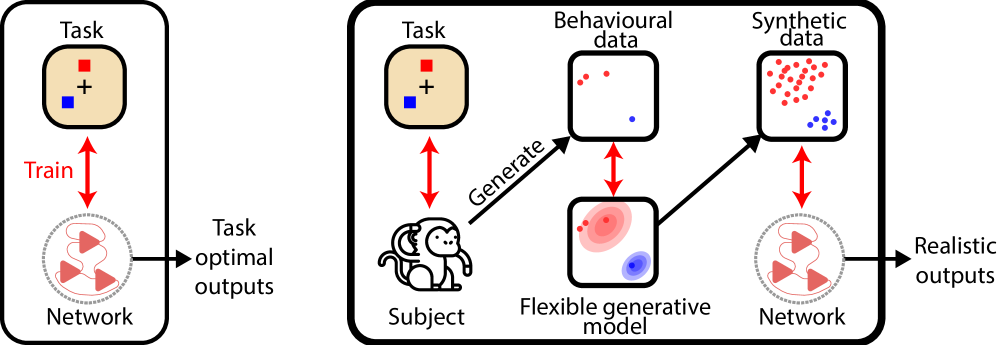
IN SHORT: This paper addresses the core challenge of automating the discovery of biologically plausible recurrent neural network (RNN) dynamics that can replicate the full richness of human and animal behavioral data, including characteristic errors and suboptimalities, rather than just optimal task performance.
核心创新
- Methodology Introduces a novel diffusion model-based training objective for RNNs to capture complex, multimodal behavioral response distributions (e.g., from swap errors), moving beyond traditional moment-matching or simple loss functions like MSE.
- Methodology Proposes using a non-parametric generative model (Bayesian Non-parametric model of Swap errors, BNS) to create surrogate behavioral data for training, overcoming the data scarcity problem inherent in experimental neuroscience.
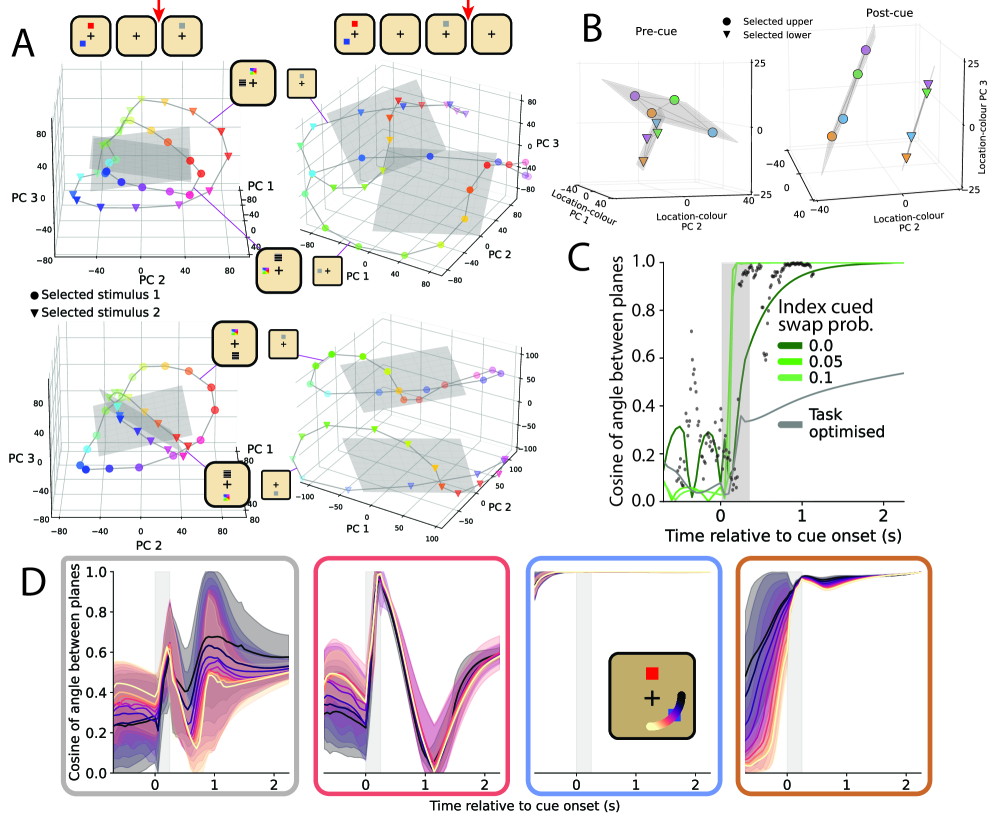
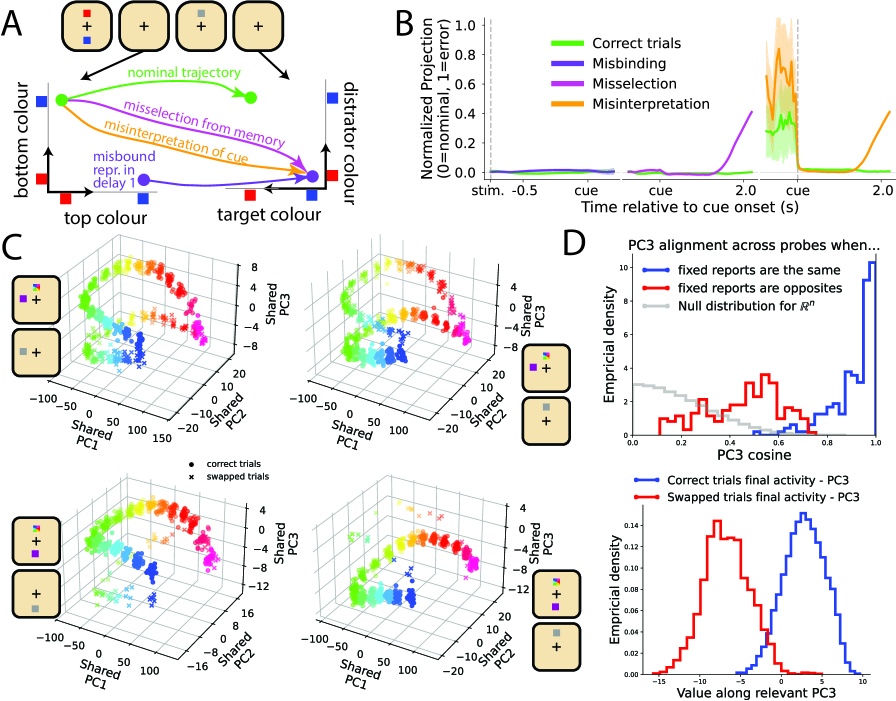
- Biology Demonstrates that RNNs trained to reproduce suboptimal behavior (swap errors) successfully recapitulate qualitative neural signatures (e.g., planar alignment of population activity) observed in macaque prefrontal cortex during visual working memory tasks, which task-optimal networks fail to capture.
主要结论
- RNNs trained with the novel diffusion-based method to reproduce probe-distance-dependent swap errors successfully matched the planar alignment geometry of neural population activity observed in macaque PFC (cosine similarity increase during cue period, as in Panichello et al., 2021), a signature not captured by task-optimal or no-swap-error models.
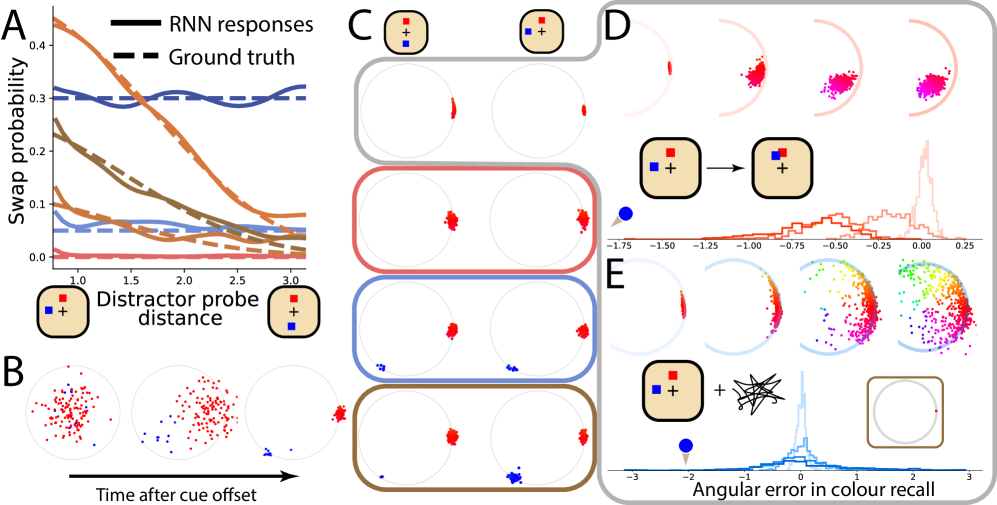
- The method accurately replicated target swap error rates as a function of distractor proximity (as defined by the generative BNS model), demonstrating quantitative fitting to complex behavioral distributions.
- The approach generated novel, testable hypotheses about the neural circuit mechanisms underlying swap errors (e.g., misselection at cue time), moving beyond descriptive population coding models.
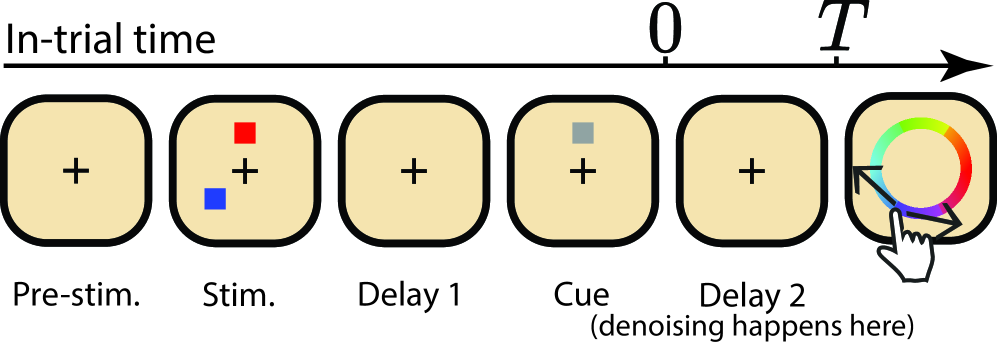
摘要: Discovering the neural mechanisms underpinning cognition is one of the grand challenges of neuroscience. However, previous approaches for building models of recurrent neural network (RNN) dynamics that explain behaviour required iterative refinement of architectures and/or optimization objectives, resulting in a piecemeal, and mostly heuristic, human-in-the-loop process. Here, we offer an alternative approach that automates the discovery of viable RNN mechanisms by explicitly training RNNs to reproduce behaviour, including the same characteristic errors and suboptimalities, that humans and animals produce in a cognitive task. Achieving this required two main innovations. First, as the amount of behavioural data that can be collected in experiments is often too limited to train RNNs, we use a non-parametric generative model of behavioural responses to produce surrogate data for training RNNs. Second, to capture all relevant statistical aspects of the data, rather than a limited number of hand-picked low-order moments as in previous moment-matching-based approaches, we developed a novel diffusion model-based approach for training RNNs. To showcase the potential of our approach, we chose a visual working memory task as our test-bed, as behaviour in this task is well known to produce response distributions that are patently multimodal (due to so-called swap errors). The resulting network dynamics correctly predicted previously reported qualitative features of neural data recorded in macaques. Importantly, these results were not possible to obtain with more traditional approaches, i.e., when only a limited set of behavioural signatures (rather than the full richness of behavioural response distributions) were fitted, or when RNNs were trained for task optimality (instead of reproducing behaviour). Our approach also yields novel predictions about the mechanism of swap errors, which can be readily tested in experiments. These results suggest that fitting RNNs to rich patterns of behaviour provides a powerful way to automatically discover the neural network dynamics supporting important cognitive functions.