
Paper List
-
An AI Implementation Science Study to Improve Trustworthy Data in a Large Healthcare System
This paper addresses the critical gap between theoretical AI research and real-world clinical implementation by providing a practical framework for as...
-
The BEAT-CF Causal Model: A model for guiding the design of trials and observational analyses of cystic fibrosis exacerbations
This paper addresses the critical gap in cystic fibrosis exacerbation management by providing a formal causal framework that integrates expert knowled...
-
Hierarchical Molecular Language Models (HMLMs)
This paper addresses the core challenge of accurately modeling context-dependent signaling, pathway cross-talk, and temporal dynamics across multiple ...
-
Stability analysis of action potential generation using Markov models of voltage‑gated sodium channel isoforms
This work addresses the challenge of systematically characterizing how the high-dimensional parameter space of Markov models for different sodium chan...
-
Approximate Bayesian Inference on Mechanisms of Network Growth and Evolution
This paper addresses the core challenge of inferring the relative contributions of multiple, simultaneous generative mechanisms in network formation w...
-
EnzyCLIP: A Cross-Attention Dual Encoder Framework with Contrastive Learning for Predicting Enzyme Kinetic Constants
This paper addresses the core challenge of jointly predicting enzyme kinetic parameters (Kcat and Km) by modeling dynamic enzyme-substrate interaction...
-
Tissue stress measurements with Bayesian Inversion Stress Microscopy
This paper addresses the core challenge of measuring absolute, tissue-scale mechanical stress without making assumptions about tissue rheology, which ...
-
DeepFRI Demystified: Interpretability vs. Accuracy in AI Protein Function Prediction
This study addresses the critical gap between high predictive accuracy and biological interpretability in DeepFRI, revealing that the model often prio...
Collective adsorption of pheromones at the water-air interface
Aix Marseille Univ, CNRS, Centrale Med, IRPHE (UMR 7342), Marseille, France | ICSM, CEA, CNRS, ENSCM, Univ. Montpellier, Marcoule, France | Institut de Recherche sur la Biologie de l’Insecte, UMR 7261, CNRS-Université de Tours, Tours, France


30秒速读
IN SHORT: This paper addresses the core challenge of understanding how amphiphilic pheromones, previously assumed to be transported in the gas phase, can be stabilized and concentrated at the water-air interface of atmospheric aerosols through collective adsorption and a 2D phase transition.
核心创新
- Methodology Presents state-of-the-art all-atom molecular dynamics simulations to construct a full Langmuir adsorption isotherm for a pheromone monolayer, a comprehensive approach rare in the field.
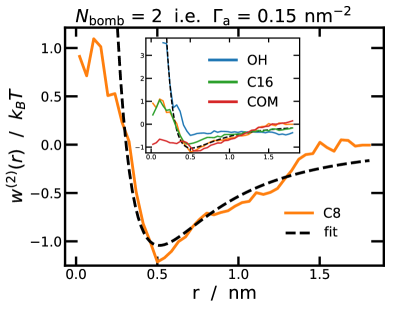
- Biology Quantifies the collective adsorption free energy gain (~2kBT per molecule) for bombykol at the water-air interface, providing a mechanistic explanation for pheromone enrichment on atmospheric aerosols.
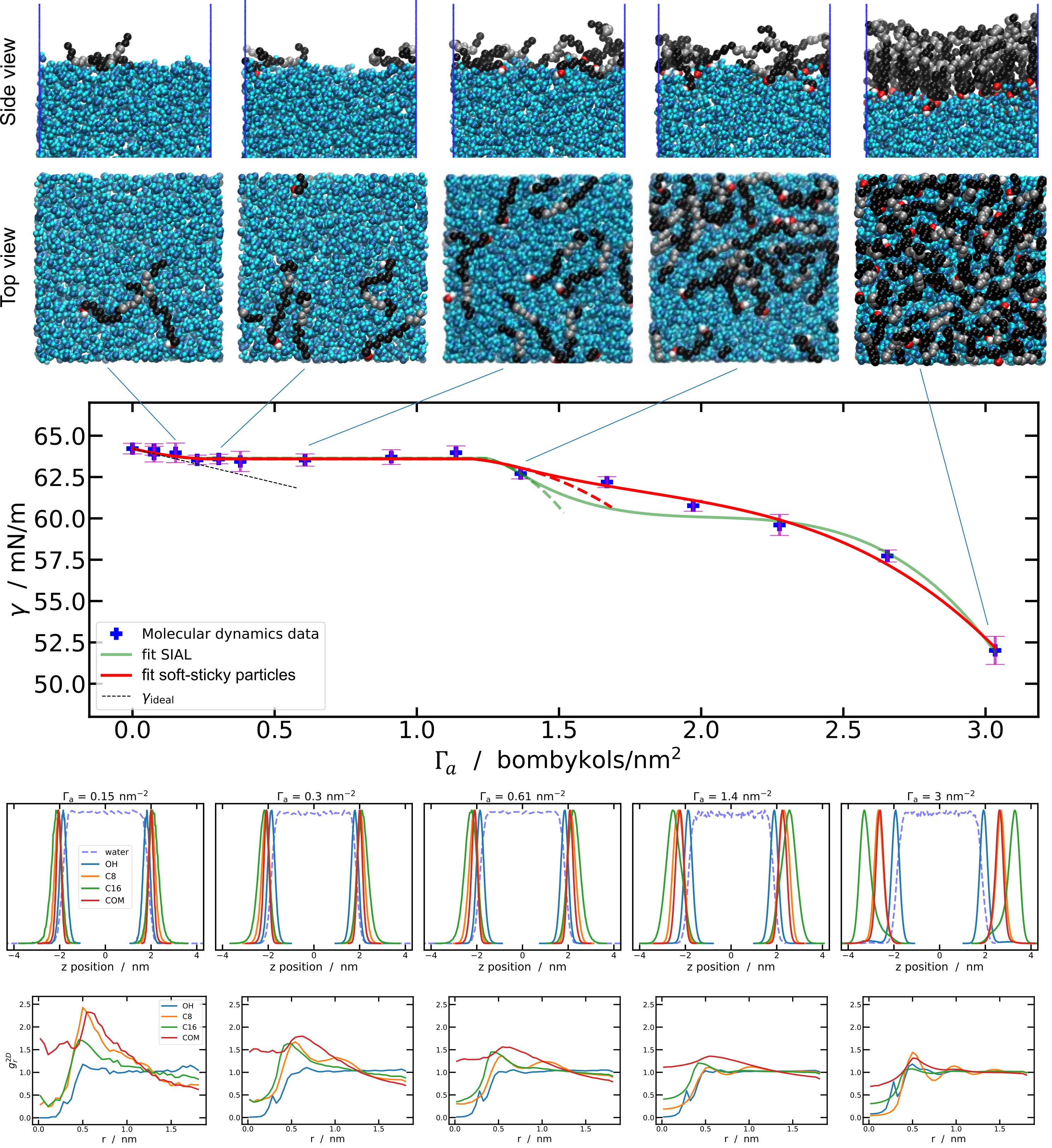
- Theory Identifies and characterizes a two-dimensional liquid-gas phase transition within the pheromone monolayer, modeled successfully with a soft-sticky particle equation of state.
主要结论
- Collective interactions within a bombykol monolayer at the water-air interface provide a stabilization free energy of approximately 2kBT per molecule, significantly enhancing adsorption compared to individual molecules.
- The monolayer exhibits a clear two-dimensional liquid-gas phase transition, accurately described by a soft-sticky particle equation of state, with the transition plateau evident in the surface tension vs. concentration isotherm.
- The calculated adsorption free energy increases under lower estimates of the condensing surface concentration (ΓC), indicating that pheromone adsorption onto aerosols is more favorable in dilute regimes, relevant for atmospheric conditions.
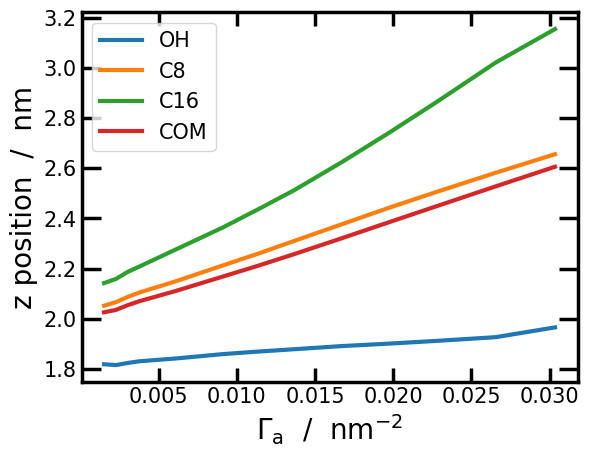
摘要: Understanding the phase behaviour of pheromones and other messaging molecules remains a significant and largely unexplored challenge, even though it plays a central role in chemical communication. Here, we present all-atom molecular dynamics simulations to investigate the behavior of bombykol, a model insect pheromone, adsorbed at the water–air interface. This system serves as a proxy for studying the amphiphilic nature of pheromones and their interactions with aerosol particles in the atmosphere. Our simulations reveal the molecular organization of the bombykol monolayer and its adsorption isotherm. A soft-sticky particle equation of state accurately describes the monolayer’s behavior. The analysis uncovers a two-dimensional liquid–gas phase transition within the monolayer. Collective adsorption stabilises the molecules at the interface and the calculated free energy gain is approximately 2kBT. This value increases under lower estimates of the condensing surface concentration, thereby enhancing pheromone adsorption onto aerosols. Overall, our findings hold broad relevance for molecular interface science, atmospheric chemistry, and organismal chemical communication, particularly in highlighting the critical role of phase transition phenomena.