
Paper List
-
Nyxus: A Next Generation Image Feature Extraction Library for the Big Data and AI Era
This paper addresses the core pain point of efficiently extracting standardized, comparable features from massive (terabyte to petabyte-scale) biomedi...
-
Topological Enhancement of Protein Kinetic Stability
This work addresses the long-standing puzzle of why knotted proteins exist by demonstrating that deep knots provide a functional advantage through enh...
-
A Multi-Label Temporal Convolutional Framework for Transcription Factor Binding Characterization
This paper addresses the critical limitation of existing TF binding prediction methods that treat transcription factors as independent entities, faili...
-
Social Distancing Equilibria in Games under Conventional SI Dynamics
This paper solves the core problem of proving the existence and uniqueness of Nash equilibria in finite-duration SI epidemic games, showing they are a...
-
Binding Free Energies without Alchemy
This paper addresses the core bottleneck of computational expense in Absolute Binding Free Energy calculations by eliminating the need for numerous al...
-
SHREC: A Spectral Embedding-Based Approach for Ab-Initio Reconstruction of Helical Molecules
This paper addresses the core bottleneck in cryo-EM helical reconstruction: eliminating the dependency on accurate initial symmetry parameter estimati...
-
Budget-Sensitive Discovery Scoring: A Formally Verified Framework for Evaluating AI-Guided Scientific Selection
This paper addresses the critical gap in evaluating AI-guided scientific selection strategies under realistic budget constraints, where existing metri...
-
Probabilistic Joint and Individual Variation Explained (ProJIVE) for Data Integration
This paper addresses the core challenge of accurately decomposing shared (joint) and dataset-specific (individual) sources of variation in multi-modal...
Generating a Contact Matrix for Aged Care Settings in Australia: an agent-based model study
University of New South Wales
30秒速读
IN SHORT: This study addresses the critical gap in understanding heterogeneous contact patterns within aged care facilities, where existing population-level contact matrices fail to capture the nuanced interactions that drive infection transmission in these high-risk environments.
核心创新
- Methodology Developed a transferable agent-based modeling framework specifically for aged care settings, parameterized with empirical survey data from 21 aged care workers to capture realistic staff-resident interaction patterns.
- Methodology Integrated proximity-based contact definitions (1.5m and 3m thresholds with 3-second duration) with temporal analysis to identify high-risk contact clustering during structured daily routines like communal activities and care tasks.
- Biology Demonstrated that medium care residents experience the highest infection risk despite not having the highest contact frequency, revealing non-linear relationships between contact patterns and transmission outcomes.
主要结论
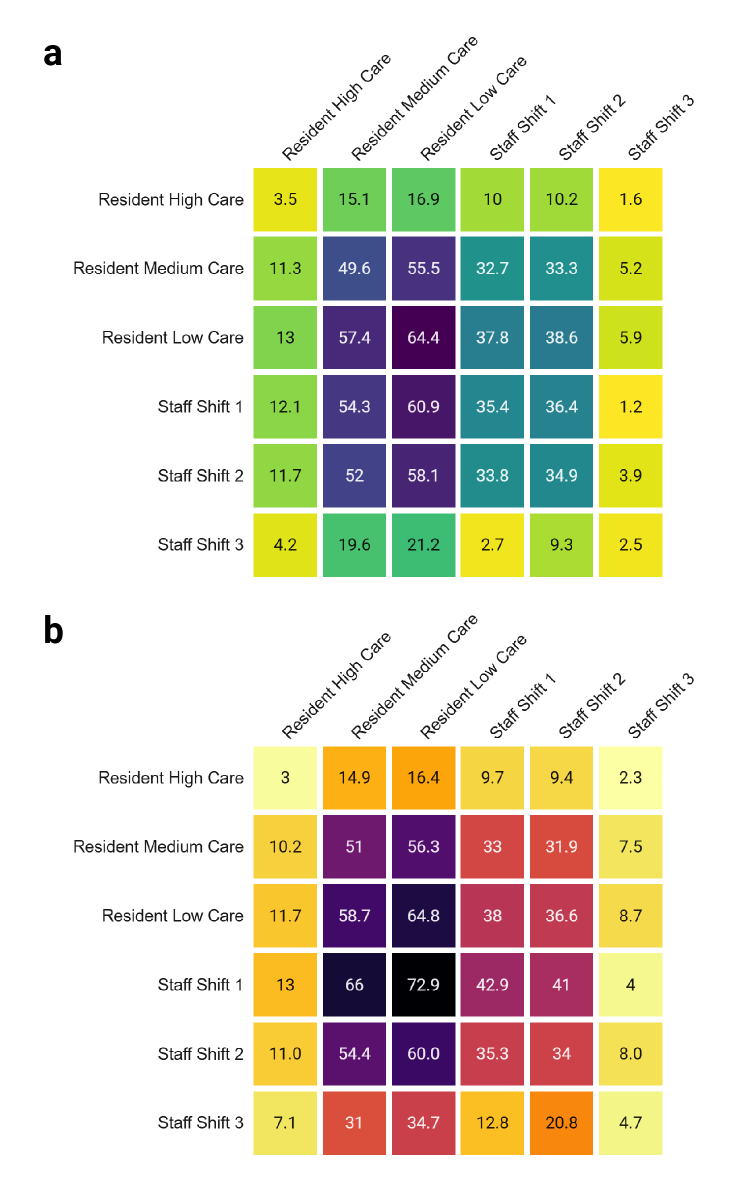
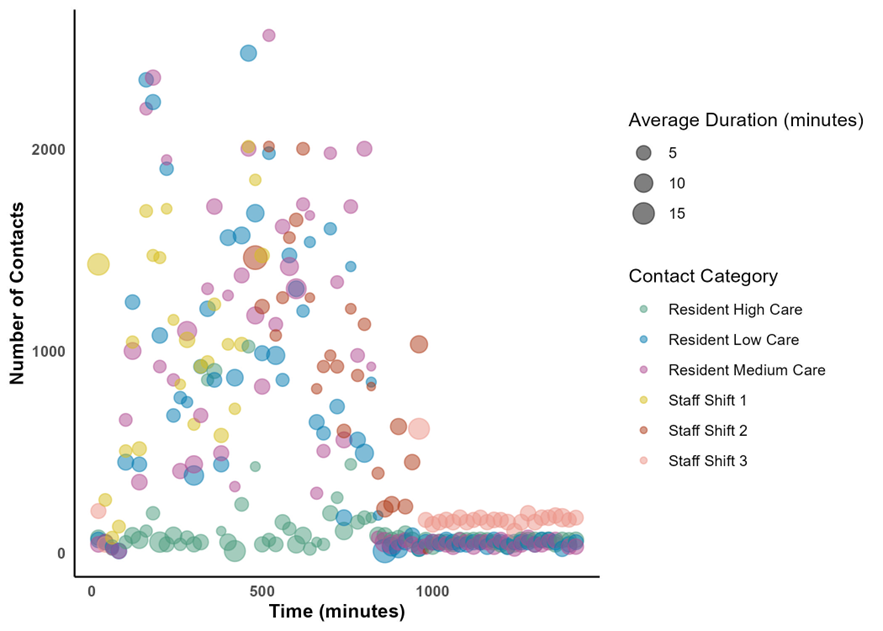
- Low and medium care residents had the highest contact frequencies (particularly with morning/afternoon shift staff), while high care residents and night staff had substantially fewer contacts, with Poisson regression confirming significant variation by care level and shift (p<0.001).
- Vaccination scenarios reduced predicted transmission by up to 68%, with maximum impact achieved when both staff and residents were vaccinated, demonstrating the multiplicative protective effect of comprehensive vaccination coverage.
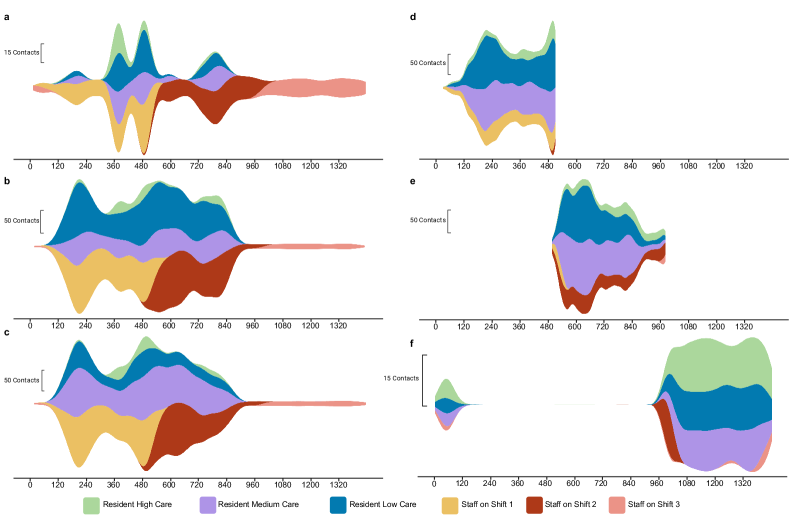
- Temporal analysis revealed clustering of high-risk contacts during structured daily routines, with infection risk highest during high-contact shifts and among medium care residents, highlighting the importance of timing in intervention strategies.
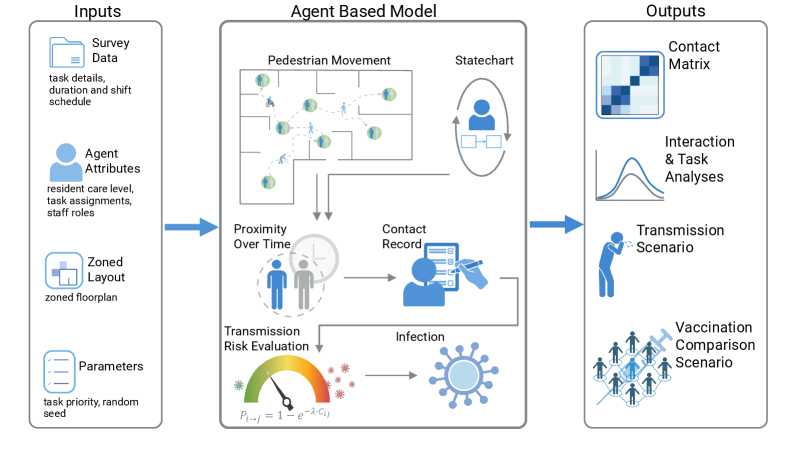
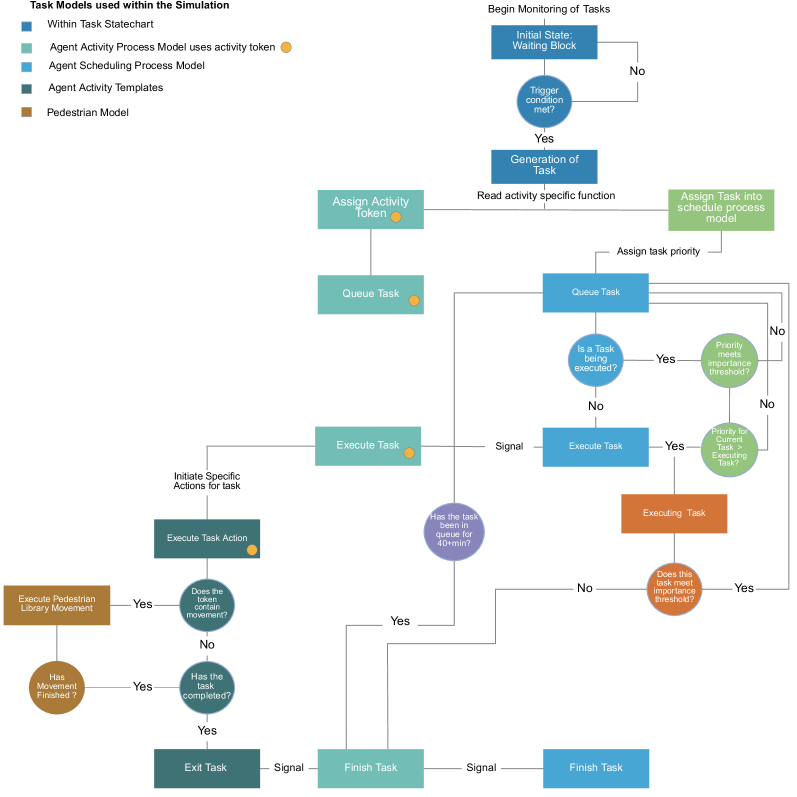
摘要: This study presents an agent-based model (ABM) developed to simulate staff and resident interactions within a synthetic aged care facility, capturing movement, task execution, and proximity-based contact events across three staff shifts and varying levels of resident care. Contacts were defined by spatial thresholds (1.5 m and 3 m) and cumulative duration, enabling the generation of detailed contact matrices. Simulation results showed that low and medium care residents experienced the highest frequency of interactions, particularly with staff on morning and afternoon shifts, while high care residents and night staff had substantially fewer contacts. Contact rates varied significantly by care level and shift, confirmed through Poisson-based regression modelling. Temporal analyses revealed clustering of high-risk contacts during structured daily routines, especially communal and care activities. An integrated airborne transmission module, seeded with a single infectious staff member, demonstrated that infection risk was highest during high-contact shifts and among medium care residents. Vaccination scenarios reduced predicted transmission by up to 68%, with the greatest impact observed when both staff and residents were vaccinated. These findings highlight the importance of accounting for contact heterogeneity in aged care and demonstrate the utility of ABMs for evaluating targeted infection control strategies in high-risk, enclosed environments.