
Paper List
-
Nyxus: A Next Generation Image Feature Extraction Library for the Big Data and AI Era
This paper addresses the core pain point of efficiently extracting standardized, comparable features from massive (terabyte to petabyte-scale) biomedi...
-
Topological Enhancement of Protein Kinetic Stability
This work addresses the long-standing puzzle of why knotted proteins exist by demonstrating that deep knots provide a functional advantage through enh...
-
A Multi-Label Temporal Convolutional Framework for Transcription Factor Binding Characterization
This paper addresses the critical limitation of existing TF binding prediction methods that treat transcription factors as independent entities, faili...
-
Social Distancing Equilibria in Games under Conventional SI Dynamics
This paper solves the core problem of proving the existence and uniqueness of Nash equilibria in finite-duration SI epidemic games, showing they are a...
-
Binding Free Energies without Alchemy
This paper addresses the core bottleneck of computational expense in Absolute Binding Free Energy calculations by eliminating the need for numerous al...
-
SHREC: A Spectral Embedding-Based Approach for Ab-Initio Reconstruction of Helical Molecules
This paper addresses the core bottleneck in cryo-EM helical reconstruction: eliminating the dependency on accurate initial symmetry parameter estimati...
-
Budget-Sensitive Discovery Scoring: A Formally Verified Framework for Evaluating AI-Guided Scientific Selection
This paper addresses the critical gap in evaluating AI-guided scientific selection strategies under realistic budget constraints, where existing metri...
-
Probabilistic Joint and Individual Variation Explained (ProJIVE) for Data Integration
This paper addresses the core challenge of accurately decomposing shared (joint) and dataset-specific (individual) sources of variation in multi-modal...
Assessment of Simulation-based Inference Methods for Stochastic Compartmental Models
Bonn Center for Mathematical Life Sciences, University of Bonn | Life and Medical Science Institute, University of Bonn | Institute of Software Technology, German Aerospace Center (DLR)
30秒速读
IN SHORT: This paper addresses the core challenge of performing accurate Bayesian parameter inference for stochastic epidemic models when the likelihood function is intractable, a common bottleneck for real-time forecasting.
核心创新
- Methodology Provides the first comprehensive, praxis-driven comparison between Particle Filters (PF) and Conditional Normalizing Flows (CNF) for inference on stochastic compartmental models, benchmarking their performance head-to-head.
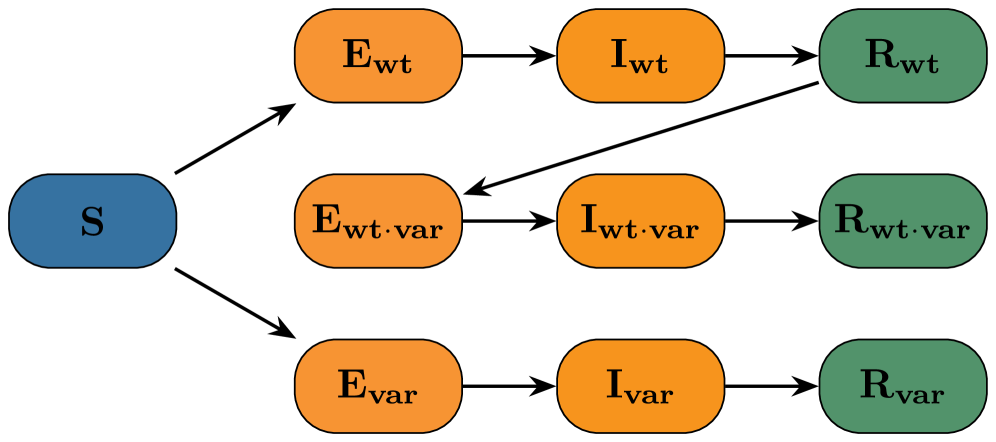
- Methodology Demonstrates the application and robustness of these likelihood-free methods on a complex, non-identifiable two-variant SEIR model with real-world data from an Ethiopian COVID-19 cohort, including scenarios with irregular sampling and missing data.
- Theory Shows that parameter space reparameterization (e.g., using R0, e0, s0) can mitigate ill-conditioning in complex models, improving posterior alignment between PF and CNF methods.
主要结论
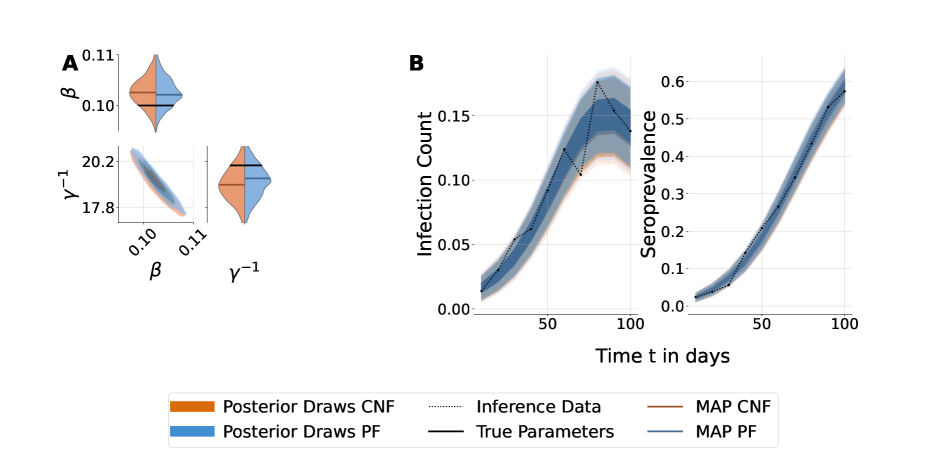
- Both PF and CNF provided robust and reliable inference on the stochastic SIR model with synthetic data, validating the implementation framework.
- For the complex two-variant SEIR model, both methods yielded good fits to synthetic data, but ill-conditioning led to differences in marginal posterior shapes; reparameterization with dimension reduction improved posterior alignment.
- Application to real Ethiopian cohort data demonstrated the operational robustness of both PF and CNF under conditions of real-world noise and irregular data sampling, proving their practical utility.
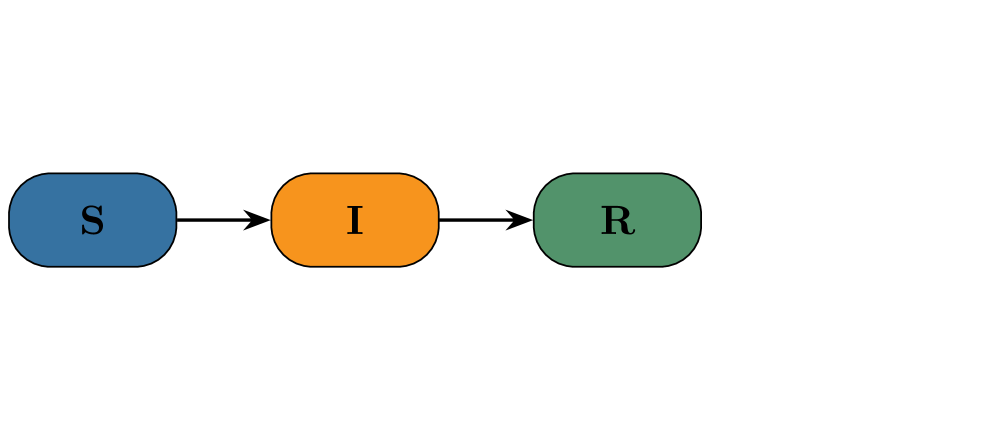
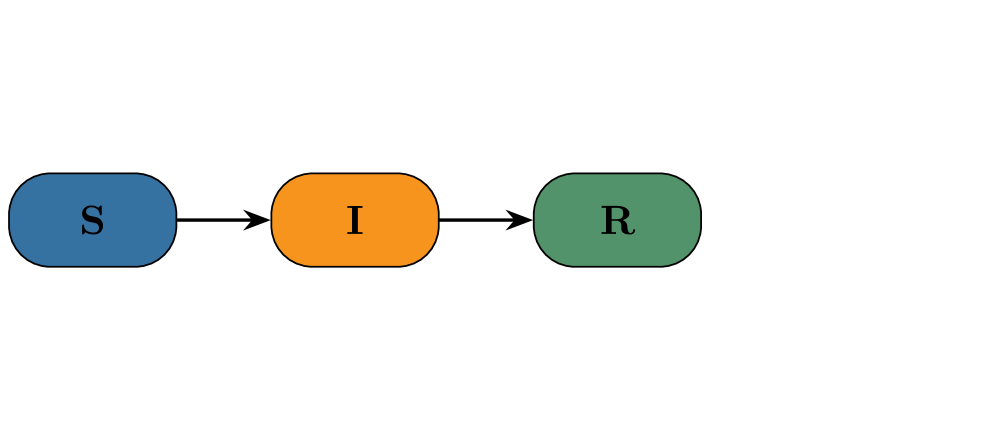
摘要: Global pandemics, such as the recent COVID-19 crisis, highlight the need for stochastic epidemic models that can capture the randomness inherent in the spread of disease. Such models must be accompanied by methods for estimating parameters in order to generate fast nowcasts and short-term forecasts that can inform public health decisions. This paper presents a comparison of two advanced Bayesian inference methods: 1) pseudo-marginal particle Markov chain Monte Carlo, short Particle Filters (PF), and 2) Conditional Normalizing Flows (CNF). We investigate their performance on two commonly used compartmental models: a classical Susceptible-Infected-Recovered (SIR) model and a two-variant Susceptible-Exposed-Infected-Recovered (SEIR) model, complemented by an observation model that maps latent trajectories to empirical data. Addressing the challenges of intractable likelihoods for parameter inference in stochastic settings, our analysis highlights how these likelihood-free methods provide accurate and robust inference capabilities. The results of our simulation study further underscore the effectiveness of these approaches in capturing the stochastic dynamics of epidemics, providing prediction capabilities for the control of epidemic outbreaks. Results on an Ethiopian cohort study demonstrate operational robustness under real‑world noise and irregular data sampling. To facilitate reuse and to enable building pipelines that ultimately contribute to better informed decision making in public health, we make code and synthetic datasets publicly available.