
Paper List
-
A Theoretical Framework for the Formation of Large Animal Groups: Topological Coordination, Subgroup Merging, and Velocity Inheritance
This paper addresses the core problem of how large, coordinated animal groups form in nature, challenging the classical view of gradual aggregation by...
-
CONFIDE: Hallucination Assessment for Reliable Biomolecular Structure Prediction and Design
This paper addresses the critical limitation of current protein structure prediction models (like AlphaFold3) where high-confidence scores (pLDDT) can...
-
Generative design and validation of therapeutic peptides for glioblastoma based on a potential target ATP5A
This paper addresses the critical bottleneck in therapeutic peptide design: how to efficiently optimize lead peptides with geometric constraints while...
-
Pharmacophore-based design by learning on voxel grids
This paper addresses the computational bottleneck and limited novelty in conventional pharmacophore-based virtual screening by introducing a voxel cap...
-
Human-Centred Evaluation of Text-to-Image Generation Models for Self-expression of Mental Distress: A Dataset Based on GPT-4o
This paper addresses the critical gap in evaluating how AI-generated images can effectively support cross-cultural mental distress communication, part...
-
ANNE Apnea Paper
This paper addresses the core challenge of achieving accurate, event-level sleep apnea detection and characterization using a non-intrusive, multimoda...
-
DeeDeeExperiment: Building an infrastructure for integrating and managing omics data analysis results in R/Bioconductor
This paper addresses the critical bottleneck of managing and organizing the growing volume of differential expression and functional enrichment analys...
-
Cross-Species Antimicrobial Resistance Prediction from Genomic Foundation Models
This paper addresses the core challenge of predicting antimicrobial resistance across phylogenetically distinct bacterial species, where traditional m...
EcoCast: A Spatio-Temporal Model for Continual Biodiversity and Climate Risk Forecasting
Concordia University | Algoma University
30秒速读
IN SHORT: This paper addresses the critical bottleneck in conservation: the lack of timely, high-resolution, near-term forecasts of species distribution shifts under rapidly changing environmental conditions, moving beyond static models to operational, data-driven decision support.
核心创新
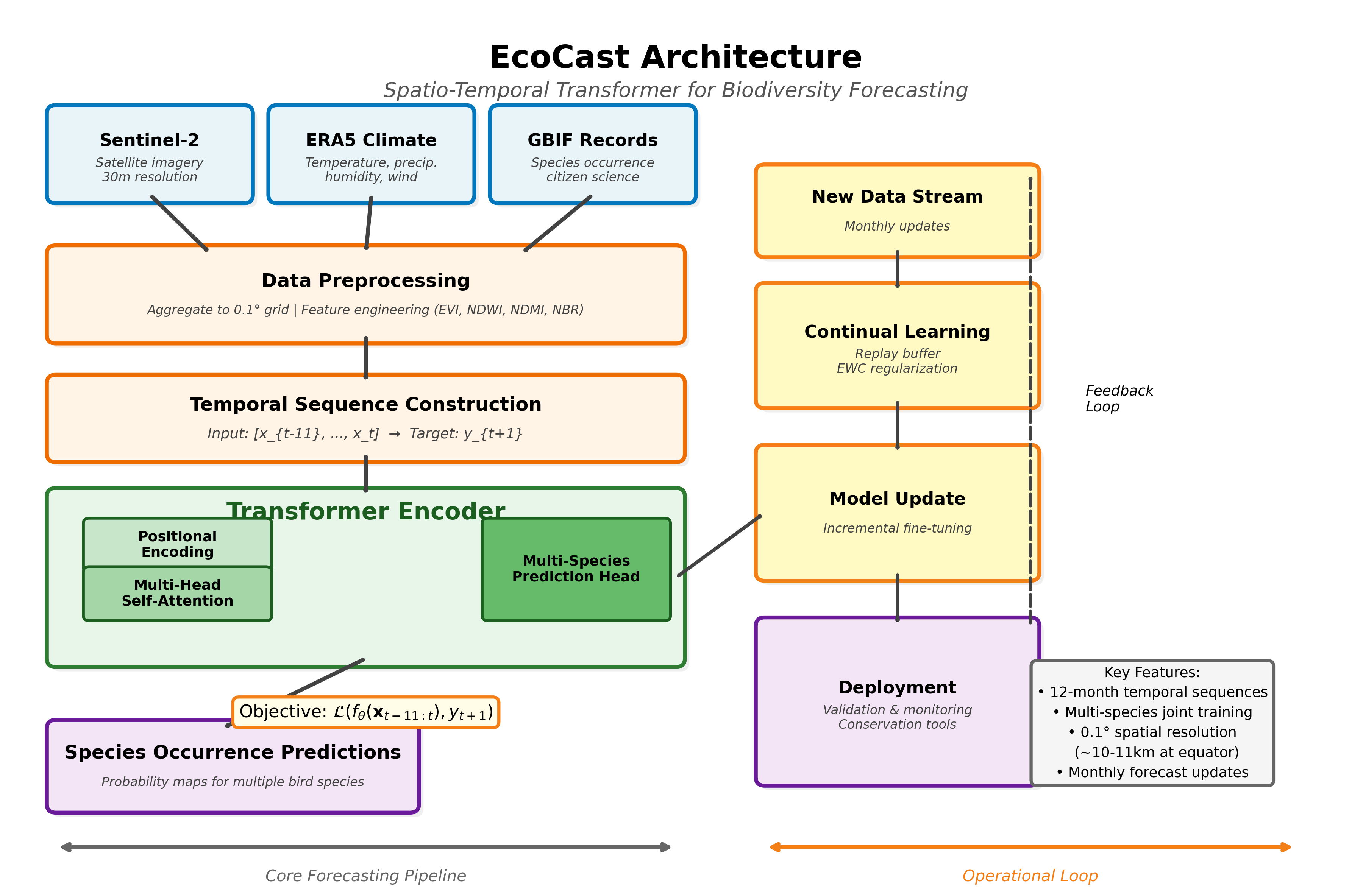
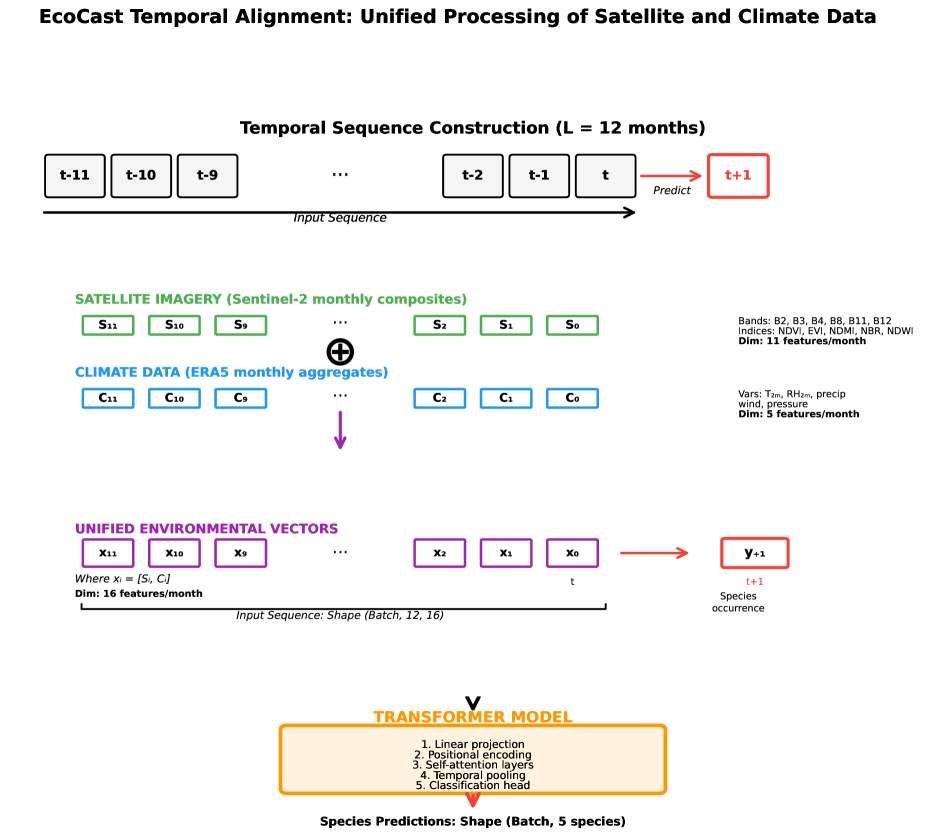
- Methodology First transformer-based model applied to ecological and climate risk forecasting in Africa, using sequence-to-point prediction (12-month environmental sequences → next-month species occurrence) with explicit temporal dependency modeling via self-attention.
- Methodology Integration of continual learning (rehearsal + EWC) into biodiversity forecasting, enabling model updates with new data streams without catastrophic forgetting, crucial for non-stationary climate impacts.
- Biology Operational near-term forecasting paradigm (monthly to seasonal) that requires no future climate projections, using observed environmental sequences to predict immediate conservation-relevant shifts, bridging geophysical forecasting architectures with species distribution modeling.
主要结论
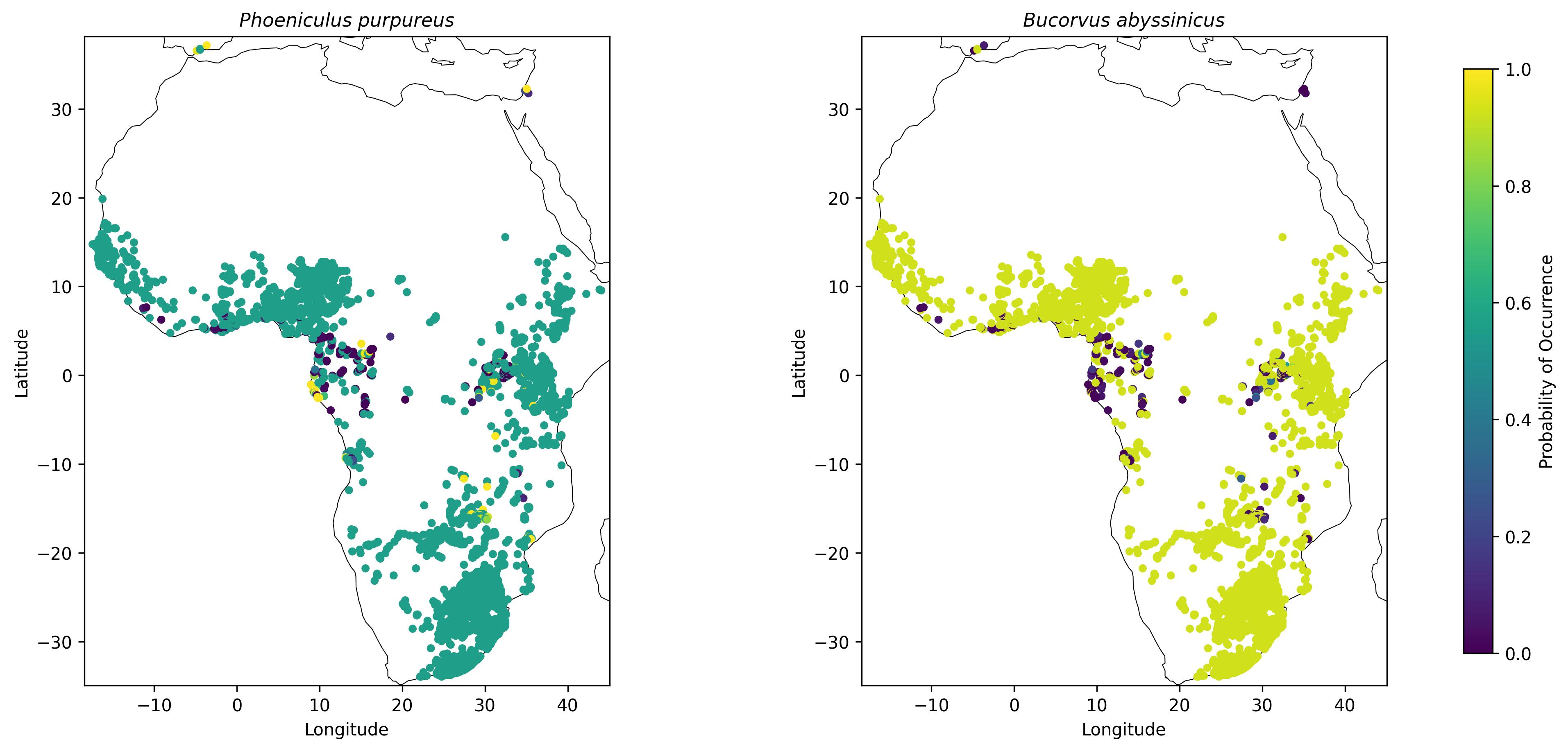
- EcoCast achieves macro-averaged F1 score of 0.65 and PR-AUC of 0.72 on 2023 holdout data for five African bird species, representing +34 and +43 percentage point improvements respectively over Random Forest baseline (F1=0.31, PR-AUC=0.29).
- Transformer architecture successfully captures critical temporal dependencies: annual seasonality via positional encoding, lagged environmental responses (2-4 month delays), and cross-species ecological signals through joint multi-label training.
- The framework demonstrates operational feasibility with monthly forecast updates using near-real-time data (ERA5 available within 5 days, final data 2-3 months later), enabling alignment with conservation planning cycles rather than static decadal projections.
摘要: Increasing climate change and habitat loss are driving unprecedented shifts in species distributions. Conservation professionals urgently need timely, high-resolution predictions of biodiversity risks, especially in ecologically diverse regions like Africa. We propose EcoCast, a spatio-temporal model designed for continual biodiversity and climate risk forecasting. Utilizing multisource satellite imagery, climate data, and citizen science occurrence records, EcoCast predicts near-term (monthly to seasonal) shifts in species distributions through sequence-based transformers that model spatio-temporal environmental dependencies. The architecture is designed with support for continual learning to enable future operational deployment with new data streams. Our pilot study in Africa shows promising improvements in forecasting distributions of selected bird species compared to a Random Forest baseline, highlighting EcoCast's potential to inform targeted conservation policies. By demonstrating an end-to-end pipeline from multi-modal data ingestion to operational forecasting, EcoCast bridges the gap between cutting-edge machine learning and biodiversity management, ultimately guiding data-driven strategies for climate resilience and ecosystem conservation throughout Africa.