
Paper List
-
Mapping of Lesion Images to Somatic Mutations
This paper addresses the critical bottleneck of delayed genetic analysis in cancer diagnosis by predicting a patient's full somatic mutation profile d...
-
Reinventing Clinical Dialogue: Agentic Paradigms for LLM‑Enabled Healthcare Communication
This paper addresses the core challenge of transforming reactive, stateless LLMs into autonomous, reliable clinical dialogue agents capable of longitu...
-
Binary Latent Protein Fitness Landscapes for Quantum Annealing Optimization
通过将序列映射到二元潜在空间进行基于QUBO的适应度优化,桥接蛋白质表示学习和组合优化。
-
Controlling Fish Schools via Reinforcement Learning of Virtual Fish Movement
证明了无模型强化学习可以利用虚拟视觉刺激有效引导鱼群,克服了缺乏精确行为模型的问题。
The Effective Reproduction Number in the Kermack-McKendrick model with age of infection and reinfection
School of Mathematical Sciences, Beijing Normal University, Beijing 100875, People’s Republic of China.
30秒速读
IN SHORT: This paper addresses the challenge of accurately estimating the time-varying effective reproduction number ℛ(t) in epidemics by incorporating two critical real-world complexities: the age of infection (time since infection) and the possibility of reinfection.
核心创新
- Methodology Introduces a novel extension of the classical Kermack-McKendrick SIRS model by formally incorporating both infection-age structure (a) and a reinfection term (δ), moving beyond constant transmission rate assumptions.
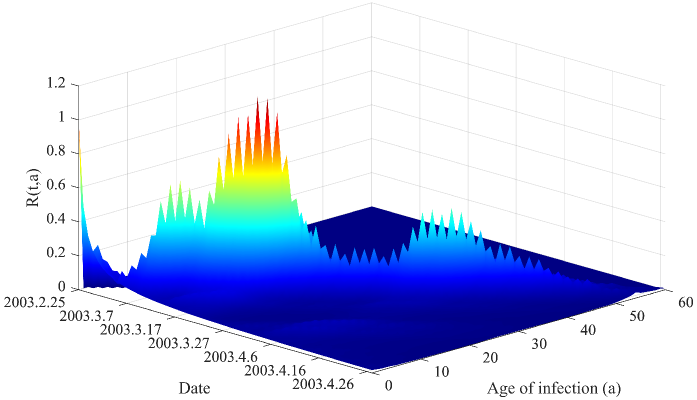
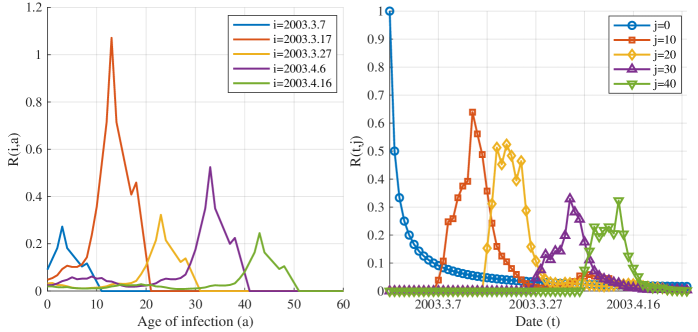
- Methodology Derives a rigorous mathematical framework using Volterra integral equations, the contraction mapping principle, and measure-valued solutions (e.g., Dirac mass for initial cohorts) to connect the flow of new infections N(t) to the reproductive power ℛ(t,a) and ultimately ℛ(t).
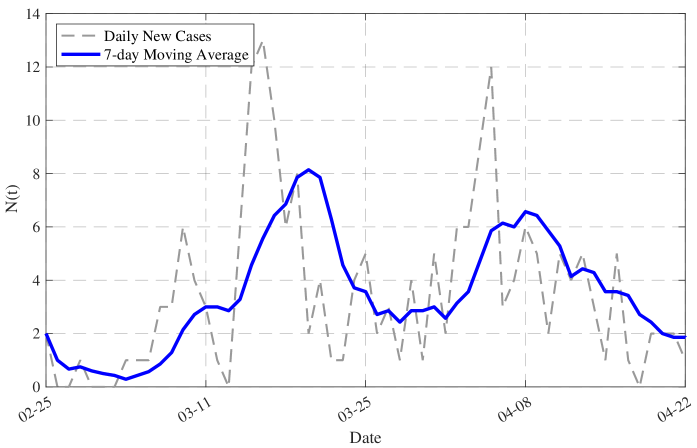
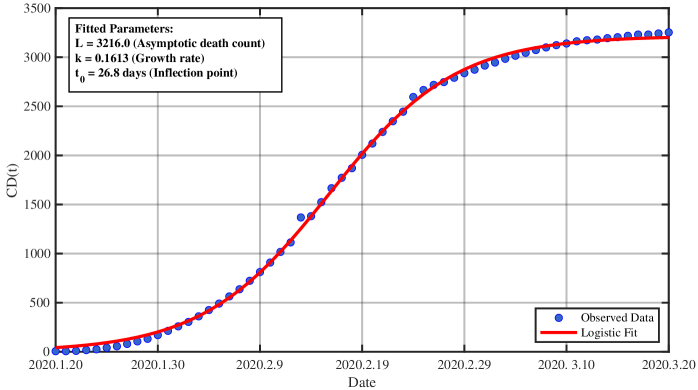
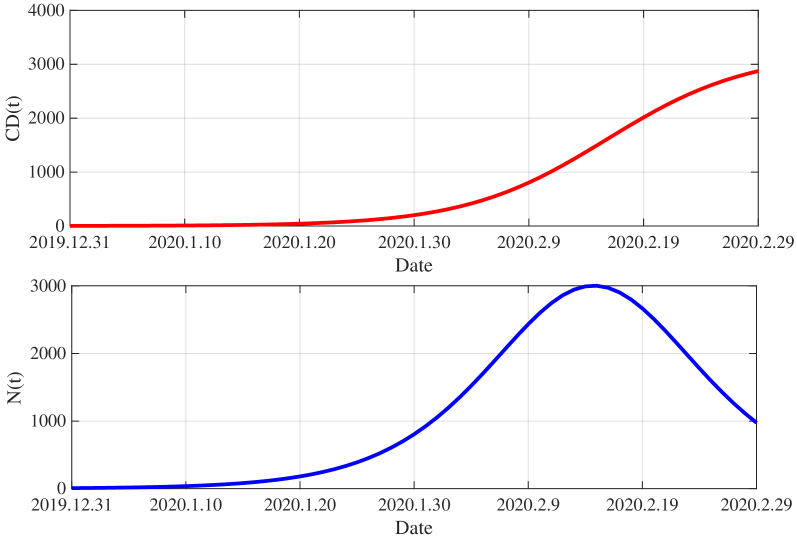
- Methodology/Biology Develops a practical parameter identification methodology that works with two common but challenging data types: 1) direct daily new case counts (applied to 2003 SARS in Singapore) and 2) cumulative death counts when new infection data is unreliable (applied to COVID-19 in China).
主要结论
- The model successfully formulates the infection dynamics as a nonlinear Volterra integral equation of the second kind for N(t) (Eq. 2.14), providing a solvable link between observable data and the underlying transmission parameters.
- Theoretical analysis justifies the use of a Dirac mass initial condition (representing a single cohort infected at time t0) via a limiting process of approximating functions i_κ(a), proving uniform convergence of the solution N_κ(t) to N(t) (Theorem 3.2).
- The derived framework enables the identification of the effective reproduction number ℛ(t) from epidemic curves, demonstrated through application to real-world SARS and COVID-19 datasets, bridging theoretical constructs with practical public health analytics.
摘要: This study introduces a novel epidemiological model that expands upon the Kermack-McKendrick model by incorporating the age of infection and reinfection. By including infection age, we can classify participants, which enables a more targeted analysis within the modeling framework. The reinfection term addresses the real-world occurrences of secondary or recurrent viral infections. In the theoretical part, we apply the contraction mapping principle, the dominated convergence theorem, and the properties of Volterra integral equations to derive analytical expressions for the number of newly infected individuals denoted by N(t). Then, we establish a Volterra integral equation for N(t) and study its initial conditions for both a single cohort and multiple cohorts. From this equation, we derive a method for identifying the effective reproduction number, denoted as ℛ(t). In the practical aspect, we present two distinct methods and separately apply them to analyze the daily new infection cases from the 2003 SARS outbreak in Singapore and the cumulative number of deaths from the COVID-19 epidemic in China. This work effectively bridges theoretical epidemiology and computational modeling, providing a robust framework for analyzing infection dynamics influenced by infection-age-structured transmission and reinfection mechanisms.