
Paper List
-
The Effective Reproduction Number in the Kermack-McKendrick model with age of infection and reinfection
This paper addresses the challenge of accurately estimating the time-varying effective reproduction number ℛ(t) in epidemics by incorporating two crit...
-
Covering Relations in the Poset of Combinatorial Neural Codes
This work addresses the core challenge of navigating the complex poset structure of neural codes to systematically test the conjecture linking convex ...
-
Collective adsorption of pheromones at the water-air interface
This paper addresses the core challenge of understanding how amphiphilic pheromones, previously assumed to be transported in the gas phase, can be sta...
-
pHapCompass: Probabilistic Assembly and Uncertainty Quantification of Polyploid Haplotype Phase
This paper addresses the core challenge of accurately assembling polyploid haplotypes from sequencing data, where read assignment ambiguity and an exp...
-
Setting up for failure: automatic discovery of the neural mechanisms of cognitive errors
This paper addresses the core challenge of automating the discovery of biologically plausible recurrent neural network (RNN) dynamics that can replica...
-
Influence of Object Affordance on Action Language Understanding: Evidence from Dynamic Causal Modeling Analysis
This study addresses the core challenge of moving beyond correlational evidence to establish the *causal direction* and *temporal dynamics* of how obj...
-
Revealing stimulus-dependent dynamics through statistical complexity
This paper addresses the core challenge of detecting stimulus-specific patterns in neural population dynamics that remain hidden to traditional variab...
-
Exactly Solvable Population Model with Square-Root Growth Noise and Cell-Size Regulation
This paper addresses the fundamental gap in understanding how microscopic growth fluctuations, specifically those with size-dependent (square-root) no...
Physics-Guided Surrogate Modeling for Machine Learning–Driven DLD Design Optimization
Department of Mechanical Engineering, Lehigh University | Computational Engineering Department, Lawrence Livermore National Laboratory | Department of Industrial and Production Engineering, Bangladesh University of Engineering and Technology | Precision Medicine Translational Research Center, West China Hospital, Sichuan University
30秒速读
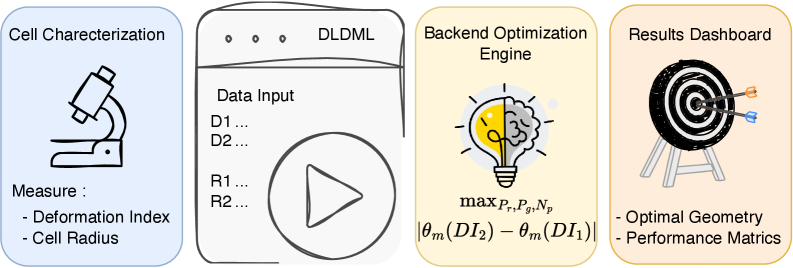
IN SHORT: This paper addresses the core bottleneck of translating microfluidic DLD devices from research prototypes to clinical applications by replacing weeks-long empirical design cycles with a physics-guided machine learning framework that delivers fabrication-ready specifications in under 60 seconds.
核心创新
- Methodology First complete inverse design framework for DLD that transforms measured cellular deformability into optimized device geometry through physics-guided machine learning.
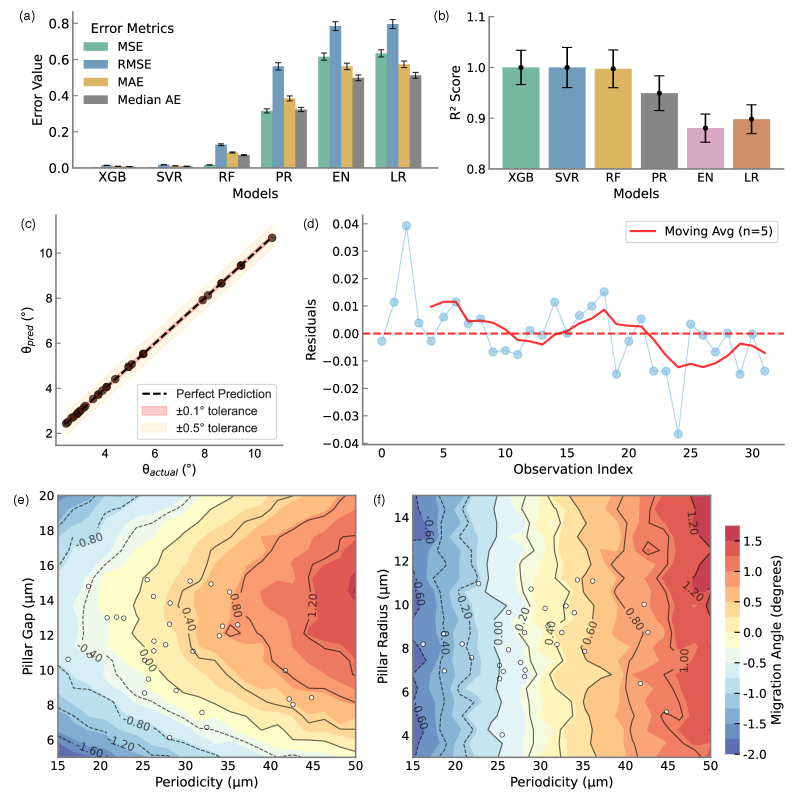
- Methodology Integration of high-fidelity Lattice-Boltzmann/Immersed-Boundary simulations with XGBoost surrogate models achieving sub-degree predictive accuracy (R²=0.9999, MSE=2×10⁻⁴).
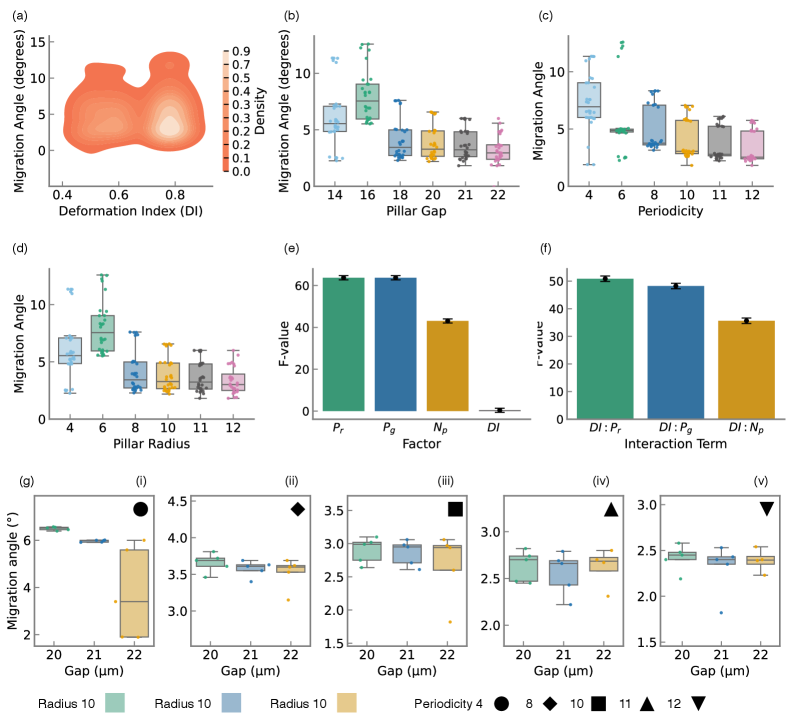
- Methodology Statistical quantification of deformability-geometry interactions via Type II ANOVA revealing significant interaction effects (F=48.23, p<10⁻³⁴) despite geometric dominance of main effects.
主要结论
- Geometric parameters dominate migration angle variance (F=63.72, p<10⁻³⁷), but cellular deformability exerts statistically significant effects through interactions with device geometry (F=48.23, p<10⁻³⁴).
- The XGBoost surrogate model achieves exceptional predictive accuracy (R²=0.9999, MSE=2×10⁻⁴), enabling sub-degree migration angle prediction across the design space.
- Bayesian optimization via tree-structured Parzen estimation identifies optimal DLD architectures in under 60 seconds, reducing design iteration from weeks of experimental prototyping to minutes of automated computation.
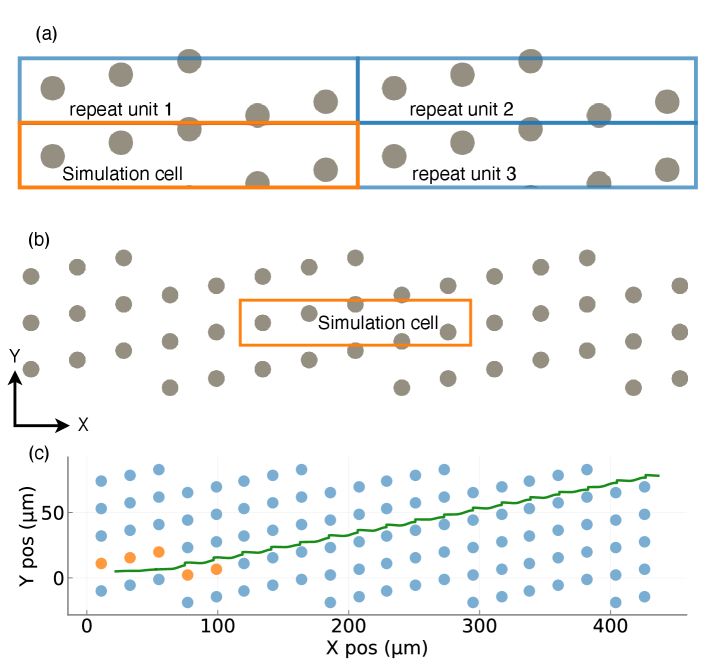
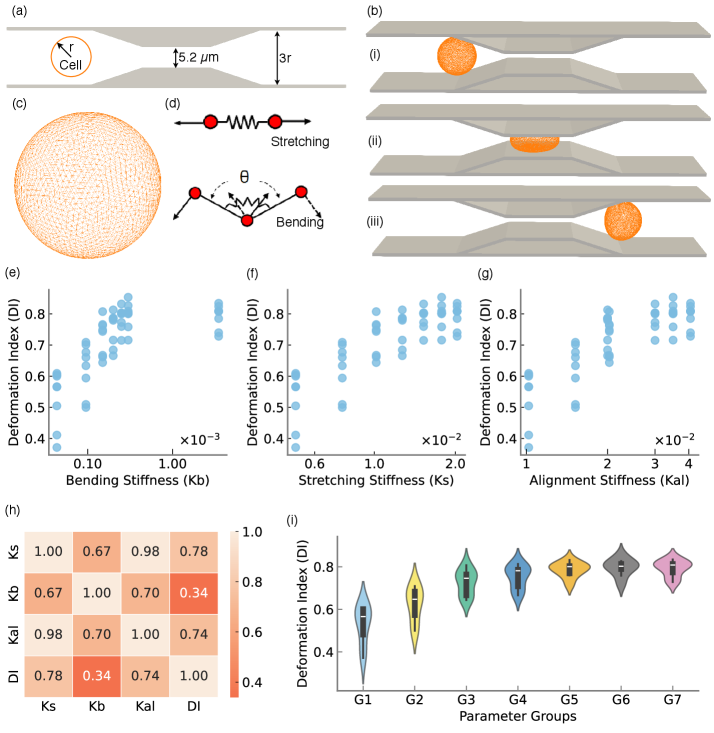
摘要: Microfluidic separation technologies have transformed label-free cell sorting by exploiting intrinsic biophysical properties, yet the translation of these platforms from laboratory prototypes to clinical applications remains constrained by the empirical, trial-and-error nature of device design. Deterministic Lateral Displacement (DLD) represents a paradigmatic example: while demonstrating robust discrimination of cells by size, shape, and deformability across diverse applications including circulating tumor cell isolation and malaria diagnostics, DLD performance exhibits extreme sensitivity to the coupled interplay between cellular mechanical phenotype and micron-scale geometric parameters, necessitating iterative fabrication-testing cycles that span weeks to months. We present the first complete inverse design framework that transforms measured cellular deformability into fabrication-ready DLD specifications through physics-guided machine learning. Our approach integrates high-fidelity lattice-Boltzmann and immersed-boundary simulations with gradient-boosted surrogate models to systematically map cellular mechanical properties to migration behavior across manufacturing-feasible geometric configurations (pillar radius, gap, periodicity). Type II ANOVA quantifies the relative influence of these parameters, revealing that while geometric factors dominate migration angle variance (F=63.72, p<10−37), cellular deformability exerts statistically significant effects through interactions with device geometry (F=48.23, p<10−34). The resulting XGBoost surrogate achieves sub-degree predictive accuracy (R2=0.9999, MSE =2×10⁻⁴), enabling Bayesian optimization via tree-structured Parzen estimation to identify optimal array architectures in under 60 seconds—reducing design iteration from weeks of experimental prototyping to minutes of automated computation. By deploying this validated pipeline as an accessible web application that accepts experimentally measured deformation indices and returns optimized device specifications with tolerance analysis, we democratize DLD design for researchers without specialized computational expertise, thereby accelerating the translation of microfluidic technologies from research-grade prototypes to application-specific, clinically deployable devices.