
Paper List
-
Autonomous Agents Coordinating Distributed Discovery Through Emergent Artifact Exchange
This paper addresses the fundamental limitation of current AI-assisted scientific research by enabling truly autonomous, decentralized investigation w...
-
D-MEM: Dopamine-Gated Agentic Memory via Reward Prediction Error Routing
This paper addresses the fundamental scalability bottleneck in LLM agentic memory systems: the O(N²) computational complexity and unbounded API token ...
-
Countershading coloration in blue shark skin emerges from hierarchically organized and spatially tuned photonic architectures inside skin denticles
This paper solves the core problem of how blue sharks achieve their striking dorsoventral countershading camouflage, revealing that coloration origina...
-
Human-like Object Grouping in Self-supervised Vision Transformers
This paper addresses the core challenge of quantifying how well self-supervised vision models capture human-like object grouping in natural scenes, br...
-
Hierarchical pp-Adic Framework for Gene Regulatory Networks: Theory and Stability Analysis
This paper addresses the core challenge of mathematically capturing the inherent hierarchical organization and multi-scale stability of gene regulator...
-
Towards unified brain-to-text decoding across speech production and perception
This paper addresses the core challenge of developing a unified brain-to-text decoding framework that works across both speech production and percepti...
-
Dual-Laws Model for a theory of artificial consciousness
This paper addresses the core challenge of developing a comprehensive, testable theory of consciousness that bridges biological and artificial systems...
-
Pulse desynchronization of neural populations by targeting the centroid of the limit cycle in phase space
This work addresses the core challenge of determining optimal pulse timing and intensity for desynchronizing pathological neural oscillations when the...
Enhancing Clinical Note Generation with ICD-10, Clinical Ontology Knowledge Graphs, and Chain-of-Thought Prompting Using GPT-4
Computer Science, Old Dominion University | Biomedical Informatics, University of Arkansas for Medical Sciences

30秒速读
IN SHORT: This paper addresses the core challenge of generating accurate and clinically relevant patient notes from sparse inputs (ICD codes and basic demographics) by augmenting Chain-of-Thought prompting with semantic search and structured medical knowledge graphs.
核心创新
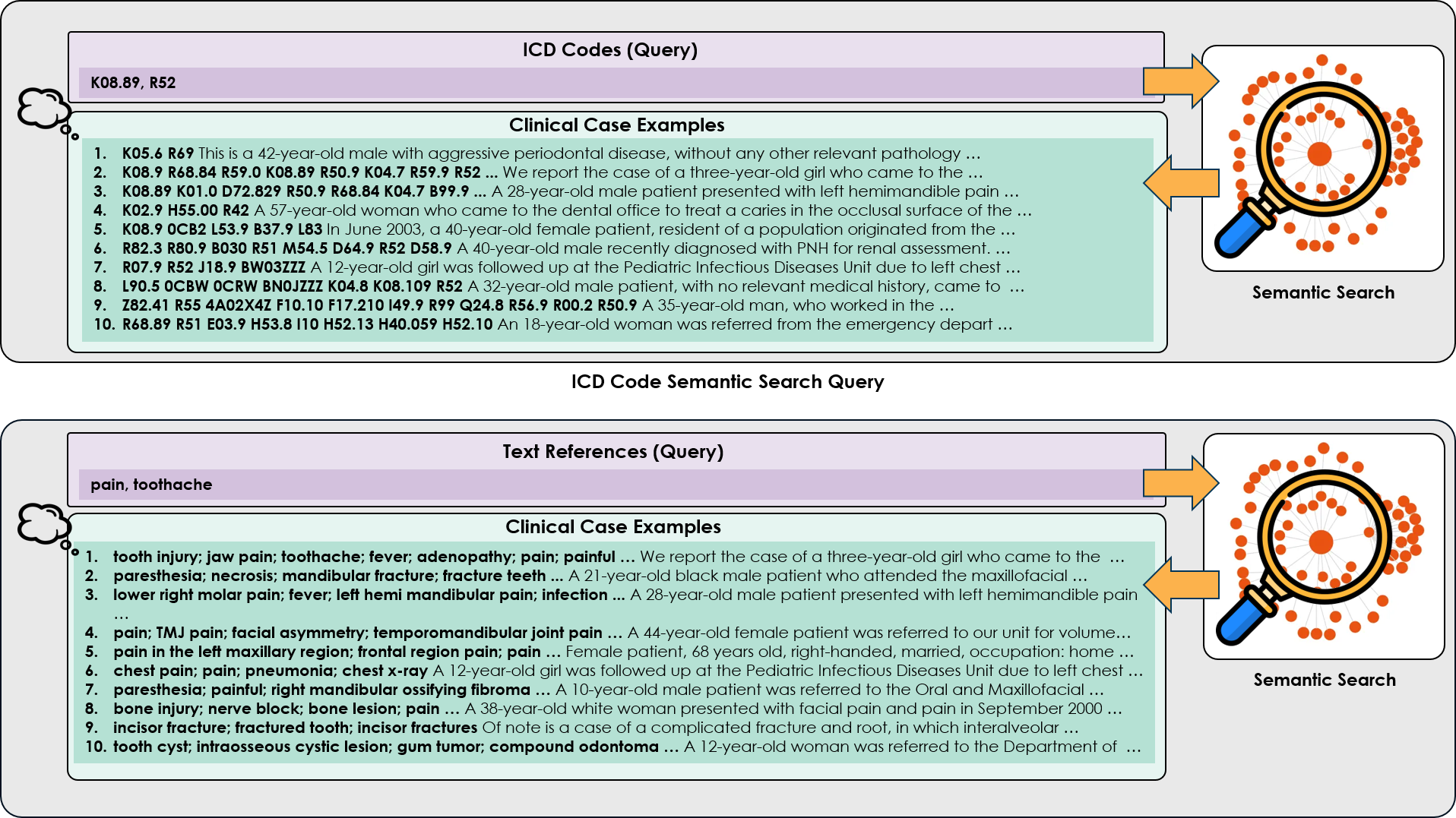
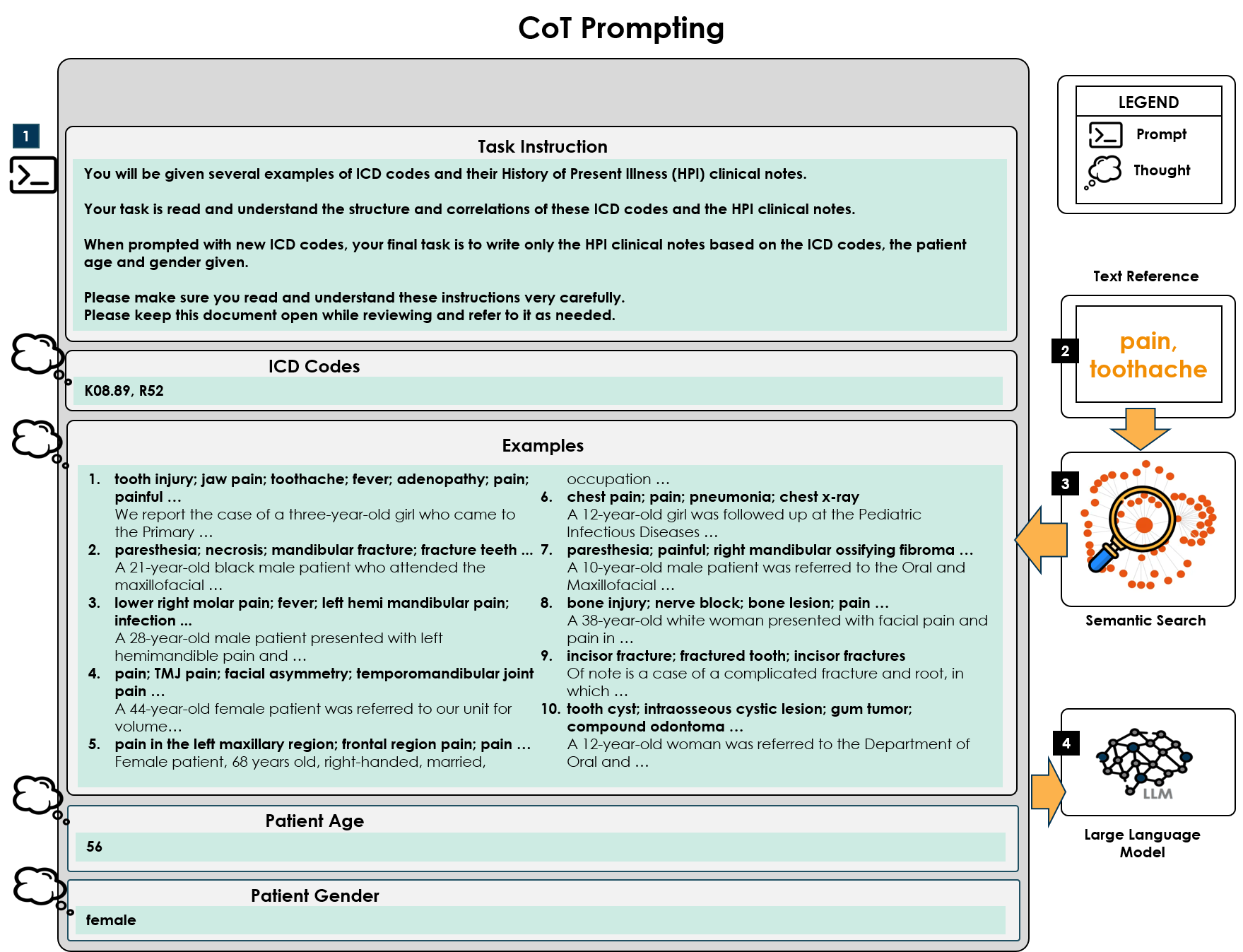
- Methodology Proposes a novel hybrid prompting framework that integrates traditional Chain-of-Thought reasoning with semantic search results from a clinical corpus (CodiEsp dataset) to provide contextual examples.
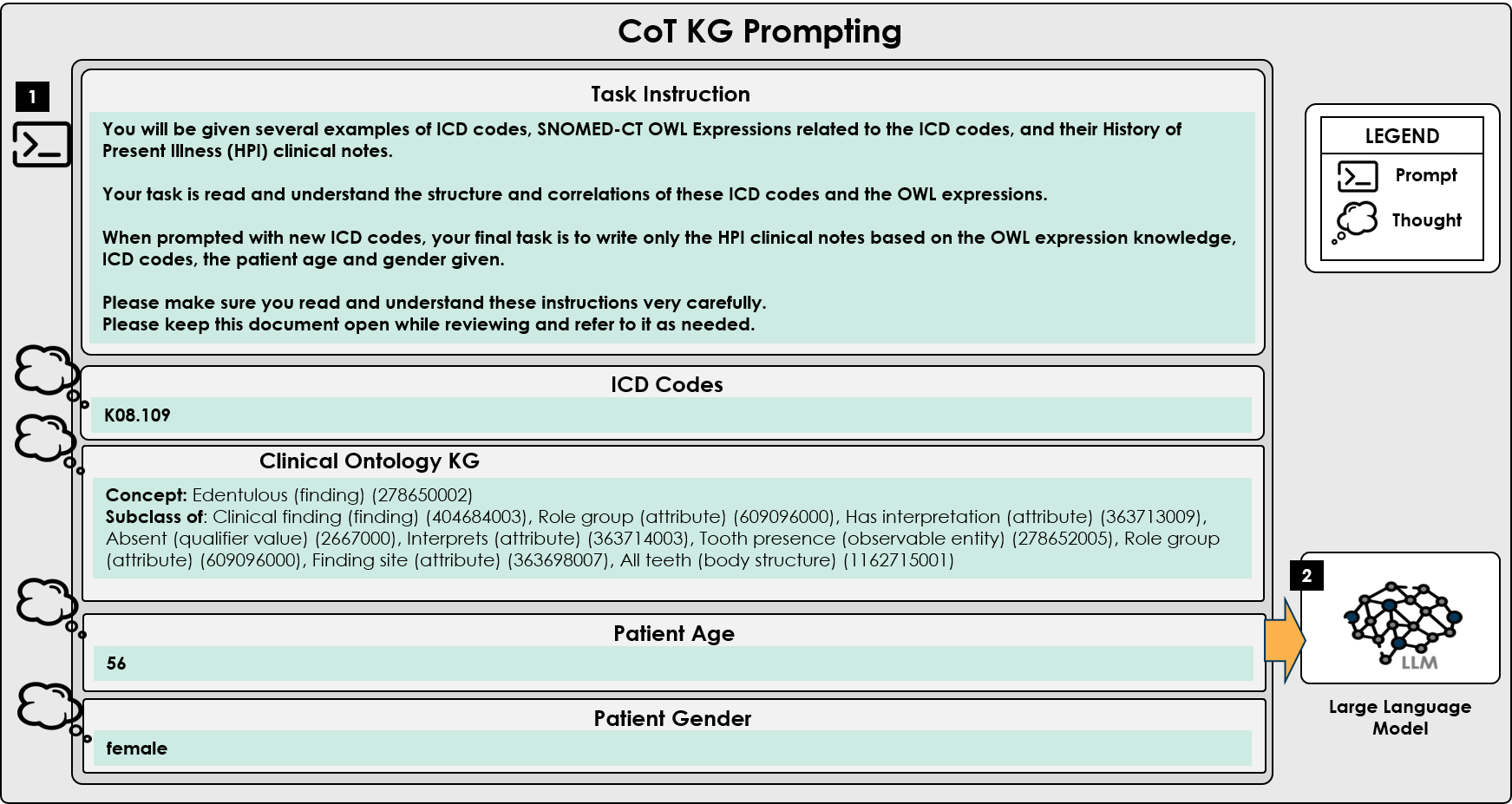
- Methodology Introduces the infusion of a structured clinical ontology knowledge graph (built from SNOMED CT OWL expressions) directly into the LLM prompt to ground generation in formal medical relationships and constraints.
- Methodology/Biology Demonstrates the first systematic approach to reverse the common ICD code classification task, instead generating comprehensive clinical notes from ICD codes as primary input, evaluated on six distinct clinical cases.
主要结论
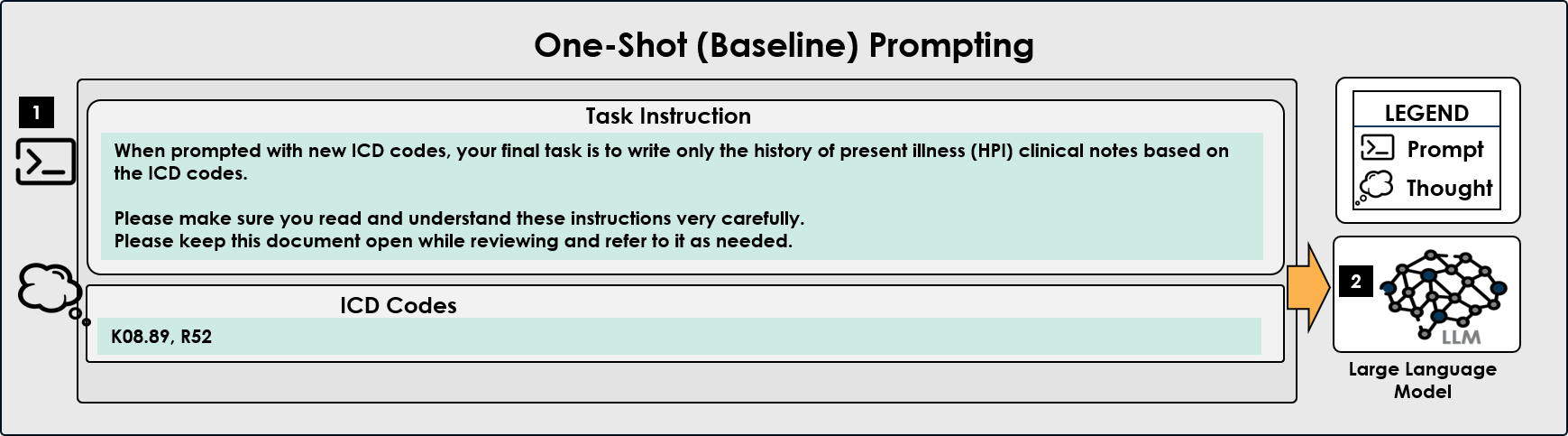
- The proposed CoT prompting with semantic search (using ICD codes as query) consistently outperformed the standard one-shot baseline across six clinical cases, as evidenced by lower cosine distance scores (e.g., Case C showed a clear leftward shift in KDE peak, indicating higher semantic similarity to ground truth).
- Incorporating a clinical knowledge graph (SNOMED CT OWL) into the prompt (CoT KG) provided structured medical relationships, enriching the generated notes with domain-specific terminology and logical constraints derived from formal ontologies.
- The hybrid approach (CoT Semantic Search + KG) leverages both in-context examples from similar cases and formal medical knowledge, offering a robust framework for improving the factual accuracy and clinical relevance of LLM-generated notes from coded inputs.
摘要: In the past decade a surge in the amount of electronic health record (EHR) data in the United States, attributed to a favorable policy environment created by the Health Information Technology for Economic and Clinical Health (HITECH) Act of 2009 and the 21st Century Cures Act of 2016. Clinical notes for patients’ assessments, diagnoses, and treatments are captured in these EHRs in free-form text by physicians, who spend a considerable amount of time entering and editing them. Manually writing clinical notes takes a considerable amount of a doctor’s valuable time, increasing the patient’s waiting time and possibly delaying diagnoses. Large language models (LLMs) possess the ability to generate news articles that closely resemble human-written ones. We investigate the usage of Chain-of-Thought (CoT) prompt engineering to improve the LLM’s response in clinical note generation. In our prompts, we use as input International Classification of Diseases (ICD) codes and basic patient information. We investigate a strategy that combines the traditional CoT with semantic search results to improve the quality of generated clinical notes. Additionally, we infuse a knowledge graph (KG) built from clinical ontology to further enrich the domain-specific knowledge of generated clinical notes. We test our prompting technique on six clinical cases from the CodiEsp test dataset using GPT-4 and our results show that it outperformed the clinical notes generated by standard one-shot prompts.