
Paper List
-
Evolutionarily Stable Stackelberg Equilibrium
通过要求追随者策略对突变入侵具有鲁棒性,弥合了斯塔克尔伯格领导力模型与演化稳定性之间的鸿沟。
-
Recovering Sparse Neural Connectivity from Partial Measurements: A Covariance-Based Approach with Granger-Causality Refinement
通过跨多个实验会话累积协方差统计,实现从部分记录到完整神经连接性的重建。
-
Atomic Trajectory Modeling with State Space Models for Biomolecular Dynamics
ATMOS通过提供一个基于SSM的高效框架,用于生物分子的原子级轨迹生成,弥合了计算昂贵的MD模拟与时间受限的深度生成模型之间的差距。
-
Slow evolution towards generalism in a model of variable dietary range
通过证明是种群统计噪声(而非确定性动力学)驱动了模式形成和泛化食性的演化,解决了间接竞争下物种形成的悖论。
-
Grounded Multimodal Retrieval-Augmented Drafting of Radiology Impressions Using Case-Based Similarity Search
通过将印象草稿基于检索到的历史病例,并采用明确引用和基于置信度的拒绝机制,解决放射学报告生成中的幻觉问题。
-
Unified Policy–Value Decomposition for Rapid Adaptation
通过双线性分解在策略和价值函数之间共享低维目标嵌入,实现对新颖任务的零样本适应。
-
Mathematical Modeling of Cancer–Bacterial Therapy: Analysis and Numerical Simulation via Physics-Informed Neural Networks
提供了一个严格的、无网格的PINN框架,用于模拟和分析细菌癌症疗法中复杂的、空间异质的相互作用。
-
Sample-Efficient Adaptation of Drug-Response Models to Patient Tumors under Strong Biological Domain Shift
通过从无标记分子谱中学习可迁移表征,利用最少的临床数据实现患者药物反应的有效预测。
Enhancing Clinical Note Generation with ICD-10, Clinical Ontology Knowledge Graphs, and Chain-of-Thought Prompting Using GPT-4
Computer Science, Old Dominion University | Biomedical Informatics, University of Arkansas for Medical Sciences

30秒速读
IN SHORT: This paper addresses the core challenge of generating accurate and clinically relevant patient notes from sparse inputs (ICD codes and basic demographics) by augmenting Chain-of-Thought prompting with semantic search and structured medical knowledge graphs.
核心创新
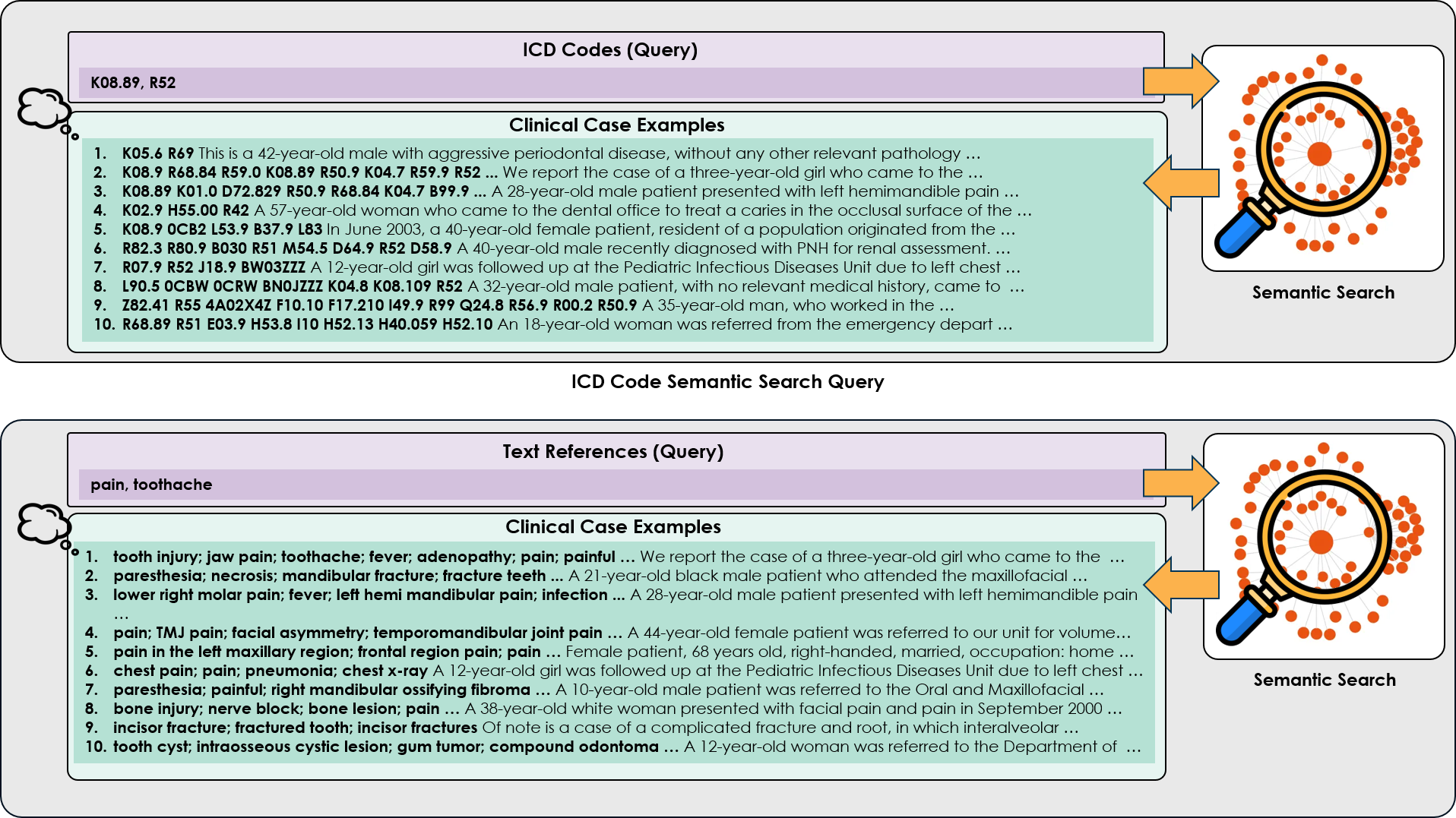
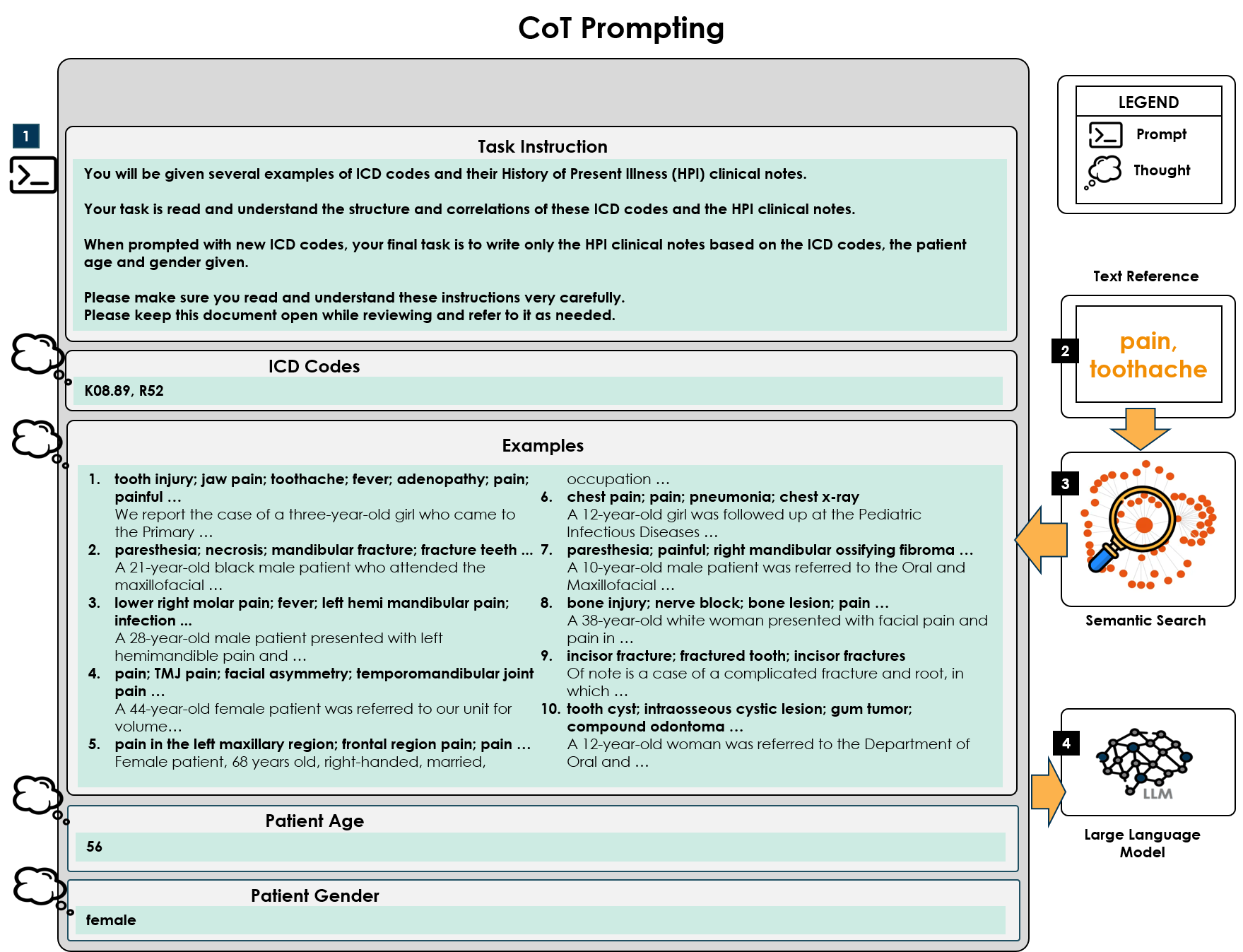
- Methodology Proposes a novel hybrid prompting framework that integrates traditional Chain-of-Thought reasoning with semantic search results from a clinical corpus (CodiEsp dataset) to provide contextual examples.
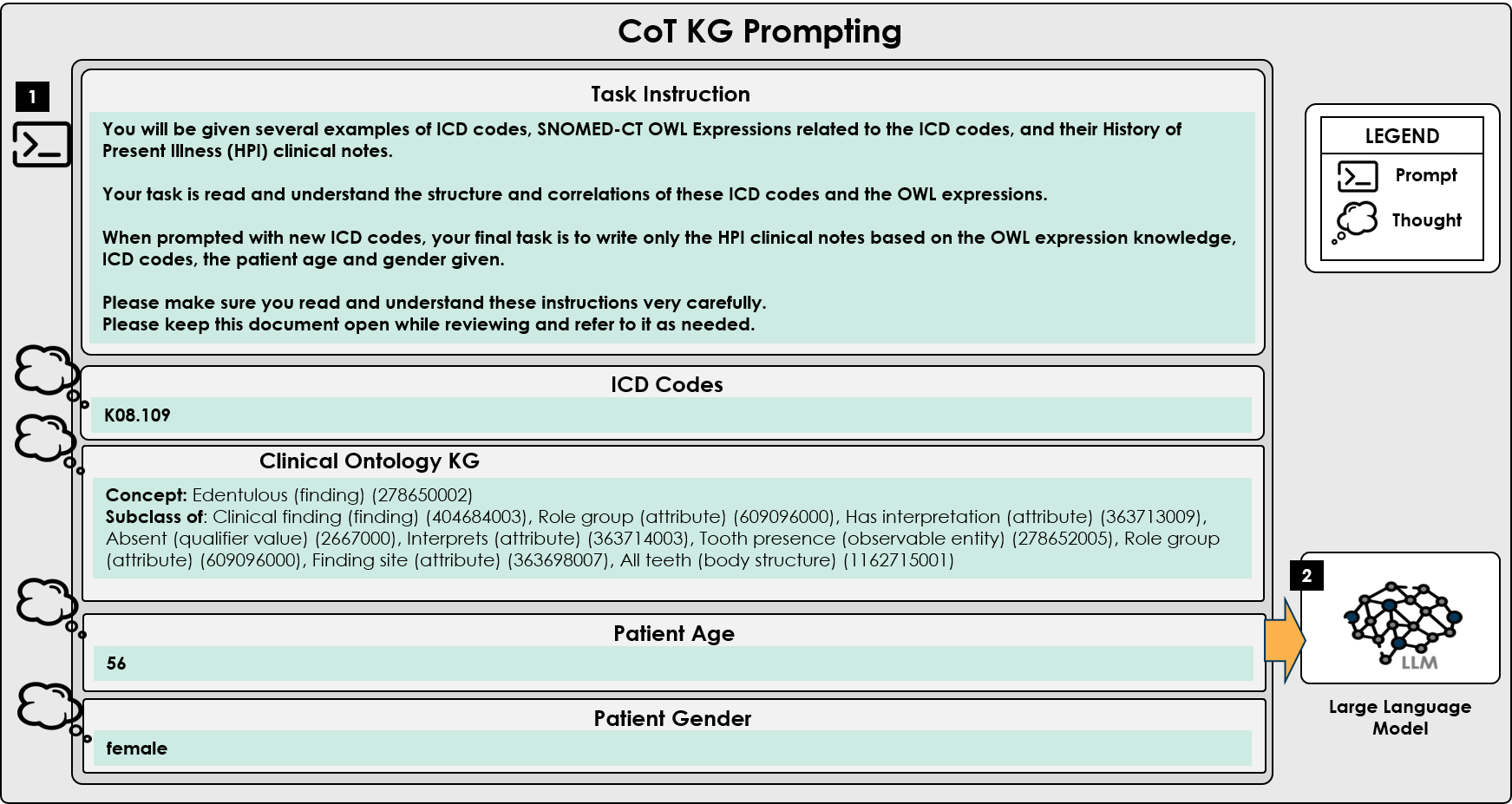
- Methodology Introduces the infusion of a structured clinical ontology knowledge graph (built from SNOMED CT OWL expressions) directly into the LLM prompt to ground generation in formal medical relationships and constraints.
- Methodology/Biology Demonstrates the first systematic approach to reverse the common ICD code classification task, instead generating comprehensive clinical notes from ICD codes as primary input, evaluated on six distinct clinical cases.
主要结论
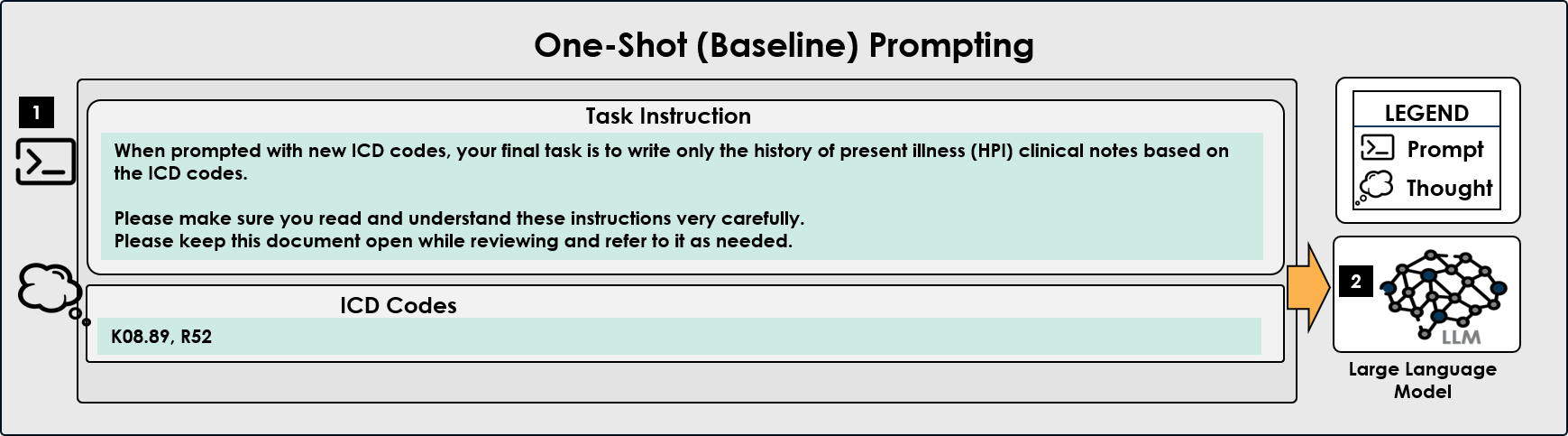
- The proposed CoT prompting with semantic search (using ICD codes as query) consistently outperformed the standard one-shot baseline across six clinical cases, as evidenced by lower cosine distance scores (e.g., Case C showed a clear leftward shift in KDE peak, indicating higher semantic similarity to ground truth).
- Incorporating a clinical knowledge graph (SNOMED CT OWL) into the prompt (CoT KG) provided structured medical relationships, enriching the generated notes with domain-specific terminology and logical constraints derived from formal ontologies.
- The hybrid approach (CoT Semantic Search + KG) leverages both in-context examples from similar cases and formal medical knowledge, offering a robust framework for improving the factual accuracy and clinical relevance of LLM-generated notes from coded inputs.
摘要: In the past decade a surge in the amount of electronic health record (EHR) data in the United States, attributed to a favorable policy environment created by the Health Information Technology for Economic and Clinical Health (HITECH) Act of 2009 and the 21st Century Cures Act of 2016. Clinical notes for patients’ assessments, diagnoses, and treatments are captured in these EHRs in free-form text by physicians, who spend a considerable amount of time entering and editing them. Manually writing clinical notes takes a considerable amount of a doctor’s valuable time, increasing the patient’s waiting time and possibly delaying diagnoses. Large language models (LLMs) possess the ability to generate news articles that closely resemble human-written ones. We investigate the usage of Chain-of-Thought (CoT) prompt engineering to improve the LLM’s response in clinical note generation. In our prompts, we use as input International Classification of Diseases (ICD) codes and basic patient information. We investigate a strategy that combines the traditional CoT with semantic search results to improve the quality of generated clinical notes. Additionally, we infuse a knowledge graph (KG) built from clinical ontology to further enrich the domain-specific knowledge of generated clinical notes. We test our prompting technique on six clinical cases from the CodiEsp test dataset using GPT-4 and our results show that it outperformed the clinical notes generated by standard one-shot prompts.