
Paper List
-
Discovery of a Hematopoietic Manifold in scGPT Yields a Method for Extracting Performant Algorithms from Biological Foundation Model Internals
This work addresses the core challenge of extracting reusable, interpretable, and high-performance biological algorithms from the opaque internal repr...
-
MS2MetGAN: Latent-space adversarial training for metabolite–spectrum matching in MS/MS database search
This paper addresses the critical bottleneck in metabolite identification: the generation of high-quality negative training samples that are structura...
-
Toward Robust, Reproducible, and Widely Accessible Intracranial Language Brain-Computer Interfaces: A Comprehensive Review of Neural Mechanisms, Hardware, Algorithms, Evaluation, Clinical Pathways and Future Directions
This review addresses the core challenge of fragmented and heterogeneous evidence that hinders the clinical translation of intracranial language BCIs,...
-
Less Is More in Chemotherapy of Breast Cancer
通过纳入细胞周期时滞和竞争项,解决了现有肿瘤-免疫模型的过度简化问题,以定量比较化疗方案。
-
Fold-CP: A Context Parallelism Framework for Biomolecular Modeling
This paper addresses the critical bottleneck of GPU memory limitations that restrict AlphaFold 3-like models to processing only a few thousand residue...
-
Open Biomedical Knowledge Graphs at Scale: Construction, Federation, and AI Agent Access with Samyama Graph Database
This paper addresses the core pain point of fragmented biomedical data by constructing and federating large-scale, open knowledge graphs to enable sea...
-
Predictive Analytics for Foot Ulcers Using Time-Series Temperature and Pressure Data
This paper addresses the critical need for continuous, real-time monitoring of diabetic foot health by developing an unsupervised anomaly detection fr...
-
Hypothesis-Based Particle Detection for Accurate Nanoparticle Counting and Digital Diagnostics
This paper addresses the core challenge of achieving accurate, interpretable, and training-free nanoparticle counting in digital diagnostic assays, wh...
Competition, stability, and functionality in excitatory-inhibitory neural circuits
Università degli Studi di Padova | University of California at San Diego | Rice University | University of California at Santa Barbara
30秒速读
IN SHORT: This paper addresses the core challenge of extending interpretable energy-based frameworks to biologically realistic asymmetric neural networks, where traditional symmetric weight assumptions break down.
核心创新
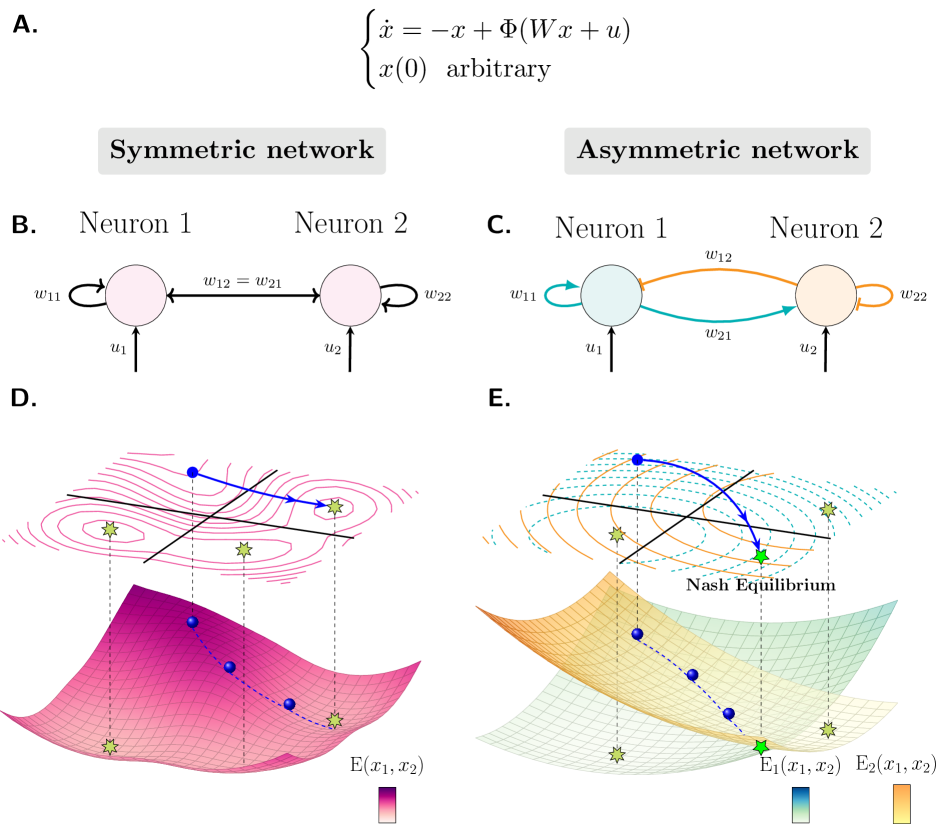
- Methodology Introduces a game-theoretic interpretation where each neuron acts as a selfish agent minimizing its own energy, with collective dynamics reaching Nash equilibria rather than global energy minima.
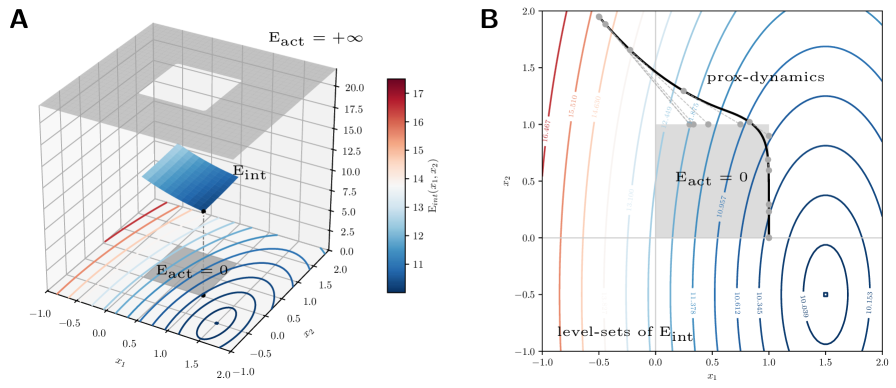
- Methodology Extends the proximal gradient dynamics framework to asymmetric firing rate networks, defining neuron-specific interaction costs {E_int^i(x,u_i)} and activation costs {E_act^i(x_i)}.
- Theory Bridges energy-based models with network stability theory (Lyapunov diagonal stability) to analyze regulation and balancing in excitatory-inhibitory circuits.
主要结论
- Asymmetric neural networks can be reformulated as noncooperative games where Nash equilibria correspond to stable network states, providing interpretability without global energy functions.
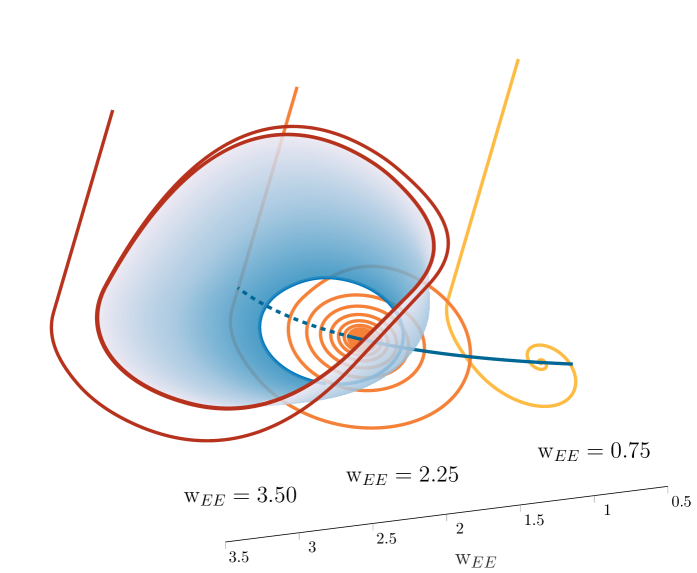
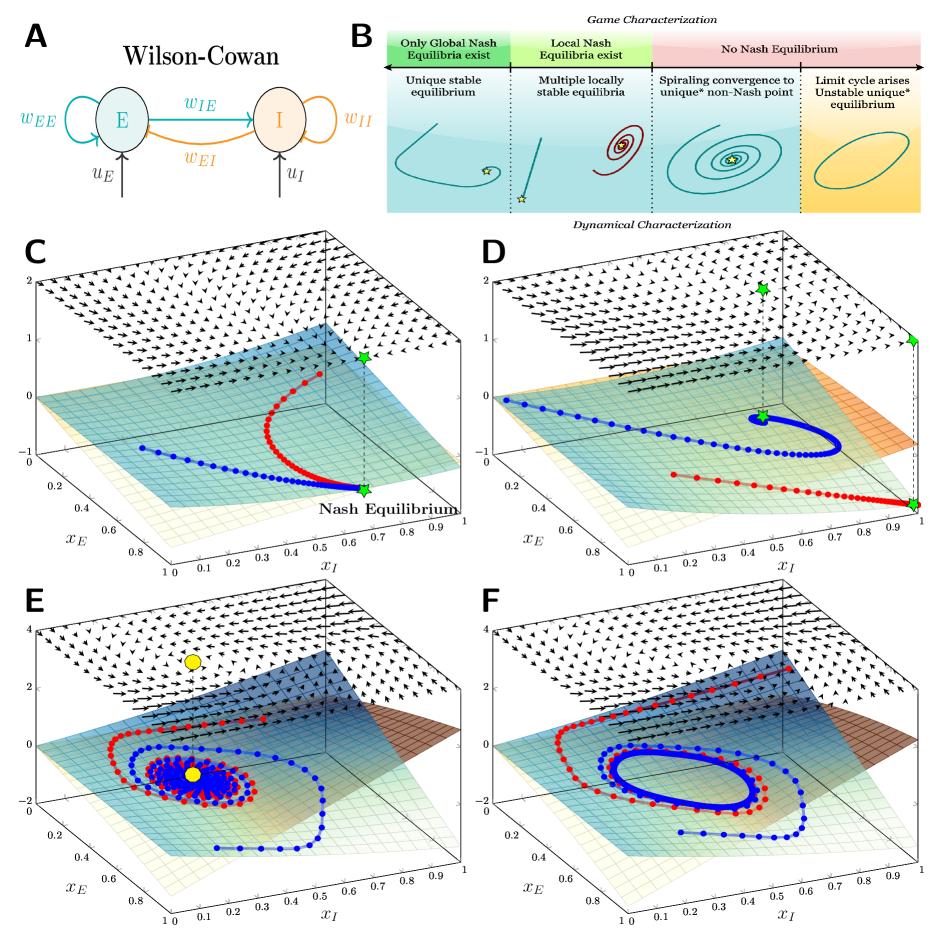
- The Wilson-Cowan model reveals that excitatory self-connection weight w_EE serves as a principal switch governing transitions between cooperative and antagonistic dynamical regimes.
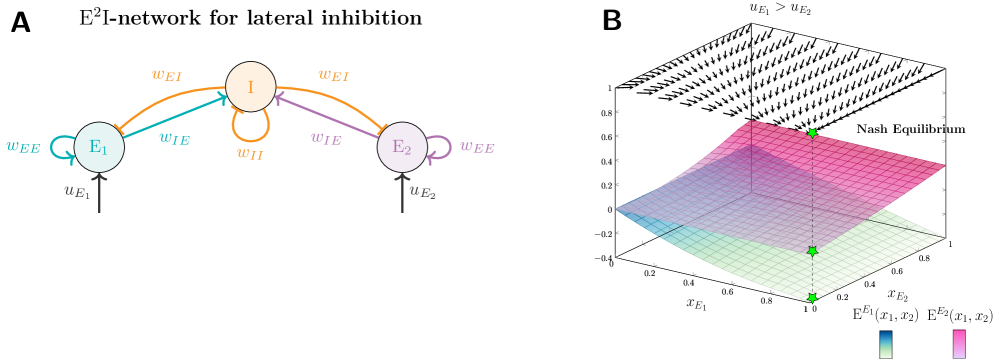
- Lateral inhibition microcircuits function as contrast enhancers through hierarchical excitation-inhibition interplay, sharpening subtle environmental differences with arbitrary precision.
摘要: Energy-based models have become a central paradigm for understanding computation and stability in both theoretical neuroscience and machine learning. However, the energetic framework typically relies on symmetry in synaptic or weight matrices - a constraint that excludes biologically realistic systems such as excitatory–inhibitory (E–I) networks. When symmetry is relaxed, the classical notion of a global energy landscape fails, leaving the dynamics of asymmetric neural systems conceptually unanchored. In this work, we extend the energetic framework to asymmetric firing rate networks, revealing an underlying game-theoretic structure for the neural dynamics in which each neuron is an agent that seeks to minimize its own energy. In addition, we exploit rigorous stability principles from network theory to study regulation and balancing of neural activity in E-I networks. We combine the novel game-energetic interpretation and the stability results to revisit standard frameworks in theoretical neuroscience, such as the Wilson-Cowan and lateral inhibition models. These insights allow us to study cortical columns of lateral inhibition microcircuits as contrast enhancer - with the ability to selectively sharpen subtle differences in the environment through hierarchical excitation–inhibition interplay. Our results bridge energetic and game-theoretic views of neural computation, offering a pathway toward the systematic engineering of biologically grounded, dynamically stable neural architectures.