
Paper List
-
Nyxus: A Next Generation Image Feature Extraction Library for the Big Data and AI Era
This paper addresses the core pain point of efficiently extracting standardized, comparable features from massive (terabyte to petabyte-scale) biomedi...
-
Topological Enhancement of Protein Kinetic Stability
This work addresses the long-standing puzzle of why knotted proteins exist by demonstrating that deep knots provide a functional advantage through enh...
-
A Multi-Label Temporal Convolutional Framework for Transcription Factor Binding Characterization
This paper addresses the critical limitation of existing TF binding prediction methods that treat transcription factors as independent entities, faili...
-
Social Distancing Equilibria in Games under Conventional SI Dynamics
This paper solves the core problem of proving the existence and uniqueness of Nash equilibria in finite-duration SI epidemic games, showing they are a...
-
Binding Free Energies without Alchemy
This paper addresses the core bottleneck of computational expense in Absolute Binding Free Energy calculations by eliminating the need for numerous al...
-
SHREC: A Spectral Embedding-Based Approach for Ab-Initio Reconstruction of Helical Molecules
This paper addresses the core bottleneck in cryo-EM helical reconstruction: eliminating the dependency on accurate initial symmetry parameter estimati...
-
Budget-Sensitive Discovery Scoring: A Formally Verified Framework for Evaluating AI-Guided Scientific Selection
This paper addresses the critical gap in evaluating AI-guided scientific selection strategies under realistic budget constraints, where existing metri...
-
Probabilistic Joint and Individual Variation Explained (ProJIVE) for Data Integration
This paper addresses the core challenge of accurately decomposing shared (joint) and dataset-specific (individual) sources of variation in multi-modal...
Competition, stability, and functionality in excitatory-inhibitory neural circuits
Università degli Studi di Padova | University of California at San Diego | Rice University | University of California at Santa Barbara
30秒速读
IN SHORT: This paper addresses the core challenge of extending interpretable energy-based frameworks to biologically realistic asymmetric neural networks, where traditional symmetric weight assumptions break down.
核心创新
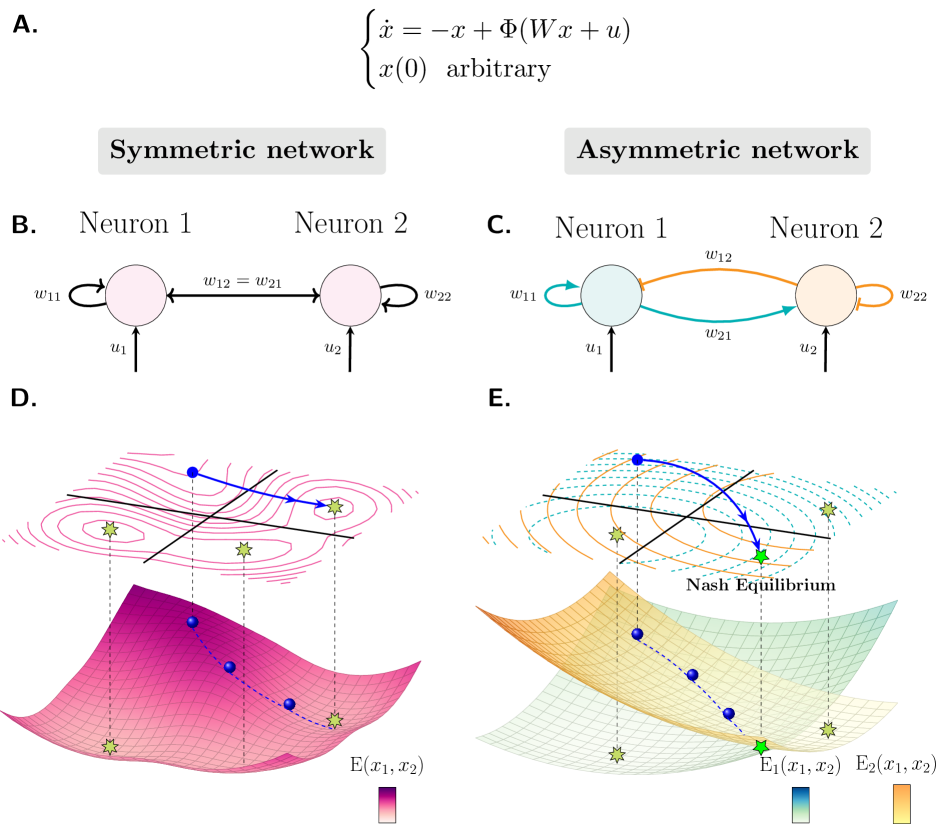
- Methodology Introduces a game-theoretic interpretation where each neuron acts as a selfish agent minimizing its own energy, with collective dynamics reaching Nash equilibria rather than global energy minima.
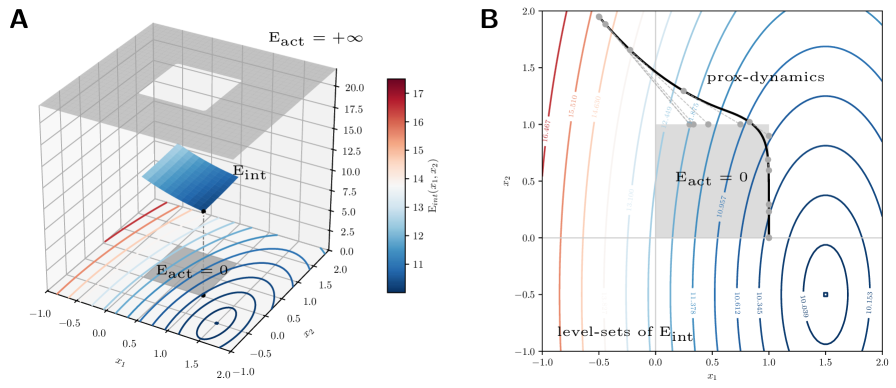
- Methodology Extends the proximal gradient dynamics framework to asymmetric firing rate networks, defining neuron-specific interaction costs {E_int^i(x,u_i)} and activation costs {E_act^i(x_i)}.
- Theory Bridges energy-based models with network stability theory (Lyapunov diagonal stability) to analyze regulation and balancing in excitatory-inhibitory circuits.
主要结论
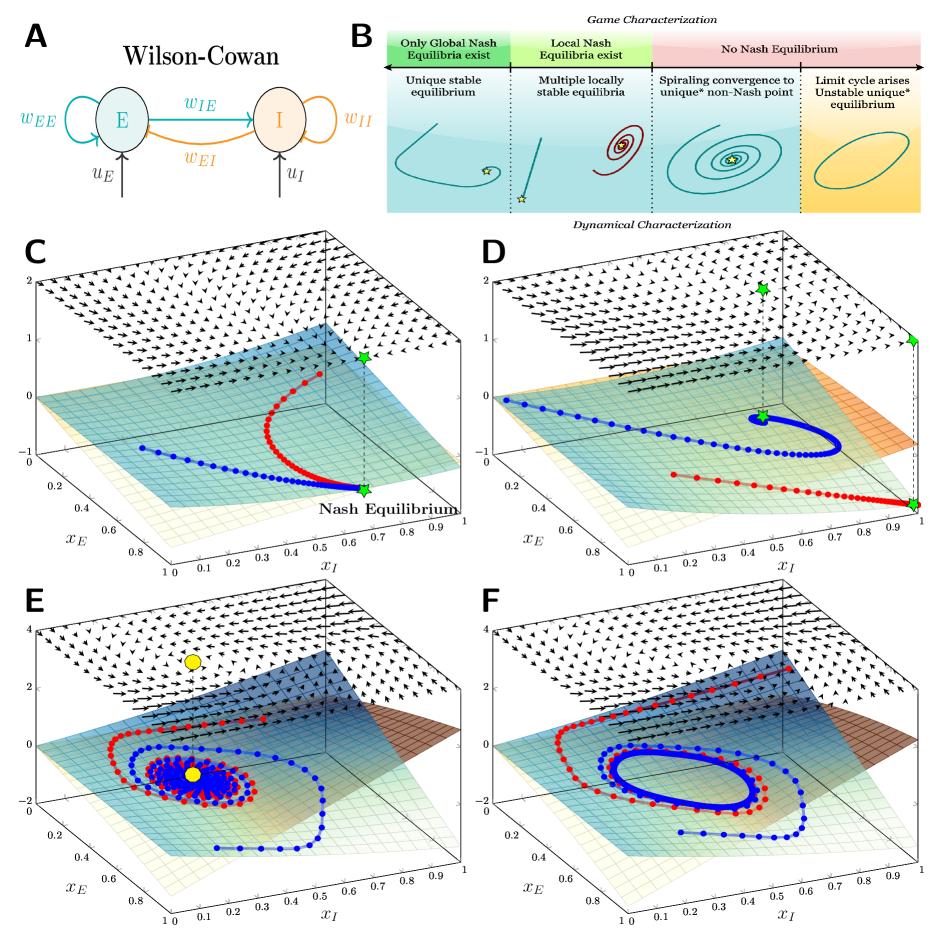
- Asymmetric neural networks can be reformulated as noncooperative games where Nash equilibria correspond to stable network states, providing interpretability without global energy functions.
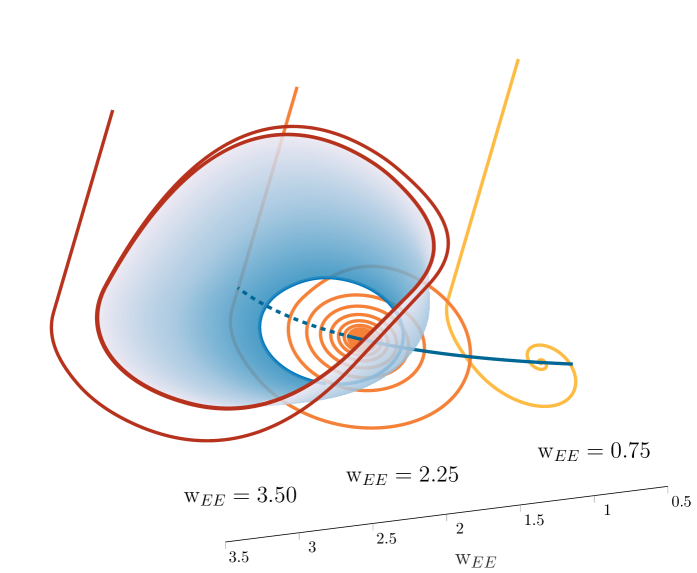
- The Wilson-Cowan model reveals that excitatory self-connection weight w_EE serves as a principal switch governing transitions between cooperative and antagonistic dynamical regimes.
- Lateral inhibition microcircuits function as contrast enhancers through hierarchical excitation-inhibition interplay, sharpening subtle environmental differences with arbitrary precision.
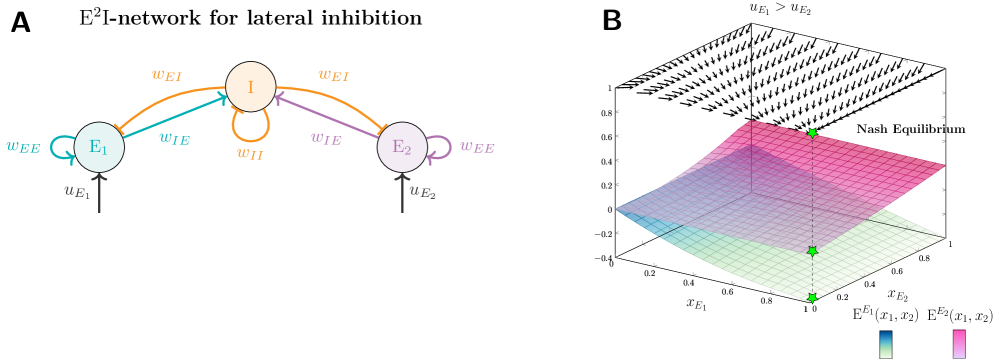
摘要: Energy-based models have become a central paradigm for understanding computation and stability in both theoretical neuroscience and machine learning. However, the energetic framework typically relies on symmetry in synaptic or weight matrices - a constraint that excludes biologically realistic systems such as excitatory–inhibitory (E–I) networks. When symmetry is relaxed, the classical notion of a global energy landscape fails, leaving the dynamics of asymmetric neural systems conceptually unanchored. In this work, we extend the energetic framework to asymmetric firing rate networks, revealing an underlying game-theoretic structure for the neural dynamics in which each neuron is an agent that seeks to minimize its own energy. In addition, we exploit rigorous stability principles from network theory to study regulation and balancing of neural activity in E-I networks. We combine the novel game-energetic interpretation and the stability results to revisit standard frameworks in theoretical neuroscience, such as the Wilson-Cowan and lateral inhibition models. These insights allow us to study cortical columns of lateral inhibition microcircuits as contrast enhancer - with the ability to selectively sharpen subtle differences in the environment through hierarchical excitation–inhibition interplay. Our results bridge energetic and game-theoretic views of neural computation, offering a pathway toward the systematic engineering of biologically grounded, dynamically stable neural architectures.