
Paper List
-
An AI Implementation Science Study to Improve Trustworthy Data in a Large Healthcare System
This paper addresses the critical gap between theoretical AI research and real-world clinical implementation by providing a practical framework for as...
-
The BEAT-CF Causal Model: A model for guiding the design of trials and observational analyses of cystic fibrosis exacerbations
This paper addresses the critical gap in cystic fibrosis exacerbation management by providing a formal causal framework that integrates expert knowled...
-
Hierarchical Molecular Language Models (HMLMs)
This paper addresses the core challenge of accurately modeling context-dependent signaling, pathway cross-talk, and temporal dynamics across multiple ...
-
Stability analysis of action potential generation using Markov models of voltage‑gated sodium channel isoforms
This work addresses the challenge of systematically characterizing how the high-dimensional parameter space of Markov models for different sodium chan...
-
Approximate Bayesian Inference on Mechanisms of Network Growth and Evolution
This paper addresses the core challenge of inferring the relative contributions of multiple, simultaneous generative mechanisms in network formation w...
-
EnzyCLIP: A Cross-Attention Dual Encoder Framework with Contrastive Learning for Predicting Enzyme Kinetic Constants
This paper addresses the core challenge of jointly predicting enzyme kinetic parameters (Kcat and Km) by modeling dynamic enzyme-substrate interaction...
-
Tissue stress measurements with Bayesian Inversion Stress Microscopy
This paper addresses the core challenge of measuring absolute, tissue-scale mechanical stress without making assumptions about tissue rheology, which ...
-
DeepFRI Demystified: Interpretability vs. Accuracy in AI Protein Function Prediction
This study addresses the critical gap between high predictive accuracy and biological interpretability in DeepFRI, revealing that the model often prio...
Competition, stability, and functionality in excitatory-inhibitory neural circuits
Università degli Studi di Padova | University of California at San Diego | Rice University | University of California at Santa Barbara
30秒速读
IN SHORT: This paper addresses the core challenge of extending interpretable energy-based frameworks to biologically realistic asymmetric neural networks, where traditional symmetric weight assumptions break down.
核心创新
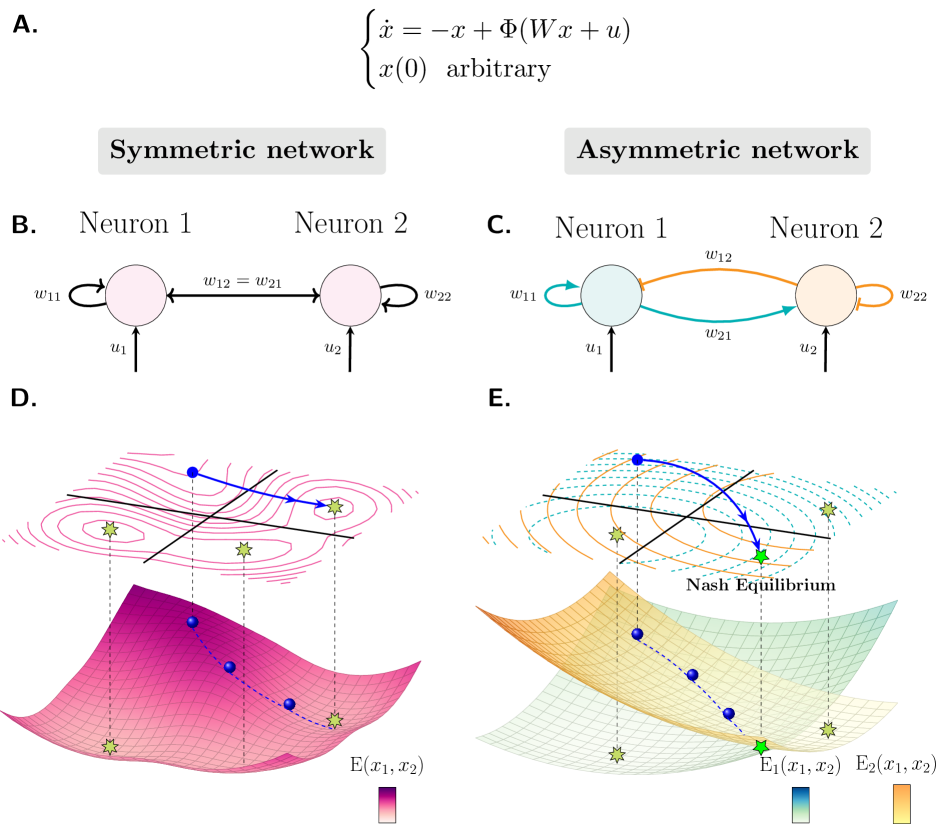
- Methodology Introduces a game-theoretic interpretation where each neuron acts as a selfish agent minimizing its own energy, with collective dynamics reaching Nash equilibria rather than global energy minima.
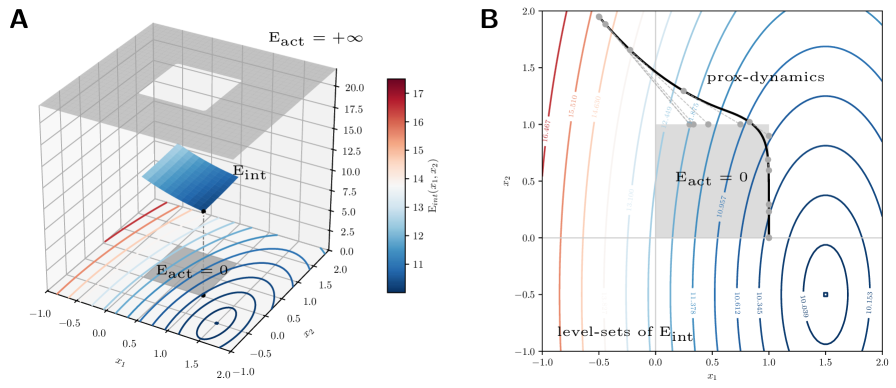
- Methodology Extends the proximal gradient dynamics framework to asymmetric firing rate networks, defining neuron-specific interaction costs {E_int^i(x,u_i)} and activation costs {E_act^i(x_i)}.
- Theory Bridges energy-based models with network stability theory (Lyapunov diagonal stability) to analyze regulation and balancing in excitatory-inhibitory circuits.
主要结论
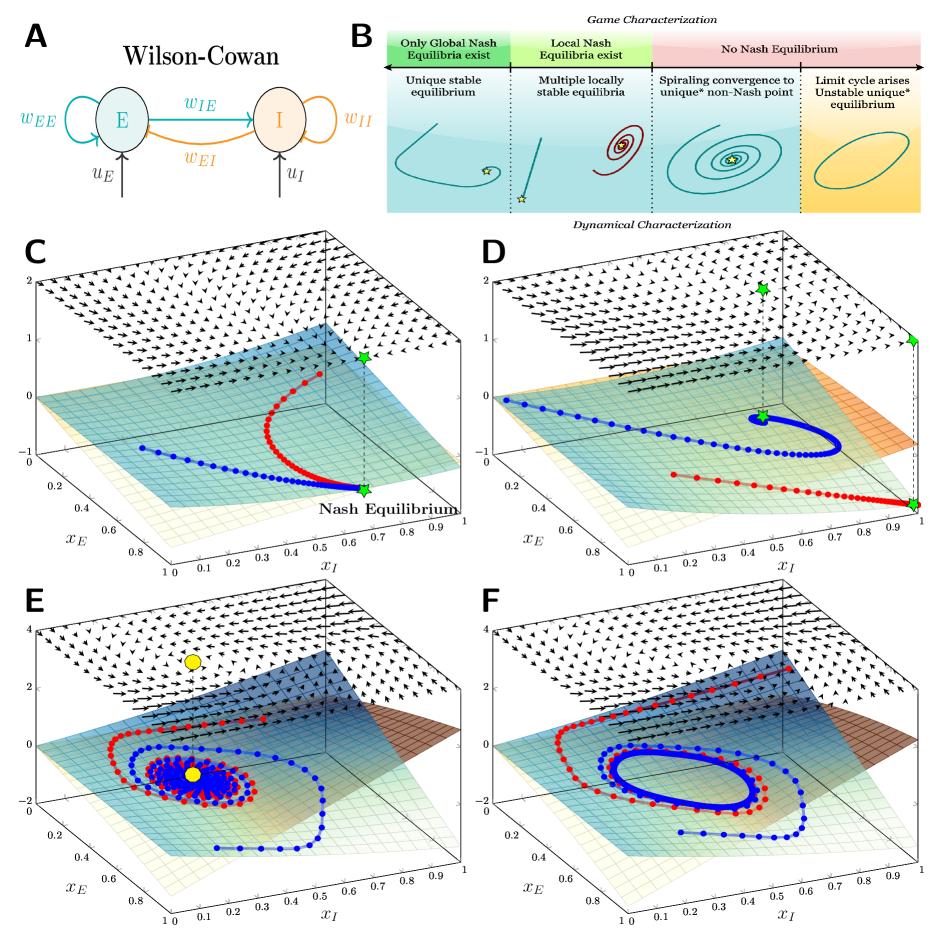
- Asymmetric neural networks can be reformulated as noncooperative games where Nash equilibria correspond to stable network states, providing interpretability without global energy functions.
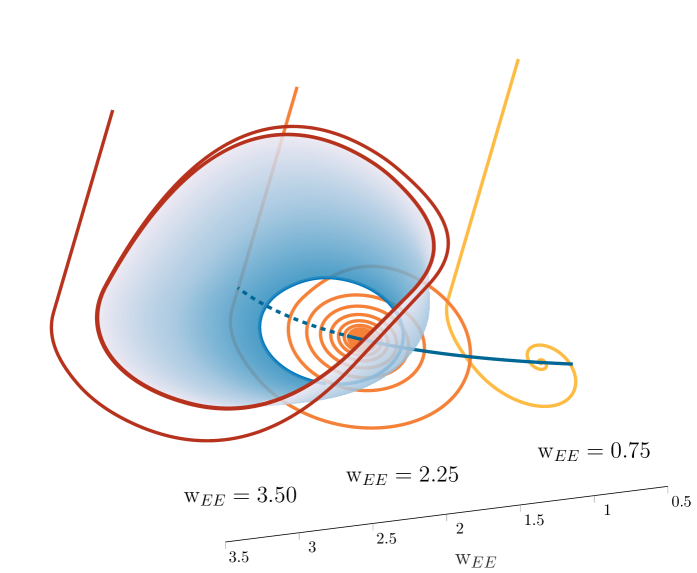
- The Wilson-Cowan model reveals that excitatory self-connection weight w_EE serves as a principal switch governing transitions between cooperative and antagonistic dynamical regimes.
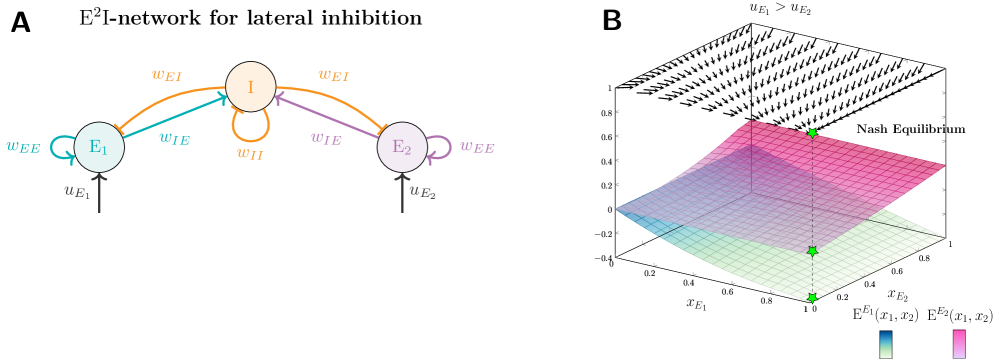
- Lateral inhibition microcircuits function as contrast enhancers through hierarchical excitation-inhibition interplay, sharpening subtle environmental differences with arbitrary precision.
摘要: Energy-based models have become a central paradigm for understanding computation and stability in both theoretical neuroscience and machine learning. However, the energetic framework typically relies on symmetry in synaptic or weight matrices - a constraint that excludes biologically realistic systems such as excitatory–inhibitory (E–I) networks. When symmetry is relaxed, the classical notion of a global energy landscape fails, leaving the dynamics of asymmetric neural systems conceptually unanchored. In this work, we extend the energetic framework to asymmetric firing rate networks, revealing an underlying game-theoretic structure for the neural dynamics in which each neuron is an agent that seeks to minimize its own energy. In addition, we exploit rigorous stability principles from network theory to study regulation and balancing of neural activity in E-I networks. We combine the novel game-energetic interpretation and the stability results to revisit standard frameworks in theoretical neuroscience, such as the Wilson-Cowan and lateral inhibition models. These insights allow us to study cortical columns of lateral inhibition microcircuits as contrast enhancer - with the ability to selectively sharpen subtle differences in the environment through hierarchical excitation–inhibition interplay. Our results bridge energetic and game-theoretic views of neural computation, offering a pathway toward the systematic engineering of biologically grounded, dynamically stable neural architectures.