
Paper List
-
Evolutionarily Stable Stackelberg Equilibrium
通过要求追随者策略对突变入侵具有鲁棒性,弥合了斯塔克尔伯格领导力模型与演化稳定性之间的鸿沟。
-
Recovering Sparse Neural Connectivity from Partial Measurements: A Covariance-Based Approach with Granger-Causality Refinement
通过跨多个实验会话累积协方差统计,实现从部分记录到完整神经连接性的重建。
-
Atomic Trajectory Modeling with State Space Models for Biomolecular Dynamics
ATMOS通过提供一个基于SSM的高效框架,用于生物分子的原子级轨迹生成,弥合了计算昂贵的MD模拟与时间受限的深度生成模型之间的差距。
-
Slow evolution towards generalism in a model of variable dietary range
通过证明是种群统计噪声(而非确定性动力学)驱动了模式形成和泛化食性的演化,解决了间接竞争下物种形成的悖论。
-
Grounded Multimodal Retrieval-Augmented Drafting of Radiology Impressions Using Case-Based Similarity Search
通过将印象草稿基于检索到的历史病例,并采用明确引用和基于置信度的拒绝机制,解决放射学报告生成中的幻觉问题。
-
Unified Policy–Value Decomposition for Rapid Adaptation
通过双线性分解在策略和价值函数之间共享低维目标嵌入,实现对新颖任务的零样本适应。
-
Mathematical Modeling of Cancer–Bacterial Therapy: Analysis and Numerical Simulation via Physics-Informed Neural Networks
提供了一个严格的、无网格的PINN框架,用于模拟和分析细菌癌症疗法中复杂的、空间异质的相互作用。
-
Sample-Efficient Adaptation of Drug-Response Models to Patient Tumors under Strong Biological Domain Shift
通过从无标记分子谱中学习可迁移表征,利用最少的临床数据实现患者药物反应的有效预测。
Competition, stability, and functionality in excitatory-inhibitory neural circuits
Università degli Studi di Padova | University of California at San Diego | Rice University | University of California at Santa Barbara
30秒速读
IN SHORT: This paper addresses the core challenge of extending interpretable energy-based frameworks to biologically realistic asymmetric neural networks, where traditional symmetric weight assumptions break down.
核心创新
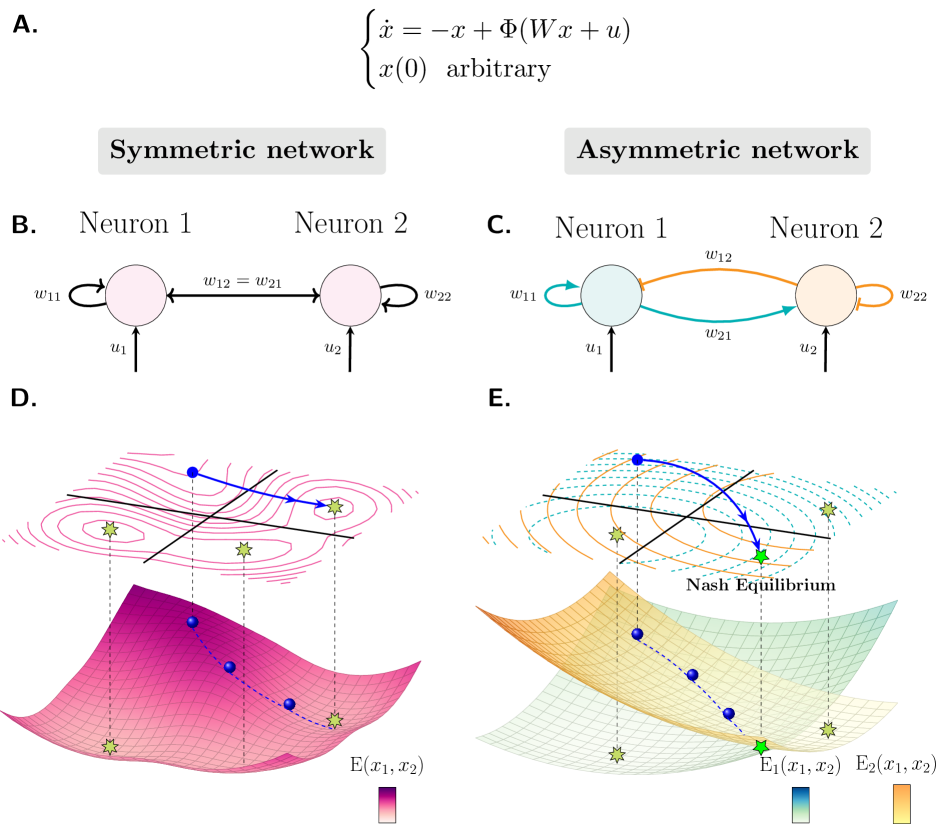
- Methodology Introduces a game-theoretic interpretation where each neuron acts as a selfish agent minimizing its own energy, with collective dynamics reaching Nash equilibria rather than global energy minima.
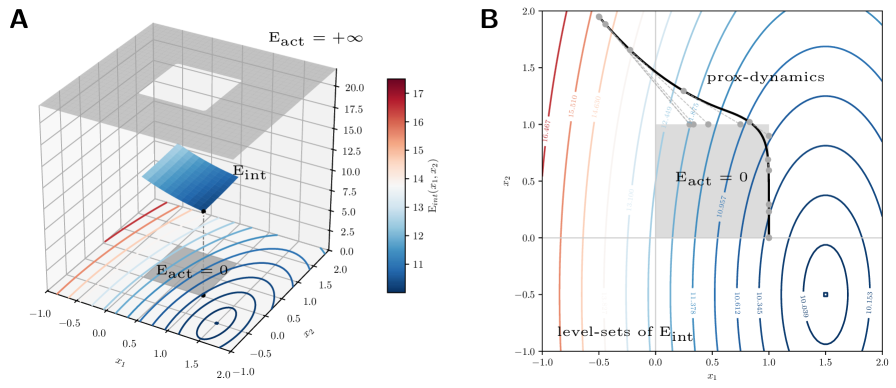
- Methodology Extends the proximal gradient dynamics framework to asymmetric firing rate networks, defining neuron-specific interaction costs {E_int^i(x,u_i)} and activation costs {E_act^i(x_i)}.
- Theory Bridges energy-based models with network stability theory (Lyapunov diagonal stability) to analyze regulation and balancing in excitatory-inhibitory circuits.
主要结论
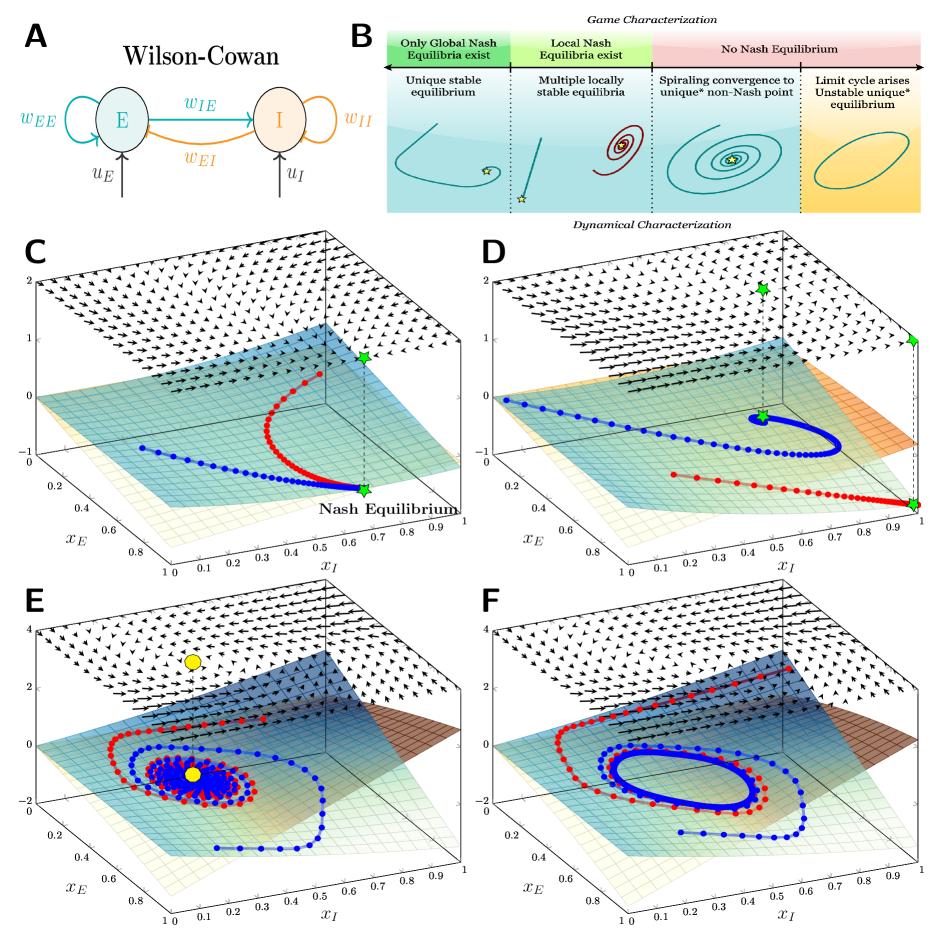
- Asymmetric neural networks can be reformulated as noncooperative games where Nash equilibria correspond to stable network states, providing interpretability without global energy functions.
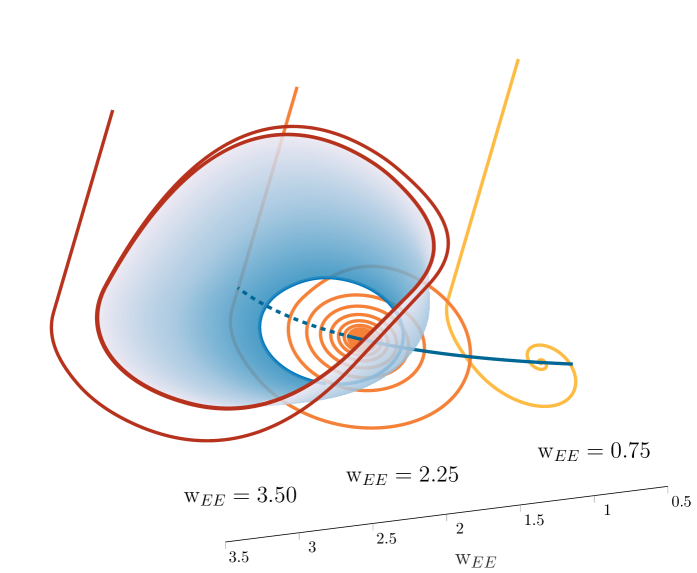
- The Wilson-Cowan model reveals that excitatory self-connection weight w_EE serves as a principal switch governing transitions between cooperative and antagonistic dynamical regimes.
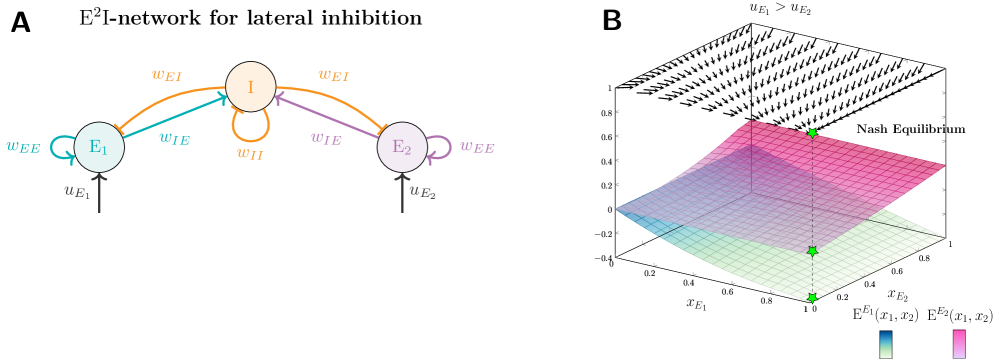
- Lateral inhibition microcircuits function as contrast enhancers through hierarchical excitation-inhibition interplay, sharpening subtle environmental differences with arbitrary precision.
摘要: Energy-based models have become a central paradigm for understanding computation and stability in both theoretical neuroscience and machine learning. However, the energetic framework typically relies on symmetry in synaptic or weight matrices - a constraint that excludes biologically realistic systems such as excitatory–inhibitory (E–I) networks. When symmetry is relaxed, the classical notion of a global energy landscape fails, leaving the dynamics of asymmetric neural systems conceptually unanchored. In this work, we extend the energetic framework to asymmetric firing rate networks, revealing an underlying game-theoretic structure for the neural dynamics in which each neuron is an agent that seeks to minimize its own energy. In addition, we exploit rigorous stability principles from network theory to study regulation and balancing of neural activity in E-I networks. We combine the novel game-energetic interpretation and the stability results to revisit standard frameworks in theoretical neuroscience, such as the Wilson-Cowan and lateral inhibition models. These insights allow us to study cortical columns of lateral inhibition microcircuits as contrast enhancer - with the ability to selectively sharpen subtle differences in the environment through hierarchical excitation–inhibition interplay. Our results bridge energetic and game-theoretic views of neural computation, offering a pathway toward the systematic engineering of biologically grounded, dynamically stable neural architectures.