
Paper List
-
Mapping of Lesion Images to Somatic Mutations
This paper addresses the critical bottleneck of delayed genetic analysis in cancer diagnosis by predicting a patient's full somatic mutation profile d...
-
Reinventing Clinical Dialogue: Agentic Paradigms for LLM‑Enabled Healthcare Communication
This paper addresses the core challenge of transforming reactive, stateless LLMs into autonomous, reliable clinical dialogue agents capable of longitu...
-
Binary Latent Protein Fitness Landscapes for Quantum Annealing Optimization
通过将序列映射到二元潜在空间进行基于QUBO的适应度优化,桥接蛋白质表示学习和组合优化。
-
Controlling Fish Schools via Reinforcement Learning of Virtual Fish Movement
证明了无模型强化学习可以利用虚拟视觉刺激有效引导鱼群,克服了缺乏精确行为模型的问题。
Exactly Solvable Population Model with Square-Root Growth Noise and Cell-Size Regulation
Institute for Theoretical Physics, Department of Physics, Utrecht University, Utrecht, Netherlands | Centre for Complex Systems Studies, Utrecht University, Utrecht, Netherlands

30秒速读
IN SHORT: This paper addresses the fundamental gap in understanding how microscopic growth fluctuations, specifically those with size-dependent (square-root) noise, shape population-level fitness and statistics in cell populations, providing an exactly solvable model that contrasts sharply with existing size-independent noise models.
核心创新
- Theory Demonstrates that the asymptotic population growth rate Λ is exactly equal to the mean single-cell growth rate k, independent of noise strength σ and division mechanisms, establishing square-root growth noise as neutral for long-term fitness.
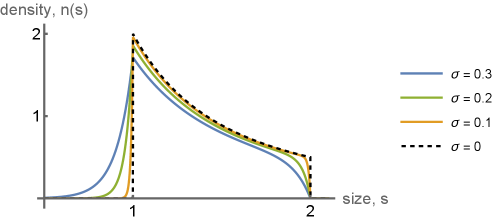
- Methodology Derives exact, closed-form expressions for the steady-state snapshot cell-size distribution, showing it results from a universal one-sided exponential convolution of the deterministic inverse-square-law solution, with kernel width σ².
- Theory Proves that the mean-rescaled population size Nt/⟨Nt⟩ converges to a stationary compound Poisson–exponential distribution determined solely by the growth noise parameter σ, independent of division or partitioning noise.
主要结论
- Population growth rate Λ = k exactly, demonstrating fitness neutrality of square-root noise (contrasting with models where Λ increases with variance of size-independent noise).
- Steady-state population mean cell size shifts by -σ² (e.g., ⟨s⟩pop = 2ln2 - σ² + O(e^{-1/σ²})), while variance is modified only at order σ⁴, showing a hierarchy of decoupling.
- The coefficient of variation of total cell number saturates to √(2σ²), and the full distribution of the mean-rescaled population size is a compound Poisson–exponential, providing concrete, testable signatures.
摘要: We analyze a size-structured branching process in which individual cells grow exponentially according to a Feller square-root process and divide under general size-control mechanisms. We obtain exact expressions for the asymptotic population growth rate, the steady-state snapshot distribution of cell sizes, and the fluctuations of the total cell number. Our first result is that the population growth rate is exactly equal to the mean single-cell growth rate, for all noise strengths and for all division and size-regulation schemes that maintain size homeostasis. Thus square-root growth noise is neutral with respect to long-term fitness, in sharp contrast to models with size-independent stochastic growth rates. Second, we show that the steady-state population cell-size distribution is obtained from the deterministic inverse-square-law solution by a one-sided exponential convolution with kernel width set by the strength of growth fluctuations. Third, the mean-rescaled population size Nt/⟨Nt⟩ converges to a stationary compound Poisson–exponential distribution that depends only on growth noise. This distribution, and hence the long-time shape of population-size fluctuations, is unchanged by division-size noise or asymmetric partitioning. These results identify Feller-type exponential growth with square-root noise as an exactly solvable benchmark for stochastic growth in size-controlled populations and provide concrete signatures that distinguish it from models with size-independent growth-rate noise.