
Paper List
-
An AI Implementation Science Study to Improve Trustworthy Data in a Large Healthcare System
This paper addresses the critical gap between theoretical AI research and real-world clinical implementation by providing a practical framework for as...
-
The BEAT-CF Causal Model: A model for guiding the design of trials and observational analyses of cystic fibrosis exacerbations
This paper addresses the critical gap in cystic fibrosis exacerbation management by providing a formal causal framework that integrates expert knowled...
-
Hierarchical Molecular Language Models (HMLMs)
This paper addresses the core challenge of accurately modeling context-dependent signaling, pathway cross-talk, and temporal dynamics across multiple ...
-
Stability analysis of action potential generation using Markov models of voltage‑gated sodium channel isoforms
This work addresses the challenge of systematically characterizing how the high-dimensional parameter space of Markov models for different sodium chan...
-
Approximate Bayesian Inference on Mechanisms of Network Growth and Evolution
This paper addresses the core challenge of inferring the relative contributions of multiple, simultaneous generative mechanisms in network formation w...
-
EnzyCLIP: A Cross-Attention Dual Encoder Framework with Contrastive Learning for Predicting Enzyme Kinetic Constants
This paper addresses the core challenge of jointly predicting enzyme kinetic parameters (Kcat and Km) by modeling dynamic enzyme-substrate interaction...
-
Tissue stress measurements with Bayesian Inversion Stress Microscopy
This paper addresses the core challenge of measuring absolute, tissue-scale mechanical stress without making assumptions about tissue rheology, which ...
-
DeepFRI Demystified: Interpretability vs. Accuracy in AI Protein Function Prediction
This study addresses the critical gap between high predictive accuracy and biological interpretability in DeepFRI, revealing that the model often prio...
Revealing stimulus-dependent dynamics through statistical complexity
Universidade Federal de Pernambuco | University of Minho | University of Arkansas | Universidade Federal de Alagoas
30秒速读
IN SHORT: This paper addresses the core challenge of detecting stimulus-specific patterns in neural population dynamics that remain hidden to traditional variability metrics like the coefficient of variation.
核心创新
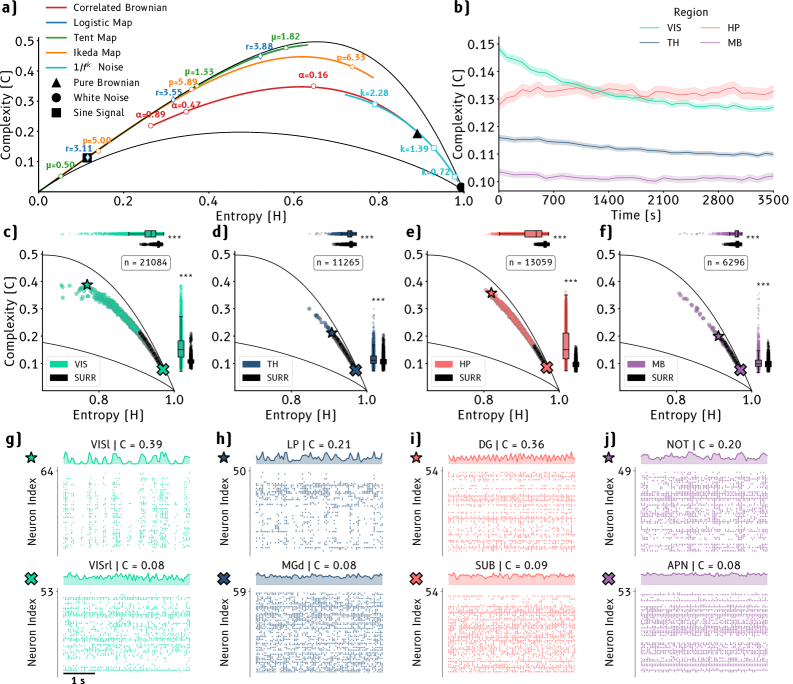
- Methodology Introduces the application of statistical complexity, an information-theoretic measure based on ordinal pattern analysis (Bandt-Pompe symbolization), to characterize the organizational structure of neural population dynamics across multiple brain regions.
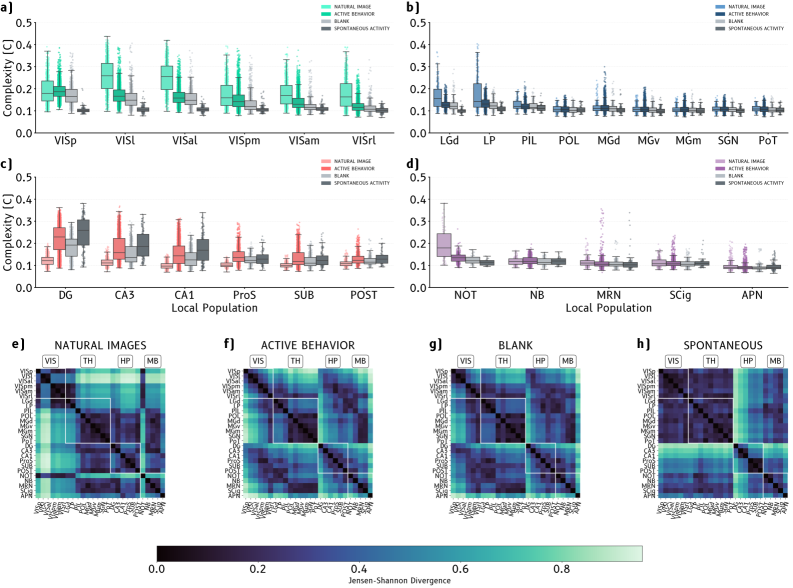
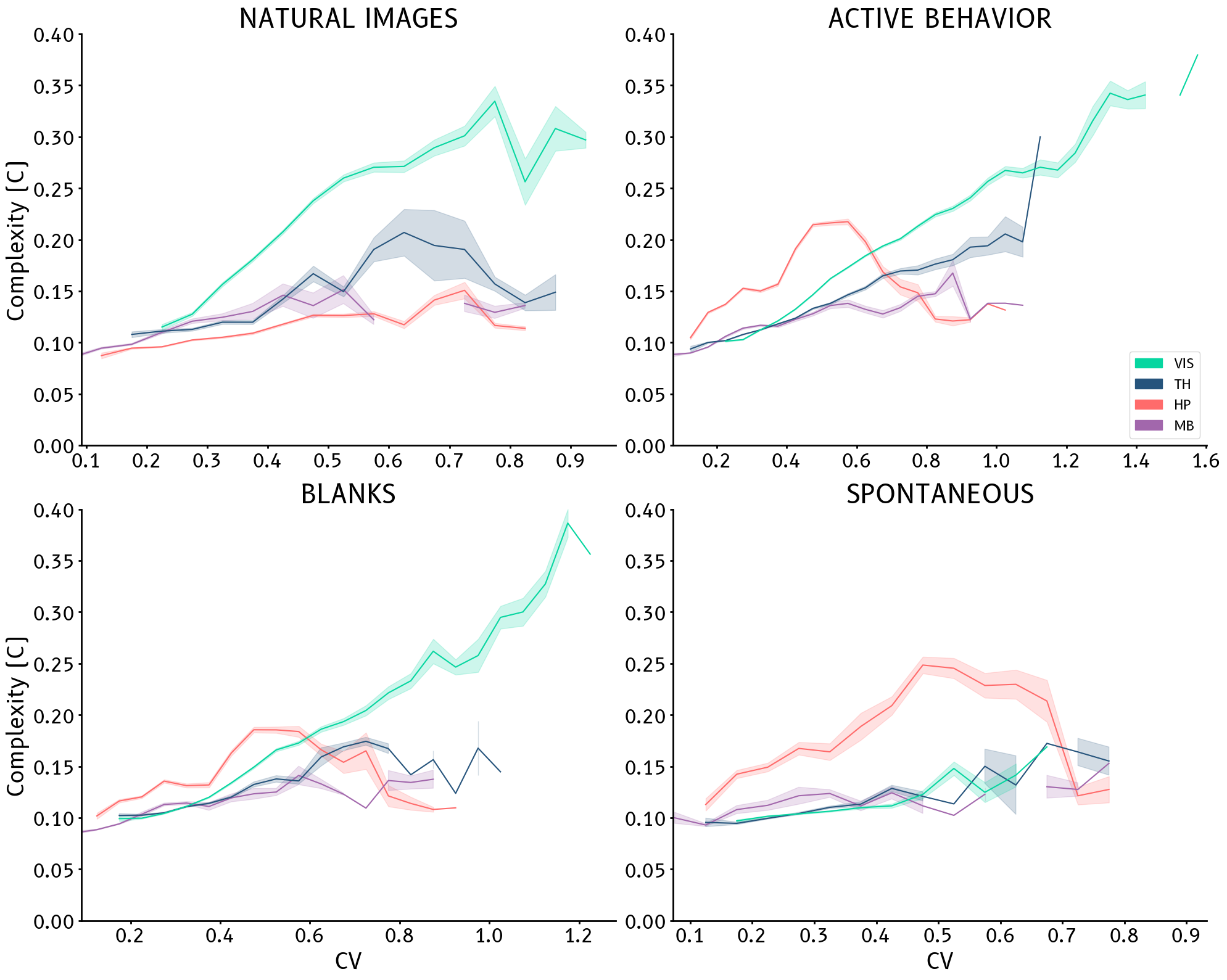
- Biology Reveals a hierarchical gradient of stimulus-dependence: visual cortex dynamics are strongly modulated by stimulus conditions, thalamus shows attenuated modulation, while hippocampus and midbrain maintain relatively invariant dynamics, suggesting distinct computational roles.
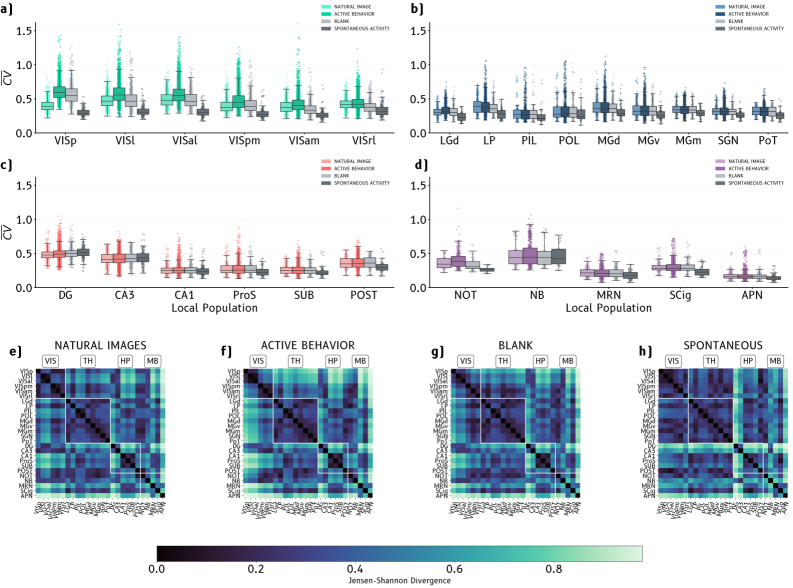
- Methodology Demonstrates that statistical complexity, but not the classical coefficient of variation (CV), can discriminate between different stimulus conditions (natural images, blank screens, spontaneous activity), uncovering structured motifs in population activity.
主要结论
- Statistical complexity revealed clear, stimulus-specific motifs in population activity across visual cortex, hippocampus, thalamus, and midbrain, while the coefficient of variation (CV) failed to discriminate between natural image presentations, blank screens, and spontaneous activity conditions.
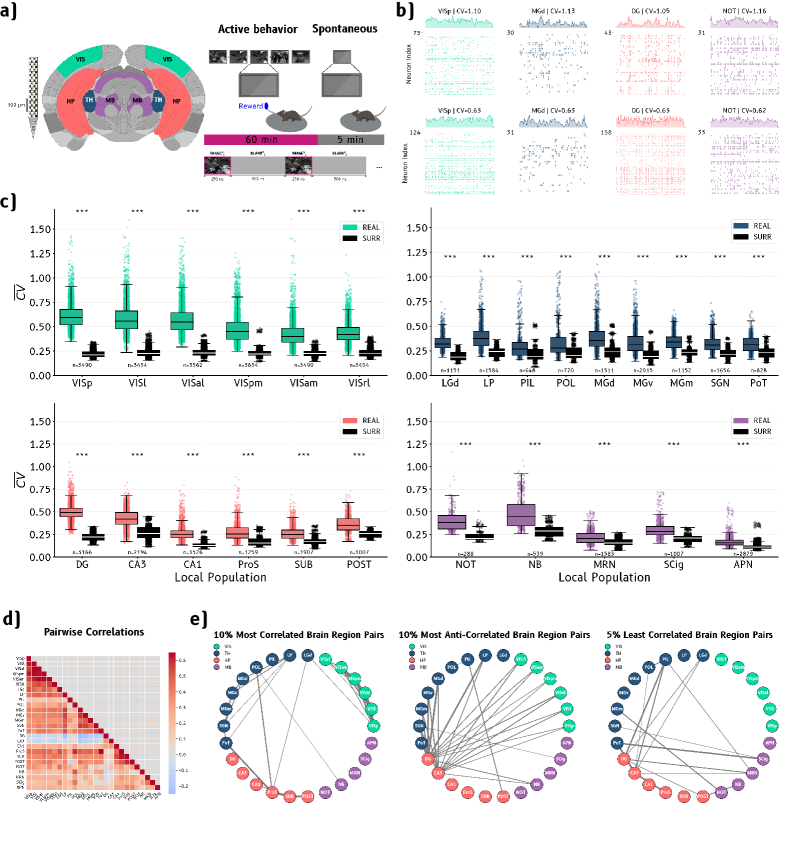
- Visual cortex subregions exhibited the highest CV values (median range: 0.40–0.59, approximately 2–3× higher than shuffled surrogates, p<0.001), showing strong stimulus-dependent modulation, while midbrain areas displayed the most invariant dynamics across all experimental conditions.
- The complexity-entropy (C-H) plane framework enabled classification of dynamical regimes, with different brain regions occupying distinct positions: visual cortex showed intermediate entropy with high complexity during stimulus presentation, while surrogate data clustered near the random limit (high entropy, low complexity).
摘要: Advances in large-scale neural recordings have expanded our ability to describe the activity of distributed brain circuits. However, understanding how neural population dynamics differ across regions and behavioral contexts remains challenging. Here, we surveyed neuronal population dynamics across multiple mouse brain areas (visual cortex, hippocampus, thalamus, and midbrain) using spike data from local ensembles. Two complementary measures were used to characterize these dynamics: the coefficient of variation (CV), a classical indicator of spike-time variability, and statistical complexity, an information-theoretic quantifier of organizational structure. To probe stimulus-dependent activity, we segmented and concatenated recordings from behavioral experiments into distinct time series corresponding to natural image presentations, blank screens during visual task, and spontaneous activity. While the CV failed to discriminate between these conditions, statistical complexity revealed clear, stimulus-specific motifs in population activity. These results indicate that information-theoretic measures can uncover structured, stimulus-dependent patterns in neural population dynamics that remain unobserved in traditional variability metrics.