
Paper List
-
Discovery of a Hematopoietic Manifold in scGPT Yields a Method for Extracting Performant Algorithms from Biological Foundation Model Internals
This work addresses the core challenge of extracting reusable, interpretable, and high-performance biological algorithms from the opaque internal repr...
-
MS2MetGAN: Latent-space adversarial training for metabolite–spectrum matching in MS/MS database search
This paper addresses the critical bottleneck in metabolite identification: the generation of high-quality negative training samples that are structura...
-
Toward Robust, Reproducible, and Widely Accessible Intracranial Language Brain-Computer Interfaces: A Comprehensive Review of Neural Mechanisms, Hardware, Algorithms, Evaluation, Clinical Pathways and Future Directions
This review addresses the core challenge of fragmented and heterogeneous evidence that hinders the clinical translation of intracranial language BCIs,...
-
Less Is More in Chemotherapy of Breast Cancer
通过纳入细胞周期时滞和竞争项,解决了现有肿瘤-免疫模型的过度简化问题,以定量比较化疗方案。
-
Fold-CP: A Context Parallelism Framework for Biomolecular Modeling
This paper addresses the critical bottleneck of GPU memory limitations that restrict AlphaFold 3-like models to processing only a few thousand residue...
-
Open Biomedical Knowledge Graphs at Scale: Construction, Federation, and AI Agent Access with Samyama Graph Database
This paper addresses the core pain point of fragmented biomedical data by constructing and federating large-scale, open knowledge graphs to enable sea...
-
Predictive Analytics for Foot Ulcers Using Time-Series Temperature and Pressure Data
This paper addresses the critical need for continuous, real-time monitoring of diabetic foot health by developing an unsupervised anomaly detection fr...
-
Hypothesis-Based Particle Detection for Accurate Nanoparticle Counting and Digital Diagnostics
This paper addresses the core challenge of achieving accurate, interpretable, and training-free nanoparticle counting in digital diagnostic assays, wh...
Setting up for failure: automatic discovery of the neural mechanisms of cognitive errors
Department of Engineering, University of Cambridge | Department of Psychology, University of Cambridge | Department of Cognitive Science, Central European University
30秒速读
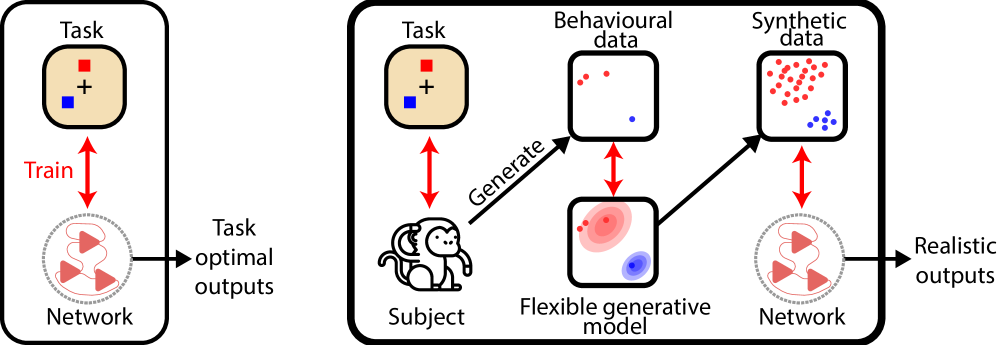
IN SHORT: This paper addresses the core challenge of automating the discovery of biologically plausible recurrent neural network (RNN) dynamics that can replicate the full richness of human and animal behavioral data, including characteristic errors and suboptimalities, rather than just optimal task performance.
核心创新
- Methodology Introduces a novel diffusion model-based training objective for RNNs to capture complex, multimodal behavioral response distributions (e.g., from swap errors), moving beyond traditional moment-matching or simple loss functions like MSE.
- Methodology Proposes using a non-parametric generative model (Bayesian Non-parametric model of Swap errors, BNS) to create surrogate behavioral data for training, overcoming the data scarcity problem inherent in experimental neuroscience.
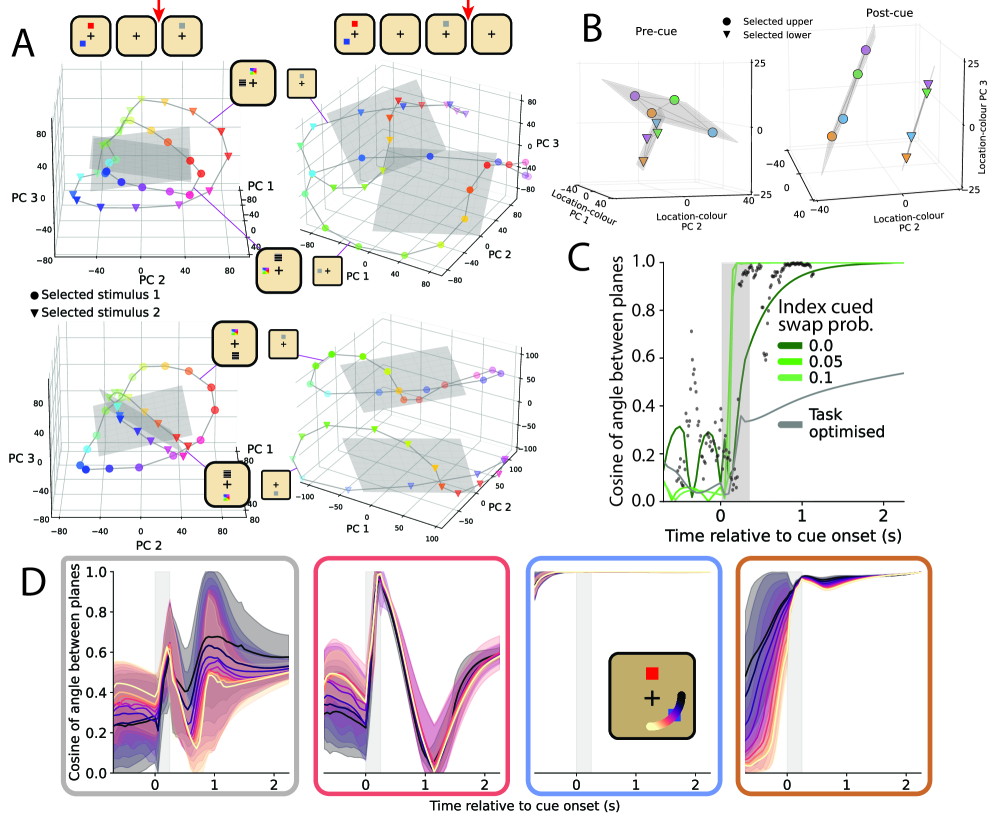
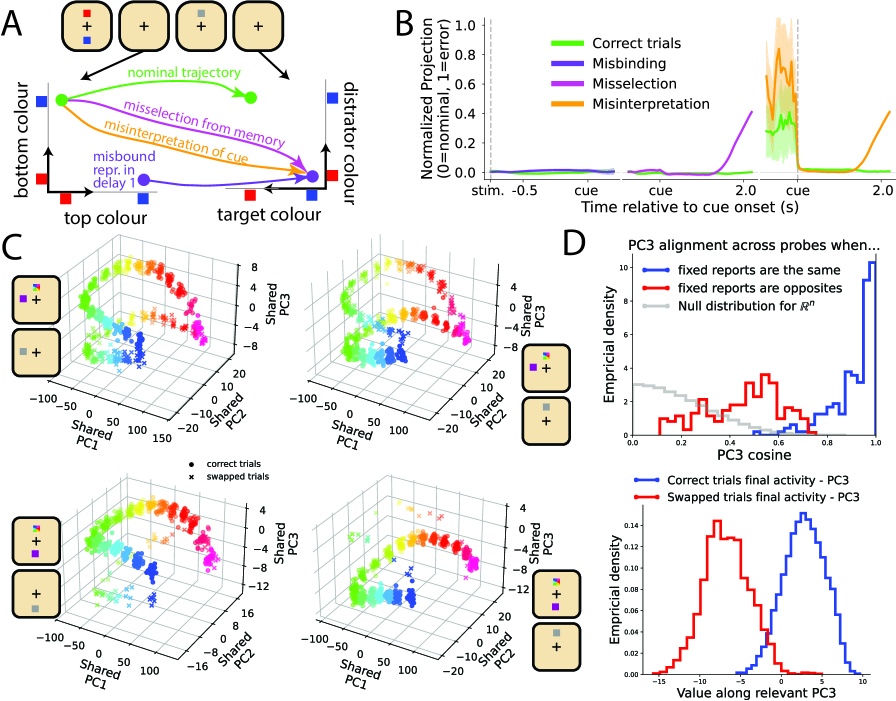
- Biology Demonstrates that RNNs trained to reproduce suboptimal behavior (swap errors) successfully recapitulate qualitative neural signatures (e.g., planar alignment of population activity) observed in macaque prefrontal cortex during visual working memory tasks, which task-optimal networks fail to capture.
主要结论
- RNNs trained with the novel diffusion-based method to reproduce probe-distance-dependent swap errors successfully matched the planar alignment geometry of neural population activity observed in macaque PFC (cosine similarity increase during cue period, as in Panichello et al., 2021), a signature not captured by task-optimal or no-swap-error models.
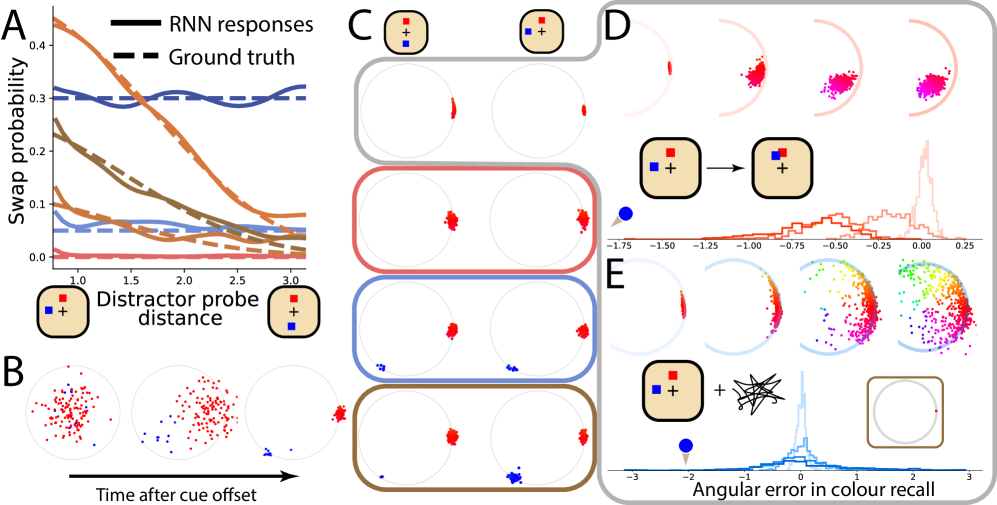
- The method accurately replicated target swap error rates as a function of distractor proximity (as defined by the generative BNS model), demonstrating quantitative fitting to complex behavioral distributions.
- The approach generated novel, testable hypotheses about the neural circuit mechanisms underlying swap errors (e.g., misselection at cue time), moving beyond descriptive population coding models.
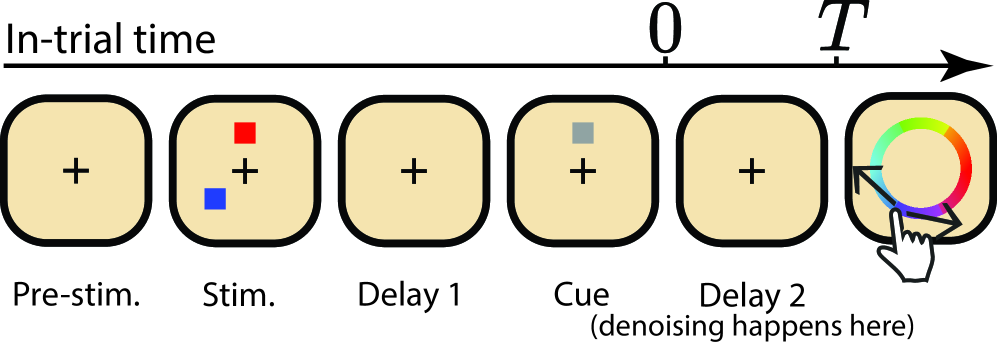
摘要: Discovering the neural mechanisms underpinning cognition is one of the grand challenges of neuroscience. However, previous approaches for building models of recurrent neural network (RNN) dynamics that explain behaviour required iterative refinement of architectures and/or optimization objectives, resulting in a piecemeal, and mostly heuristic, human-in-the-loop process. Here, we offer an alternative approach that automates the discovery of viable RNN mechanisms by explicitly training RNNs to reproduce behaviour, including the same characteristic errors and suboptimalities, that humans and animals produce in a cognitive task. Achieving this required two main innovations. First, as the amount of behavioural data that can be collected in experiments is often too limited to train RNNs, we use a non-parametric generative model of behavioural responses to produce surrogate data for training RNNs. Second, to capture all relevant statistical aspects of the data, rather than a limited number of hand-picked low-order moments as in previous moment-matching-based approaches, we developed a novel diffusion model-based approach for training RNNs. To showcase the potential of our approach, we chose a visual working memory task as our test-bed, as behaviour in this task is well known to produce response distributions that are patently multimodal (due to so-called swap errors). The resulting network dynamics correctly predicted previously reported qualitative features of neural data recorded in macaques. Importantly, these results were not possible to obtain with more traditional approaches, i.e., when only a limited set of behavioural signatures (rather than the full richness of behavioural response distributions) were fitted, or when RNNs were trained for task optimality (instead of reproducing behaviour). Our approach also yields novel predictions about the mechanism of swap errors, which can be readily tested in experiments. These results suggest that fitting RNNs to rich patterns of behaviour provides a powerful way to automatically discover the neural network dynamics supporting important cognitive functions.