
Paper List
-
Developing the PsyCogMetrics™ AI Lab to Evaluate Large Language Models and Advance Cognitive Science
This paper addresses the critical gap between sophisticated LLM evaluation needs and the lack of accessible, scientifically rigorous platforms that in...
-
Equivalence of approximation by networks of single- and multi-spike neurons
This paper resolves the fundamental question of whether single-spike spiking neural networks (SNNs) are inherently less expressive than multi-spike SN...
-
The neuroscience of transformers
提出了Transformer架构与皮层柱微环路之间的新颖计算映射,连接了现代AI与神经科学。
-
Framing local structural identifiability and observability in terms of parameter-state symmetries
This paper addresses the core challenge of systematically determining which parameters and states in a mechanistic ODE model can be uniquely inferred ...
-
Leveraging Phytolith Research using Artificial Intelligence
This paper addresses the critical bottleneck in phytolith research by automating the labor-intensive manual microscopy process through a multimodal AI...
-
Neural network-based encoding in free-viewing fMRI with gaze-aware models
This paper addresses the core challenge of building computationally efficient and ecologically valid brain encoding models for naturalistic vision by ...
-
Scalable DNA Ternary Full Adder Enabled by a Competitive Blocking Circuit
This paper addresses the core bottleneck of carry information attenuation and limited computational scale in DNA binary adders by introducing a scalab...
-
ELISA: An Interpretable Hybrid Generative AI Agent for Expression-Grounded Discovery in Single-Cell Genomics
This paper addresses the critical bottleneck of translating high-dimensional single-cell transcriptomic data into interpretable biological hypotheses ...
Collective adsorption of pheromones at the water-air interface
Aix Marseille Univ, CNRS, Centrale Med, IRPHE (UMR 7342), Marseille, France | ICSM, CEA, CNRS, ENSCM, Univ. Montpellier, Marcoule, France | Institut de Recherche sur la Biologie de l’Insecte, UMR 7261, CNRS-Université de Tours, Tours, France


30秒速读
IN SHORT: This paper addresses the core challenge of understanding how amphiphilic pheromones, previously assumed to be transported in the gas phase, can be stabilized and concentrated at the water-air interface of atmospheric aerosols through collective adsorption and a 2D phase transition.
核心创新
- Methodology Presents state-of-the-art all-atom molecular dynamics simulations to construct a full Langmuir adsorption isotherm for a pheromone monolayer, a comprehensive approach rare in the field.
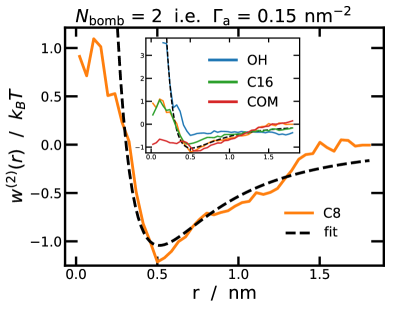
- Biology Quantifies the collective adsorption free energy gain (~2kBT per molecule) for bombykol at the water-air interface, providing a mechanistic explanation for pheromone enrichment on atmospheric aerosols.
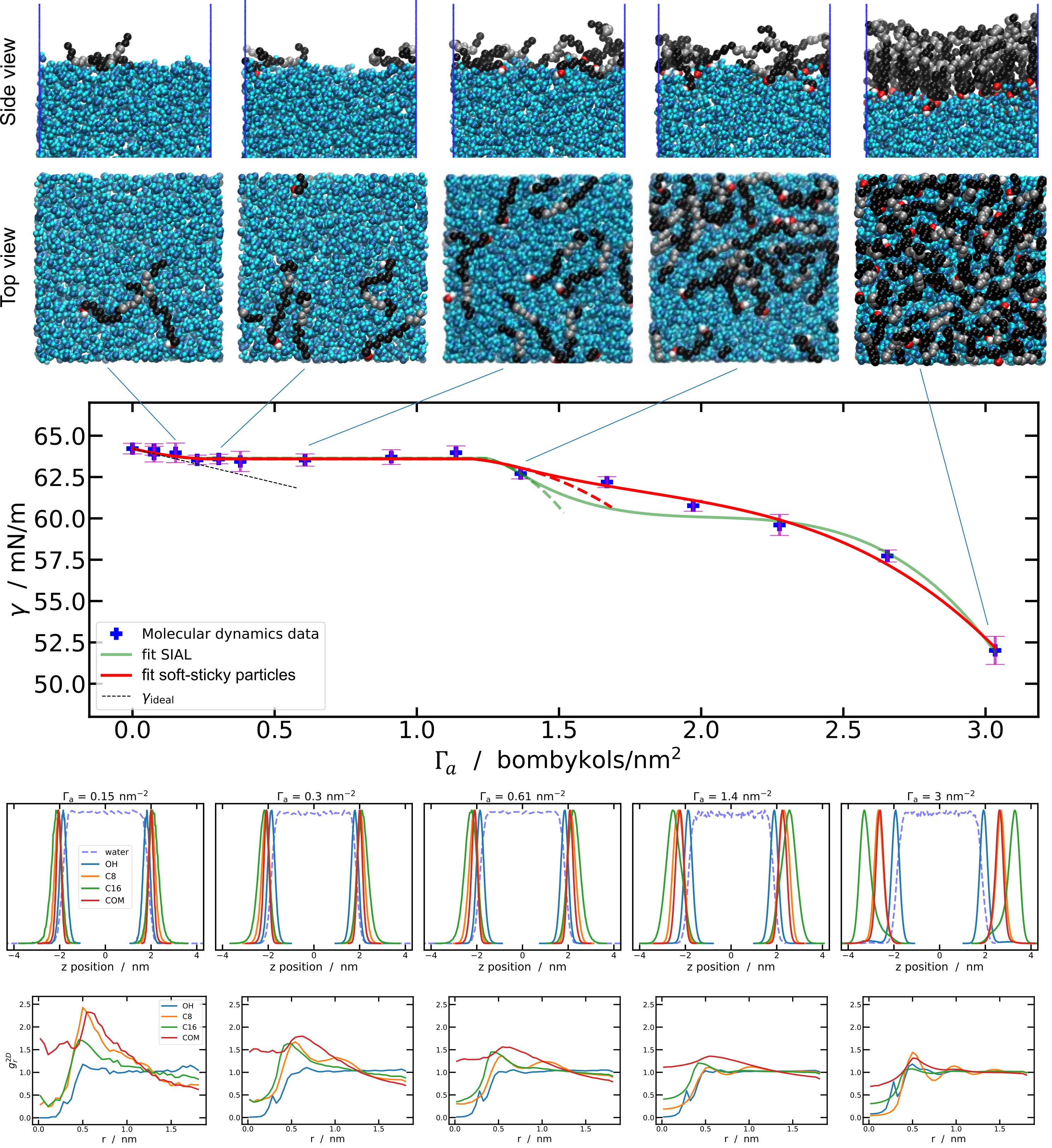
- Theory Identifies and characterizes a two-dimensional liquid-gas phase transition within the pheromone monolayer, modeled successfully with a soft-sticky particle equation of state.
主要结论
- Collective interactions within a bombykol monolayer at the water-air interface provide a stabilization free energy of approximately 2kBT per molecule, significantly enhancing adsorption compared to individual molecules.
- The monolayer exhibits a clear two-dimensional liquid-gas phase transition, accurately described by a soft-sticky particle equation of state, with the transition plateau evident in the surface tension vs. concentration isotherm.
- The calculated adsorption free energy increases under lower estimates of the condensing surface concentration (ΓC), indicating that pheromone adsorption onto aerosols is more favorable in dilute regimes, relevant for atmospheric conditions.
摘要: Understanding the phase behaviour of pheromones and other messaging molecules remains a significant and largely unexplored challenge, even though it plays a central role in chemical communication. Here, we present all-atom molecular dynamics simulations to investigate the behavior of bombykol, a model insect pheromone, adsorbed at the water–air interface. This system serves as a proxy for studying the amphiphilic nature of pheromones and their interactions with aerosol particles in the atmosphere. Our simulations reveal the molecular organization of the bombykol monolayer and its adsorption isotherm. A soft-sticky particle equation of state accurately describes the monolayer’s behavior. The analysis uncovers a two-dimensional liquid–gas phase transition within the monolayer. Collective adsorption stabilises the molecules at the interface and the calculated free energy gain is approximately 2kBT. This value increases under lower estimates of the condensing surface concentration, thereby enhancing pheromone adsorption onto aerosols. Overall, our findings hold broad relevance for molecular interface science, atmospheric chemistry, and organismal chemical communication, particularly in highlighting the critical role of phase transition phenomena.